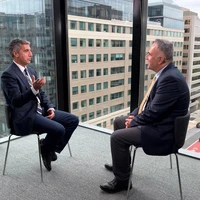
IRGC adviser warns of ‘war on Wall Street, Manhattan’
A senior adviser to the commander-in-chief of Iran’s Revolutionary Guards, said Tehran had so far fought only a conventional war and had not yet entered asymmetric warfare, which he said could mean “war on Wall Street, in Manhattan, and anywhere, at any time.”
Mohammad Reza Naqdi also said more than 90% of the Islamic Republic’s missile stockpile remained untouched and warned that any new attack would carry a heavy cost.
“We are implementing the commitments announced by the Supreme National Security Council, but the enemy must know that if it attacks us, it will pay a heavy price,” Naqdi said. “The Islamic Republic’s missile production network is resilient and self-sufficient.”
He also said relations between the Revolutionary Guards and the government were “in the best condition” and “very strong.”
A woman fills her car with gasoline at a fuel station in Iran.
Iranians pushed back against a senior government official questioning cheap gasoline, contrasting fuel subsidies with low wages and soaring living costs as the US dollar traded around a historic 2.1 million rials on Monday.
“Give us a $3,000 salary and sell gasoline for 750,000 rials ($0.36) a liter. No problem,” one person wrote in response to Mohammad Jafar Ghaempanah, President Masoud Pezeshkian’s executive vice president.
Ghaempanah questioned the sustainability of selling gasoline for 15,000 rials per liter, less than one US cent at the current exchange rate, when he put its value at 700,000 rials ($0.33).
“You cannot buy gasoline that costs 700,000 rials per liter for 15,000 rials. No sound mind accepts this,” Ghaempanah said.
His comments drew responses comparing gasoline prices with wages, food, cars and the exchange rate, with several people questioning why international pricing should apply to household costs but not incomes.
An average monthly income of around 200 million to 250 million rials amounts to just $95 to $119 at an exchange rate of 2.1 million rials to the dollar, sharpening the contrast between earnings and prices increasingly measured against international market rates. At that income level, gasoline priced at Ghaempanah’s 700,000-rial ($0.33) valuation would make a 50-liter tank cost 35 million rials ($16.67), equivalent to about 14% to 18% of a month’s income.
‘Income in rials, expenses in dollars’
A worker writing from Tabriz turned Ghaempanah’s argument back on the government, questioning why wages remained so low if selling gasoline below its assessed value was unsustainable.
A man counts US dollar banknotes outside a currency exchange in Tehran, Iran.
“We workers also ask why a worker whose wage should actually be $4,000 is paid $100,” the person wrote.
Another response focused on the exchange rate, questioning why Iranians must pay more than 2.1 million rials for one US dollar while the government objects to selling domestically produced gasoline for 15,000 rials per liter.
“You can’t have income in rials and expenses in dollars,” another person wrote.
Others compared wages with what they described as the poverty line.
“You can’t have a salary of 200 million rials ($95) when the poverty line is 1.5 billion rials ($714),” one person wrote.
Cars and food enter the comparison
Cars were another recurring point of comparison, with people questioning the gap between domestic vehicle prices and those in international markets.
“But we can buy a car worth five billion rials ($2,381) for 50 billion rials ($23,810)?” one person wrote.
Another called for cars to be offered at international market prices if officials want to apply similar logic to energy, saying consumers should not have to depend on Iranian and Chinese manufacturers.
Food prices also featured prominently in the reactions.
“It’s possible to make 400,000-rial rice cost six million rials, three-million-rial meat cost 30 million rials, and a two-billion-rial salary become 200 million rials. But gasoline has to become more expensive,” one person wrote.
Ghaempanah said food prices had risen 123%. The latest figures cited from the Statistical Center of Iran also put point-to-point food inflation above 128%, almost twice the roughly 67% rate for non-food goods.
Other messages described households cutting back on basic purchases as prices rise.
One person said their 75-year-old father, a pensioner receiving 160 million rials ($76) a month and paying rent, could no longer afford meat or chicken and had long since stopped buying fruit.
Another said they wanted to buy apples for their son but could not afford the price of 1.5 million rials ($0.71) per kilogram.
Government says budget deficit drives money printing
Ghaempanah also said the government’s budget imbalance forces it to create money to cover shortfalls, contributing to inflation.
“Because our budget is unbalanced, we are forced to print money. When money is printed, it itself creates inflation,” Ghaempanah said.
A woman walks past a currency exchange displaying foreign exchange rates in Tehran, Iran.
The executive vice president attributed 67% of inflation to the banking sector, arguing that lenders issue loans that are not repaid and accept collateral without sufficient underlying value.
Banks then seek money from the Central Bank to cover their deficits, prompting further money creation, according to Ghaempanah.
He also described Iran’s economic conditions as poor and said ordinary people were bearing the greatest pressure.
“The bitter reality is that the country’s economic conditions are not good and the greatest pressure is being placed on the people,” Ghaempanah said.
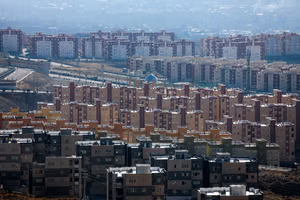
Two men look out over residential buildings in Tehran, Iran.
Forty-four percent of respondents to an Iran International Instagram poll said they would not buy a home in Iran even if they could afford one, with comments citing economic insecurity, emigration plans and concerns about keeping their wealth in the country.
Around 20,400 people participated in the online poll, with 44% saying they would not invest in property in Iran even if they could afford to do so. Only around half said they would buy a home.
Of those who participated, 67% were men and 33% women.
People aged 25 to 34 made up the largest group of respondents at 36.6%, followed by those aged 35 to 44 at 30.1%. People aged 45 to 54 accounted for 12.8%, while those aged 18 to 24 made up 11.4%.
Participants also left around 2,000 comments explaining their choices, offering a broader picture of the considerations shaping their decisions.
The responses centered on attachment to Iran, hopes for political change, plans to emigrate, economic hardship and concerns over the security of their savings.
‘If I had enough money, I wouldn't be in Iran’
For many of those opposed to buying a home, having enough money would provide an opportunity to leave Iran rather than invest more heavily in the country.
“If I had enough money, I wouldn't be in Iran at all,” one respondent wrote.
“Having enough money in this situation means having the best life abroad,” another wrote.
The responses mirror the findings of an earlier Iran International Instagram poll in which 83% of participants said they would leave Iran if given the opportunity.
Around 100,000 people participated in that poll over 24 hours. Thousands of comments cited economic problems, social restrictions, political conditions and uncertainty over the future among the reasons for wanting to emigrate.
Some participants in the latest poll associated remaining in Iran with insecurity, sanctions, inflation, power outages and difficulties meeting basic needs, saying they would rather put their money into a more stable country.
One described owning a home as inseparable from the wider conditions in which a person lives.
Residential and high-rise buildings across the Tehran skyline, Iran.
“A home needs a blue sky above it, a thriving tree with bright green leaves in its yard, air without lead coming through its windows, a meal in its kitchen that doesn't come with guilt or selling your dignity, and peace of mind because you feel safe,” the respondent wrote.
“Home is where I can look at the stars at night without waking up the next morning choked with sadness and humiliation.”
Gold and currency offer a way out
Others focused on the financial risks of property ownership.
Unlike in previous years, when buying a home was widely viewed as a relatively secure investment for the future, some said they would now prefer to keep their wealth in gold or foreign currency because those assets are more liquid and easier to take out of the country.
“Investing in a bankrupt economy is certainly a mistake because prices are unrealistic, artificial and like a hollow bubble,” one respondent wrote.
Housing has for years served as a means of preserving wealth in Iran's chronically inflationary economy, and property can provide protection against inflation over the longer term.
But international reporting has also documented a move toward assets that can be carried and quickly converted into cash during periods of uncertainty.
The Associated Press described the trend as a turn toward “portable wealth” during the 12-day war, while the World Gold Council recorded a sharp increase in investment demand for gold in Iran in 2025.
The poll comes as Iranians continue to contend with high inflation. Iran's Statistical Center put year-on-year inflation in July at nearly 88%.
‘I wouldn't trade Iran for anywhere’
For respondents who said they would buy a home, attachment to Iran and a sense of national identity emerged as leading reasons.
Some described owning a home as more than a financial investment, linking it to family, personal history and their connection to the country.
“Yes, I wouldn't trade Iran for anywhere in the world,” one wrote.
“Iran is our mother; you don't abandon your mother when times are difficult,” another wrote.
Others said the country's problems would not persuade them to build a life elsewhere.
“Iran is my first and last choice. I believe good days are ahead of us,” one participant wrote.
Some would buy only after political change
A number of respondents made their willingness to buy a home conditional on political change, greater freedoms or improvements in the country's circumstances.
“When Iran is free, 100%,” one wrote. “After Iran is free, yes, but not under these conditions,” another wrote.
Others questioned the premise of the poll itself, saying the prospect of having enough money to purchase a home was increasingly detached from the economic reality facing many people.
They pointed to difficulties paying for food, rent, medical treatment and other daily necessities, describing home ownership as an unattainable aspiration.
“We are renters, and we'll take the dream of buying a home to the grave,” one respondent wrote.
The findings follow another Iran International Instagram poll in which 90% of respondents said they did not want to marry or have children.
CENTCOM handout: US Sailors conduct night flight operations aboard USS George Washington as the ship sails in regional waters supporting operations in the Middle East.
US and Iranian forces exchanged attacks on Sunday after a week of intensive regional diplomacy failed to break the deadlock between Tehran and Washington, marking a renewed military escalation following heightened economic pressure.
The fighting resumed when US forces struck two Iranian launchers on Larak Island in the Strait of Hormuz, the first known American attack on Iran since late July.
A US official said Revolutionary Guards forces had been preparing to launch rockets carrying sea mines into the Strait. Iran’s Revolutionary Guards said the attack killed and wounded several Iranian fighters and civilians and vowed retaliation.
Hours later, the IRGC said it had launched a combined ballistic missile and drone attack on two US air bases in Jordan, claiming “heavy damage” to technical and maintenance infrastructure and areas where fighter jets were stationed at Muwaffaq Salti Air Base in Azraq and King Hussein Air Base.
There was no immediate independent confirmation of the damage claimed by Iran.
The renewed exchange came after a flurry of mediation efforts last week raised hopes that the two sides might find a path back toward negotiations.
Senior officials from Pakistan, Oman and Qatar visited Tehran within days of each other, with talks focused on de-escalation, the Strait of Hormuz and reviving stalled US-Iran diplomacy.
Qatar’s prime minister and foreign minister, Sheikh Mohammed bin Abdulrahman Al Thani, visited Tehran on Thursday, following visits by Omani Foreign Minister Badr Albusaidi and Pakistan’s army chief.
Iran and Oman had also been discussing a temporary navigational corridor through the Strait of Hormuz, but Tehran insisted any reopening would depend on Washington lifting its blockade and meeting other Iranian conditions.
President Donald Trump, meanwhile, said Thursday that Washington was not seeking talks with Iran.
‘Devastating response’
Iranian officials hardened their rhetoric following Sunday’s US attack.
IRGC spokesperson Sardar Mohebi called the strike a “strategic and fatal mistake” by the Trump administration in the course of its economic war, warning that Washington would face consequences “in both the economic and military arenas.”
Ebrahim Azizi, chairman of the Iranian parliament’s National Security and Foreign Policy Committee, said no attack “at any level” would go unanswered and threatened a “devastating, more painful and instructive” response.
The escalation came as Washington continued enforcing its blockade. US Central Command said Sunday that its forces had redirected 83 commercial vessels, disabled three and boarded two as of August 30 to ensure compliance.
Commercial traffic through Hormuz remains sharply depressed.
The number of visible commodity vessels transiting the Strait fell to five per day over the weekend, shipping data showed Monday, although the actual figure may be higher because some ships have switched off their tracking systems.
The return of military strikes quickly spilled into energy markets. Oil prices jumped more than 2% in early Monday trading following the Larak attack, with Brent crude rising 2.5% to above $90 a barrel and US West Texas Intermediate gaining 2.4%, Reuters reported.
A Revolutionary Court in Isfahan has sentenced 10 protesters to death and six others to prison terms of up to 25 years over the nationwide demonstrations in the central Iranian city, according to an activist-run Telegram news channel.
Khabaraneha, run by Iranian political activist Mehdi Mahmoudian, said Branch 1 of the Isfahan Revolutionary Court issued the initial verdicts against 16 people detained in connection with the protests that began in late December 2025.
Those sentenced to death are Taraneh Rahimi, Navid Elyasi, Mehrdad Boeri, Abolfazl Dadgostar, Armin Gholami, Mehdi Mansouri, Ahmadreza Saeedi, Mohammadmehdi Asadi, Parsa Jafari and Mehdi Jafari, also known as Mehdi Khosravi.
Romina Rahimi and Milad Boeri were each sentenced to 25 years in prison, while Hamed Mehralian received a 15-year term. Setayesh Saedi, Sajjad Abedi and Ali Boeri were each sentenced to five years, Khabaraneha reported.
In addition, all 16 defendants were sentenced to five years for “assembly and collusion,” five years for “incitement” and one year for “propaganda against the establishment,” according to the report.
The case has become known as the “Isfahan Shohada Square” case and stems from protests in the area during the January uprising.
Khabaraneha said one of the female defendants was assaulted while in detention and filed a complaint over the incident, but that the court issued its verdict without examining the complaint.
Ahmadreza Saeedi also told judges during the trial that he had been tortured during interrogation, the channel reported. Khabaraneha said there had previously been reports of restrictions on lawyers’ access to the case file and of defendants being tortured to extract confessions.
Radio Farda reported in July that the case was connected to the deaths of Abbas Kamrani, a 37-year-old Revolutionary Guards colonel, and another person described in case documents as “homeless.” It said the 16 defendants mostly worked around Shohada Street in Isfahan.
Exiled prince urges international action
The office of Iran’s exiled prince Reza Pahlavi condemned the verdicts on Sunday, calling them “brutal and unjust” and saying they reflected an intensifying crackdown by the Islamic Republic.
Pahlavi’s communications office alleged that defendants had been denied legal representation and subjected to severe torture, including sexual violence against female detainees, to extract forced confessions.
“The world cannot stay silent in the face of these atrocities,” the office said.
The verdicts come amid a wave of death sentences against protesters in Isfahan. In a separate case known as the Alikhani Square case, Iranian authorities have executed five defendants since July.
Ghaem Hosseini was executed on Aug. 20, Abolfazl Sepahi Badjani and Amirhossein Safari Hosseinabadi on July 28, and Golmohammad Mohammadi and Erfan Esfandiari on July 19. The July 28 executions were carried out publicly in Alikhani Square.
Iranian police arrested a person accused of owing the country’s banking system more than €300 million after receiving foreign currency generated by exports, state media reported on Sunday.
Police identified the detainee only by the initials “A.L.” and described the person as one of the leaders of a network of financial intermediaries, known in Iran as “trustees,” used to transfer export revenues outside the formal banking system.
Authorities said the suspect had received foreign currency proceeds from exports over several years but failed to meet obligations to the banking system. The individual had gone on the run before being located and arrested by economic security police and sent to prison.
Majidreza Hariri of the Iran-China Chamber of Commerce said on X that the detainee had served as secretary of the Iranian Association of Money Changers, a description that may point to Ahmad Lavasani, a former head of the group.
Iran’s central bank dissolved the Association of Money Changers in 2023, citing what it called violations and deviation from its objectives.
So-called trustees became increasingly important as sanctions restricted Iranian banks’ access to the international financial system. Individuals or companies with bank accounts or financial links abroad have been used to receive oil revenues, pay for imports and transfer foreign currency outside formal banking channels.
Zabihollah Khodaeian, head of Iran’s General Inspection Organization, told state broadcaster IRIB in July that some trustees had “betrayed” the country and that one intermediary had failed to return $200 million before leaving Iran.
The Tehran-based Sazandegi newspaper reported at the time that at least 15 trustees had become unreachable while holding billions of dollars in Iranian oil revenues, according to Hariri.
Sazandegi said the judiciary had opened 59 cases involving managers of trustee companies and issued prosecution orders in 43 of them. Authorities were also seeking Interpol Red Notices for 15 trustees who had fled.
Details about trustees’ identities, contracts, fees, financial guarantees and oversight are generally not made public.
Separately, an Iran International investigation found that relatives of some of Iran’s most powerful security figures, including the son of Mohsen Rezaei, were among nine people linked to an oil-sales network that sources said failed to return about $11 billion in proceeds to Iran.