Tehran gas stations run dry as Iran’s fuel deficit bites
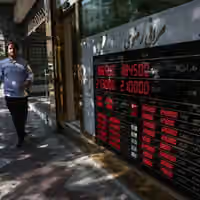
Reports of gasoline shortages spread across Tehran on Monday, with filling stations closing after running out of fuel and motorists describing long searches and queues for increasingly scarce supplies.
A billboard in Tehran featuring Iran’s Supreme Leader Mojtaba Khamenei and senior military commanders.
Mojtaba Khamenei has not been seen or heard publicly, leaving his condition and circumstances unclear as officials govern in his name, interpret messages attributed to him and invoke his authority on questions ranging from negotiations with Washington to the conduct of the war.
Khamenei’s absence from public view has not stopped competing factions from claiming his backing. Written messages attributed to him, some open to competing interpretations, have provided material for both advocates and opponents of negotiations. But the competition to define what the supreme leader wants is not necessarily an equal one.
In wartime, military and security institutions have greater power than advocates of compromise to turn their interpretation of his wishes into action. Senior commanders occupy key decision-making positions, control the forces conducting the war and repeatedly invoke the leader’s authority in explaining military and political choices.
That imbalance has given hawkish figures greater room to portray Mojtaba as opposed to compromise, even though messages attributed to him have both permitted negotiations and called for retribution.
Iran’s leader is not only central to decisions on war and peace but also, as commander-in-chief of the armed forces, at the center of the country’s power structure during crises.
The Iran-Iraq war and last year’s 12-day war with Israel and the United States demonstrated how the supreme leader’s role extends beyond military command to political cohesion, public mobilization and connecting decisions on the battlefield with society.
Mojtaba’s absence from public view has raised a different question: how supreme authority is exercised during a war when the leader himself is neither seen nor heard.
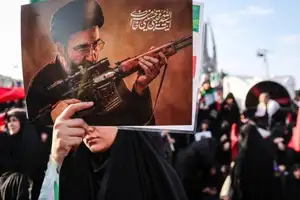
A poster featuring Mojtaba Khamenei on a street in Tehran.
Written messages attributed to Mojtaba, alongside repeated references by officials to his views and wishes, have become a means of asserting his authority over decisions and maintaining cohesion among supporters of the Islamic Republic.
They also turn the leader’s name into a source of authority under which costly decisions can be pursued, even as responsibility for implementing them and their consequences is dispersed across the political and military establishment.
Authority without a public appearance
Mojtaba has not appeared at major political, state or personal events, including the funeral of his wife and the large funeral ceremonies for his father.
His absence has produced conflicting accounts about his health, ranging from assertions that he is completely healthy to reports that he was injured or lost a limb, creating uncertainty around a leader whose name remains central to decision-making.
Security concerns have been offered as the principal explanation for keeping him out of public view.
“Security experts have strongly advised him not to reveal himself, even through the release of his voice, let alone an image,” Mohammad-Hossein Khoshvaght, secretary of the Fararu website, said.
Hamshahri newspaper has similarly argued that releasing an audio recording could make it possible to extract some of the speaker’s physical and physiological characteristics.
The secrecy prevents an independent assessment of Mojtaba’s health, his ability to address the public or his positions on major issues. It also allows multiple officials to speak for him and attribute decisions to his authority without the leader publicly clarifying his own position.
Ambiguous message divides officials over talks
A written message attributed to Mojtaba showed how that system can produce competing interpretations.
The message used the Persian expression “Al al-osul,” broadly meaning “in principle,” in discussing negotiations, while leaving responsibility with President Masoud Pezeshkian and effectively permitting an agreement to be signed.
The wording quickly became the subject of competing interpretations among figures presenting themselves as familiar with the leader’s position.
“Some people have interpreted the phrase ‘in principle, I had a different view’ to mean that the supreme leader is fundamentally opposed to negotiations, whereas this interpretation is incorrect and does not correspond with the existing realities,” the Revolutionary Guards’ political deputy said.
Mohsen Rezaei, the new secretary of the Supreme National Security Council, offered a different interpretation.
“When the leader says, ‘in principle, I had a different view,’ it means the path he had in mind was better than the path taken by the Supreme National Security Council,” Rezaei said.
The disagreement allows one camp to present the message as opposition to negotiations and another to read it as conditional approval.
Without a public appearance or unequivocal order from Mojtaba himself, such ambiguity diffuses responsibility for policy while giving greater room to institutions with the organizational and coercive power to make their interpretation prevail.
In practice, that can favor figures who view continued war as the necessary course and promote a message of a “powerful Iran,” using the prospect of continuing conflict as leverage against the United States and Israel.
Military network invokes Khamenei’s ‘authority’
Mojtaba’s physical absence has not meant an absence of authority. Instead, officials across the military and political establishment repeatedly invoke his name to validate policy.
Ebrahim Jabbari, an adviser to the Revolutionary Guards commander, has spoken of Mojtaba’s “command and oversight” of military affairs and his management of expert meetings involving the armed forces, presenting him as directly engaged in running the country’s defense establishment.
Such accounts allow difficult military and political decisions to be presented as products of the absent leader’s orders and judgment even when no public directive has been issued.
Khoshvaght has described Mojtaba’s selection as a decision made by the political system itself, reflecting a network of authority that has increasingly operated without transparent lines of responsibility.
Iran’s adversaries have, in a different way, reinforced the portrayal of Mojtaba as the ultimate decision-maker. Israeli Prime Minister Benjamin Netanyahu has said Mojtaba is alive, while US President Donald Trump has described him as “definitely, 100 percent” involved in negotiations between Tehran and Washington and has raised the prospect of meeting him.
Those remarks allow supporters to depict Mojtaba as a leader recognized by Iran’s adversaries and standing against them, while officials around him present “resistance” and readiness for further war as expressions of Iranian power.
Command appointments strengthen war camp
The combination of an absent leader and decisions made largely through military and security institutions has blurred responsibility for Iran’s political and wartime choices.
Successes can be attributed to the judgment of the leader, while the human and economic costs are dispersed across a network of institutions and officials. Ambiguous messages can meanwhile be interpreted by rival factions to support their preferred policies.
That balance gives greater weight to military figures such as Revolutionary Guards Aerospace Force commander Majid Mousavi, whose forces carry a major share of the fighting and who has called on officials to follow the leader’s wishes.
Precisely what those wishes entail remains unclear. The same leader who permitted negotiations and an agreement has also promised retribution, leaving commanders considerable scope to determine which message takes precedence.
Recent command appointments made in Mojtaba’s name form part of the same shift. While some consolidated the existing structure, comments by Mohammad-Reza Naghdi, an adviser to Iran’s supreme leader and the Revolutionary Guards, indicated that the objective was to move Iran’s military posture from defensive to offensive.
Rezaei’s appointment to lead the Supreme National Security Council adds another military figure to a central decision-making position. He has spoken against compromise with Washington and raised the possibility of changing Iran’s nuclear doctrine.
Together, the appointments and increasingly assertive rhetoric from military figures have strengthened the camp arguing against accommodation and in favor of a more offensive posture.
War policy takes shape without public order
Iran’s current war policy is therefore taking shape without a single, unambiguous public command from its supreme leader. Instead, it is emerging through written messages open to interpretation, appointments, calls for retribution and a shrinking political space for those advocating accommodation.
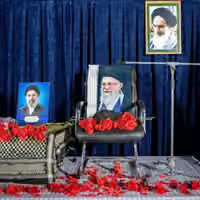
An Iranian flag bearing images of senior Iranian leaders at a gathering in Tehran.
Media outlets close to the leadership have given little room to arguments for accommodation, while senior figures increasingly speak of retaliation, confrontation and obedience to the leader.
Mojtaba remains physically absent but politically ubiquitous, his name appearing beneath written messages and in the statements of officials who interpret his wishes.
The result is a system in which the supreme leader’s authority remains central even as his own voice is absent – giving a pro-war camp already strongly represented across military, security, political and media institutions greater room to define what he wants and, through that interpretation, shape the direction of the war.
A still image from a video obtained by Reuters on June 5, 2026, shows US forces conducting an interdiction of the sanctioned stateless oil tanker Davina in the Indo-Pacific region, according to the U.S. Indo-Pacific Command.
Iranian crude loadings have fallen to about one-seventh of their pre-war level under the US naval blockade, while Chinese receipts of Iranian oil and fuel exports have also dropped sharply, tanker-tracking data reviewed by Iran International shows.
Data from commodities intelligence firm Kpler shows Iran has loaded an average of about 287,000 barrels per day (bpd) of crude so far this month, compared with roughly 2 million bpd before the Middle East war.
China, meanwhile, has received an average of just 523,000 bpd of Iranian crude so far this month. That compares with an average of about 800,000 bpd over the previous two months and more than 1.7 million bpd at the beginning of the war.
The United States reimposed a maritime blockade against the Islamic Republic in mid-July. As a result, more than 40 million barrels of Iranian oil stored on tankers in the Persian Gulf and Gulf of Oman have become effectively trapped, Kpler estimates.
Iran has stored 83 million barrels of oil outside the blockade zone, including 43 million barrels in the South China Sea, Yellow Sea and East China Sea. But with China sharply reducing its purchases, Tehran could run out of oil available for delivery to China in roughly five months if the current export rate persists.
Iran also exported around 256,000 bpd of fuel oil, or mazut, last year. Exports remained at roughly 220,000 bpd during the first two months of this year, but have plunged to just 61,000 bpd this month.
Iran had also been exporting a similar volume of LPG before the war. Those exports have now almost come to a halt.
According to Central Bank of Iran (CBI) data, the country’s crude oil and fuel oil exports were worth $57.5 billion last year, accounting for about 55% of Iran’s total exports. Crude oil, petroleum products and LPG together accounted for roughly 65% of the country’s total exports.
The sharp decline in exports of these commodities is likely not only to leave the government facing a massive budget shortfall, but also to create serious difficulties in securing the foreign currency needed to finance imports.
Iran imported nearly $78 billion worth of goods last year, including about $3 billion in gasoline, CBI data shows. Even if the country were to maintain its non-oil exports at last year’s level, they would not be sufficient to finance even half of its goods imports.
The situation is particularly difficult because Iran’s steel industry, which had generated as much as $5 billion a year in export revenues for the Islamic Republic, has been severely damaged by the recent war. The domestic market is now also facing a shortage of steel.
Iran was also a net importer of services last year, running a deficit of about $15 billion. Combined with its $78 billion in goods imports, that means Iran needed roughly $93 billion in foreign exchange to cover goods imports and its net services deficit.
Even if Iran manages to maintain its remaining non-oil exports at last year’s level, those revenues would cover only around one-third of those needs if crude oil, petroleum products, LPG and steel exports are excluded.
The pressure could increase further after US President Donald Trump on Wednesday threatened an “economic D-Day” against Iran, pledging economic warfare and isolation on an unprecedented scale after saying Tehran had failed to make a deal.
The threatened measures could make sanctions evasion more difficult and expose Iran’s already weakened foreign trade to additional challenges.
Yemen analyst Mohammad al-Basha (left) in an interview with Iran International's Kambiz Tavana in Washington DC on August 20, 2026.
Yemen’s Houthis have become a more effective ally for Iran than Hezbollah, using Iranian support and their strategic Red Sea position to pursue both Tehran’s interests and their own agenda, Yemen analyst Mohammad al-Basha told Iran International.
The Houthis’ position distinguishes them from other members of Iran’s regional network, Al-Basha said. The group seized Sanaa in 2014 and became the de facto government, inheriting the conventional military of North Yemen while taking control of territory containing roughly 80 percent of the population.
“So you’re not just talking about a militia or an insurgency; they became a de facto authority,” Al-Basha said.
That combination of territorial control, state institutions and geography has given the Houthis advantages that Hezbollah and Iran-backed groups in Iraq do not possess, he said.
Iraqi armed groups wield significant influence but do not control the government, while Lebanon’s Hezbollah has operated as a powerful armed and political force within Lebanon rather than as the state itself.
The Houthis also sit along the Red Sea and Bab al-Mandab, one of the world’s most important maritime chokepoints, while Yemen’s mountainous terrain and extensive tunnel systems make the group difficult to target from the air.
Those factors have given the Houthis “an edge” and made them “more effective as an ally for Iran than Hezbollah,” Al-Basha said.
The comparison comes as other parts of Iran’s regional network have been weakened. Al-Basha said the so-called Axis of Resistance is weaker than it was before the October 7, 2023 Hamas attack on Israel, pointing to pressure on Hamas and Hezbollah and the fall of Bashar al-Assad’s government in Syria, which severed a key land route between Iran and its Lebanese ally.
Iran’s military backing
Iran, meanwhile, has invested heavily in the military capabilities that make the Houthis’ strategic position consequential. Al-Basha said Tehran has provided anti-ship ballistic missiles, anti-ship cruise missiles, land-attack cruise missiles and long-range drones, while the Islamic Revolutionary Guard Corps and its Quds Force remain central to the relationship.
“The Houthis will not be as strong as they are today without Iran,” Al-Basha said.
He said intercepted shipments heading toward Yemen continue to demonstrate the importance of Iranian support, including components for weapons the Houthis have presented as domestically produced. The group has developed some local manufacturing and assembly capabilities, he said, but Iranian support remains particularly important to its advanced missile and drone arsenal.
The relationship differs from Tehran’s former model with Hezbollah in another significant respect. Al-Basha said Iran has not generally provided the Houthis with financial support on the scale it once provided the Lebanese group. Tehran at times supplied discounted cooking gas and crude through Iraqi and secondary markets that the Houthis could resell, he said, but its most important contribution has been weapons.
Houthi supporters attend an anti-Saudi rally amid an escalation with the kingdom, in Sanaa, Yemen, July 31, 2026.
Reports coming out of Yemen also indicate that an Iranian ambassador and a Quds Force representative have returned to Houthi-controlled territory, Al-Basha said. He said the ambassador has appeared in public photographs, while the Quds Force representative also appears to be back, with both widely understood to coordinate the relationship between Tehran and the Houthi leadership.
“Their natural partners are the Quds Force and the Guard,” Al-Basha said.
He contrasted Iran’s military support with a Saudi convoy he had recently seen carrying heavy equipment for power stations into Yemen. Iran, he said, has provided drones and ballistic missiles rather than power, electricity or food for Yemenis.
Al-Basha also described the relationship as increasingly public. He pointed to Houthi-linked delegations attending the funeral of Iran’s late supreme leader and subsequent Iranian engagement with the Houthi authorities as signs that ties once conducted more covertly are becoming increasingly visible.
An agenda of their own
The Houthis, however, are not simply acting on Tehran’s behalf. Al-Basha said they deliberately chose the current confrontation to support Iran while simultaneously exploiting changes in regional shipping to pursue their own objectives against Saudi Arabia.
With shipping through the Strait of Hormuz disrupted, Saudi Arabia has been forced to move more crude through its east-west pipeline toward the Red Sea, increasing the strategic importance of Bab al-Mandab, he said. The Houthis saw an opportunity to increase pressure on Riyadh and the international community at a moment when their own finances are strained.
Al-Basha said Iran had invested in the Houthis’ ballistic missile and drone programs, creating an expectation that they would support Tehran. But the timing also serves the Houthis’ interests as they seek greater control over airspace and shipping access as well as financial concessions from Saudi Arabia.
The group is seeking around $100 million a month in salary support and billions of dollars in reparations, Al-Basha said. Iran International has previously reported on a Houthi maritime embargo against Saudi-linked shipping and the diversion of Saudi tankers away from Bab al-Mandab.
The financial demands come as the Houthis struggle to sustain the areas they control. Al-Basha said the group collects revenue from ports, communications, aviation, taxation and customs, but much of that income is being prioritized for the war effort.
He cited signs of financial distress including the leasing of endowment properties around mosques and government offices to generate revenue. He also described people fighting over food at public events and eating from garbage, while noting that an online “I am hungry” campaign was visible but not as widespread as some accounts suggested.
That economic pressure is part of what is driving the current confrontation with Saudi Arabia, Al-Basha said. The Houthis calculate that Riyadh has more to lose from another major war in Yemen and can therefore be pressured into paying for a return to calm.
“Houthis know they have nothing to lose, and that’s why they’re going all in against Saudi Arabia,” he said. “They know that Saudi has a lot to lose.”
Bab al-Mandab leverage
The group’s ambitions extend beyond extracting financial concessions. Al-Basha described control of Bab al-Mandab as the “crown jewel” of its current military campaign, saying taking the strait would strengthen the Houthis against Yemeni government forces and give them a more direct means of threatening maritime traffic.
“They have fire control over the Red Sea,” Al-Basha said, but physical control of Bab al-Mandab would mean “you don’t need any more drones, missiles to threaten the ships. You could just send out a boat.”
Al-Basha said the Houthis also have ambitions beyond Yemen, describing an “expansionist model” that includes activity in the Horn of Africa and recruitment in Sudan. He cautioned against underestimating the group’s own power, saying it derives not only from Iranian support but from its determination, political agenda and broader ambitions.
Houthi supporters shout slogans during an anti-Saudi rally amid an escalation with the kingdom, in Sanaa, Yemen, July 31, 2026.
For now, the Houthis have also been careful to avoid bringing the United States directly into their confrontation with Saudi Arabia. Al-Basha said they are not attacking US assets and have emphasized that they are not completely closing Bab al-Mandab, allowing them to exert pressure while limiting the risk of an immediate US response.
“If they will continue attacking Saudi Arabia and continuing to be very disruptive, sooner or later US will be dragged into this war,” Al-Basha said.
For Tehran, the Houthis now offer something increasingly difficult to replicate elsewhere in its regional network: an allied armed movement that also controls territory, institutions and a substantial military structure beside a critical global shipping route.
Iranian weapons remain central to that power, Al-Basha said, but the Houthis have their own revenue sources, political objectives and regional ambitions. It is that combination of Iranian military support and independent territorial power that, in his assessment, has made them a more effective ally for Tehran than Hezbollah.
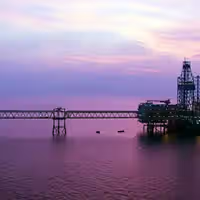
A worker at a natural gas facility in Iran. Turkey imported 4.536 bcm of Iranian gas in the first half of 2026, up 34 percent from a year earlier.
The expiry of a 25-year gas contract has exposed a shift in the Iran-Turkey energy relationship, with Ankara now enjoying more supply options while Tehran risks losing one of its most dependable export markets.
The contract expired on July 29 after governing Iranian pipeline gas supplies to Turkey for 25 years. Signed in 1996, with deliveries beginning in 2001, it provided for up to 9.6 billion cubic meters (bcm) of gas annually through the Tabriz-Ankara pipeline.
Turkish sector sources said the war prevented the two sides from holding negotiations on a new agreement before the deadline, while existing gas flows could continue temporarily under force-majeure arrangements. No new long-term contract has been publicly announced.
The expiry is particularly significant because Iranian supplies were rising sharply immediately before the agreement lapsed. Turkey imported 4.536 bcm of Iranian gas in the first half of 2026, up 34 percent from a year earlier. In June alone, Iran supplied 883 million cubic meters, narrowly behind Azerbaijan and ahead of Russia among Turkey’s pipeline suppliers.
That complicates any assumption that the expiry automatically means the end of Iranian gas exports to Turkey. Instead, it has opened a period in which Ankara must decide how much Iranian gas it still needs and under what terms, while Tehran risks losing or reducing one of its relatively stable sources of export revenue.
The uncertainty has become more consequential as Washington intensifies economic pressure on Tehran. US President Donald Trump on Wednesday announced what he called an “Economic D-Day” against Iran, threatening economic consequences for countries whose financial institutions, businesses or government entities provide Tehran with what he described as economic lifelines. Trump did not name Turkey or specify how the campaign would affect its purchases of Iranian natural gas. But the announcement adds another potential complication to any attempt by Ankara and Tehran to turn the temporary post-expiry arrangement into a new long-term agreement.
Iran’s gas vulnerabilities
Iran holds the world’s second-largest proven natural gas reserves, yet its export performance remains far below its potential. Production has long been constrained by aging fields, limited investment, insufficient access to technology and exceptionally high domestic consumption.
The South Pars field, shared with Qatar, remains central to Iranian gas production. Israeli strikes in March damaged processing facilities linked to the field and temporarily disrupted exports, although production was subsequently restored at several offshore platforms and gas was redirected to other processing facilities.
The damage has not yet been fully repaired. Iranian Oil Minister Mohsen Paknejad said in August that the war had knocked out about 95 million cubic meters of gas production and that reconstruction of four damaged refineries was continuing. He said the lost capacity was expected to return to the network by the end of September.
Rystad Energy estimates that repairing energy-related infrastructure damaged across the region could cost between $34 billion and $58 billion. Iran accounts for the largest number of affected facilities, with its repair bill potentially reaching $19 billion under the consultancy’s high-damage scenario.
These wartime losses compound problems that predate the conflict. Sanctions have restricted access to investment, technology and international markets, while domestic demand for electricity generation, heating and petrochemicals frequently takes priority over exports.
For Tehran, the Tabriz-Ankara pipeline has therefore been more than simply another commercial route. It has provided revenue, political leverage and a direct energy relationship with one of the region’s largest economies. A substantial reduction in exports to Turkey would leave Iran more dependent on limited pipeline sales to Iraq and Armenia, swaps and other short-term arrangements.
Turkey’s stronger hand
Turkey enters the post-contract period in a far stronger position than when the agreement was signed three decades ago.
Its annual gas demand generally ranges between 50 and 60 bcm, but its supply portfolio has become increasingly diversified. Russia remains a major supplier through Blue Stream and TurkStream, while Azerbaijan supplies gas through the Southern Gas Corridor. LNG has also become an increasingly important component of Turkish supply.
Turkey has expanded LNG import and storage capacity and signed long-term supply agreements with international producers, while domestic production from the Black Sea has continued to grow. Those developments give Ankara substantially more flexibility than it possessed when Iranian pipeline gas became a major part of its energy system.
That does not mean Iranian gas has become irrelevant. Turkish Energy Minister Alparslan Bayraktar said before the contract expired that Turkey could still need the Iranian pipeline for supply security. Turkish sector sources have also described Iranian gas as among the country's cheapest sources.
The combination gives Ankara considerable leverage. Iran still offers competitively priced pipeline gas delivered through existing infrastructure, but Turkey is no longer as dependent on that supply and has more alternatives with which to negotiate.
What happens after the expiry
Several outcomes remain possible. Turkey and Iran could eventually negotiate another long-term supply agreement, reach a shorter transitional arrangement, reduce contracted volumes or retain Iranian gas primarily as a source of additional supply during periods of high demand.
For Turkey, the calculation will involve not only price and physical supply but also reliability and geopolitical risk. Iranian gas has repeatedly been affected by winter shortages, infrastructure problems and now war, while tighter US economic pressure could create additional uncertainty surrounding payments and future contractual arrangements.
For Iran, the stakes are considerably higher. Reduced exports to Turkey would cut foreign-exchange earnings and further expose the gap between Iran’s enormous gas reserves and its limited ability to monetize them internationally.
The expiration of the old agreement therefore does not yet represent the end of the Iran-Turkey gas relationship. Gas continues to move, and both countries retain reasons to preserve the connection.
But the balance underlying that relationship has changed. Turkey has more suppliers, more infrastructure and greater bargaining power, while Iran faces damaged facilities, sanctions, war and renewed US efforts to restrict its remaining sources of foreign revenue.
The question is no longer whether the 25-year contract will expire. It already has. The question now is whether the gas trade that survived its expiry can be converted into another durable agreement — and on whose terms.
A special event honoring the Iranian community in the United Arab Emirates, held at the Dubai Exhibition Centre in Expo City Dubai on September 13, 2025. / Photo by WAM
The United Arab Emirates’ decision to halt all trade and financial transactions with Iran threatens one of Tehran’s most important routes for imports, petroleum-product sales and access to international commercial and financial networks.
The UAE Foreign Ministry said this week that all trade, commercial exchanges and financial transactions with Iran had been halted until further notice.
Afra Al Hameli, director of the Strategic Communications Department at the UAE Ministry of Foreign Affairs, said the decision came “in light of regional escalations that undermine regional and international peace and security.”
The UAE halted trade with Tehran a day after Donald Trump spoke by phone with UAE President Sheikh Mohamed bin Zayed, though it is unclear whether the decision was connected to Trump’s “Economic D-Day” campaign against Iran, announced later on Wednesday.
Trade between the two countries had already been severely disrupted after the war began in late February, when Iran launched attacks on the UAE and shipping through the Strait of Hormuz was curtailed.
In late June, however, Mohammad-Sadegh Ghannadzadeh, a deputy at Iran’s Trade Promotion Organization, said commercial exchanges with the UAE were gradually resuming through Jebel Ali Port. He said goods and containers stranded during the war were again being cleared and moved toward Iran.
The latest UAE announcement now casts doubt on the continuation of that channel.
Al Hameli also stressed that the UAE remains committed to protecting the integrity of the international financial system, complying with international law and applying the highest global standards.
That position is significant because even if political tensions eventually ease, Iranian businesses would still face serious restrictions stemming from US sanctions and Iran’s continued status as a high-risk jurisdiction subject to a Financial Action Task Force call for countermeasures.
One of Iran’s most important trading partners
The importance of the UAE to Iran can be seen in the latest official partner-by-partner trade figures available from Iranian customs.
During the first 10 months of the Iranian fiscal year that began in March 2025, Iran exported around $6.5 billion worth of non-oil goods to the UAE, equivalent to 14.3% of its non-oil exports.
Iran imported approximately $14.8 billion worth of goods from the UAE during the same period, accounting for 30.2% of its total imports.
Before the war, the UAE was therefore Iran’s largest supplier of goods and its third-largest destination for non-oil exports, behind China and Iraq.
Its importance extended well beyond ordinary merchandise trade. The UAE was also the largest destination for Iranian fuel oil, or mazut, and a market for other petroleum products.
A blow to mazut exports and fuel supply
Data from commodity intelligence firm Kpler, reviewed by Iran International, show that Iran exported an average of around 256,000 barrels per day of fuel oil in 2025.
Nearly 70% went to the UAE, making it by far Iran’s largest market for the product.
A prolonged halt in trade therefore threatens not only Iran’s non-oil exports but one of its most important outlets for petroleum products.
The UAE had also been among the destinations for Iranian liquefied petroleum gas, or LPG, although China accounts for the large majority of Iranian LPG exports. Iran’s total LPG exports generate more than $10 billion in annual revenue.
The UAE relationship is also important from the opposite direction.
An internal Iranian Oil Ministry report previously reviewed by Iran International showed that Tehran had increasingly relied on barter arrangements to meet domestic fuel shortages, exchanging part of its mazut exports for gasoline and diesel, particularly through traders operating in the UAE.
Iran is already struggling with a gasoline supply deficit, while officials have discussed measures ranging from tighter rationing to higher fuel prices.
Restricting access to the UAE could therefore affect not only export revenue but Iran’s ability to obtain products and refined fuels needed by the domestic market.
The end of Dubai’s role as Iran’s gateway to global trade?
The UAE’s importance to Iran has never been limited to direct bilateral trade.
For decades, Dubai has served as one of the principal re-export hubs for goods entering Iran, allowing Iranian companies to obtain products manufactured in countries with which direct trade is difficult, costly or restricted.
US sanctions and Iran’s exclusion from much of the international banking system have made this intermediary role particularly important.
Goods manufactured in Europe and Asia have routinely entered Iran through UAE-based traders and logistics networks, while Iranian companies have also used Dubai as a route to reach other markets.
The financial dimension is equally important. Dubai has long been a center for Iranian exchange houses, trading companies and intermediaries that help move money across borders despite Iran’s restricted access to the global financial system.
US sanctions packages targeting Iranian oil, petrochemical and procurement networks have repeatedly designated companies and individuals based in the UAE for alleged roles in facilitating transactions on Tehran’s behalf.
A broad and sustained UAE crackdown would therefore affect more than the physical movement of goods. It could also constrain financial, logistical and commercial networks that Iran has spent years using to mitigate its international isolation.
A major new gap for Iran’s economy
The latest available Iranian customs breakdown shows that merchandise trade between Iran and the UAE totaled about $21.3 billion in just the first 10 months of the previous Iranian fiscal year.
But even that figure understates the UAE’s economic importance because it does not capture Dubai’s wider role as a re-export, logistics and financial center for Iranian businesses.
Iran is now confronting the UAE halt while already under pressure from sanctions, foreign-currency constraints, weaker foreign trade and disruptions to energy exports.
Alternative routes through Oman, Iraq, Turkey and other neighboring countries can keep some trade moving, but they lack the combination of proximity, port infrastructure, financial connectivity and established commercial networks that Dubai offered.
The UAE has given no timetable for lifting its suspension.
For Iran, the risk is therefore not simply the loss of billions of dollars in bilateral trade. A prolonged halt could close one of its most important gateways to the global economy.