Qatar says downed Iranian aircraft were ‘aggressors’
The Iranian aircraft shot down by Qatar were engaged in “aggression,” and Qatari forces responded in accordance with their rules of engagement, Qatar’s foreign ministry spokesperson said on Tuesday.
Qatar remained in direct contact with Iran over three missing Iranian military pilots and had invited an Iranian delegation to visit, but Tehran had not responded, according to the spokesperson.
The official dismissed Iran’s request for the International Committee of the Red Cross to become involved in the pilots’ case as a “media ploy.”
The spokesperson also said mediators were waiting for Iran and Oman to reach a bilateral agreement over the Strait of Hormuz before returning to broader US-Iran negotiations.
An agreement on the waterway would make it significantly easier to resume talks between Tehran and Washington, the spokesperson added.
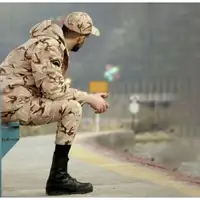
A conscript sitting on a metal bench at a train station in Iran
Iranian men conscripted into the Revolutionary Guards for their compulsory military service fear they and their families could lose the right to remain in Canada, after letters warned the mandatory stint may amount to membership in a terrorist organization.
The Unheard Conscript Advocacy Network, a community group for former Iranian conscripts and their families, says more than 500 people within its roughly 1,300-member Telegram group have reported receiving procedural fairness letters in recent weeks.
The letters give applicants 30 days to respond to concerns raised by immigration officers before a decision is made.
Canada has previously told Iran International that compulsory service in the Guards does not automatically make someone inadmissible and that applications are assessed individually. But several letters reviewed by Iran International reveal a tension between that position and what former conscripts say they are experiencing.
In one case, internal Officer Decision Notes reviewed by Iran International show a former conscript answering a procedural fairness letter with his military completion card and evidence that his service was compulsory.
The officer accepted that the service was mandatory and found him inadmissible anyway, writing that there is "no exemption for individuals whose membership arose through mandatory service." The application was refused.
In a separate case, an August 6 letter acknowledges that the applicant completed "mandatory military service" with the Guards as a soldier between 2009 and 2010, with duties that included kitchen and canteen work and occasional driving.
"I am therefore concerned that you served in the IRGC and that you may be inadmissible to Canada," the officer wrote, citing the provision of Canadian immigration law covering membership in an organization believed to engage in terrorism. The applicant was given 30 days to respond.
The consequences can reach beyond the former conscript. In another letter reviewed by Iran International, the government told the wife of one man that her application could also be refused if her husband is found inadmissible over his service.
‘Now we are the victims’
"Fatima," who asked Iran International to use only her first name because of security concerns, moved to Canada with her husband and two daughters in 2022.
Her husband completed compulsory military service between 2003 and 2005. The family applied for permanent residence in March 2024, before Canada designated the entire Revolutionary Guards a terrorist entity.
"We brought our children here to give them more opportunity, to give them a better life," Fatima told Iran International. "How come we were supporters of this regulation and now we are the victims of that?"
Iran International reviewed the family's immigration correspondence along with official documentation confirming the husband's service.
A document issued by Iran's Public Conscription Organization states that he completed 20 months of compulsory service and received a military service completion card; the family later obtained further verification of the record's authenticity from the same body.
Fatima said her husband, who holds a bachelor's degree in computer science, spent his conscription assigned to a small repair room fixing personal computers that personnel brought in. "He wasn't doing anything for the organization," she said. "People brought their computers there if there was an issue."
The stakes run through the whole family. If her husband is found inadmissible, so are their daughters, one of whom is 18 and has been accepted into a program at the University of British Columbia.
"If IRCC refuses our PR application because of my husband's conscription, and if we are inadmissible to Canada, then both my daughters are going to be inadmissible too," Fatima said.
Sam, a member of the Unheard Conscript Advocacy Network, said the 500-plus letters documented inside the group are likely a fraction of the national total. The group argues that former conscripts are effectively being asked to prove a negative: that compulsory service did not amount to voluntary membership in the Guards.
Canada's own immigration system has examined the difference between conscription and membership.
In a 2022 Response to Information Request on Iran's armed forces, the Immigration and Refugee Board cited Saeid Golkar, a scholar specializing in the Guards and the Basij, who explained that men subject to compulsory service apply through the Public Conscription Organization, which assigns them to the regular army, the police or the Guards.
Sources consulted by the board indicated conscripts do not choose the branch in which they serve. Golkar has also argued that conscription should not provide a blanket exemption from scrutiny.
The distinction was raised in Parliament days before Canada listed the Guards. Appearing before the House of Commons foreign affairs committee on June 10, 2024, University of Ottawa professor Thomas Juneau warned that broad measures could sweep up people who were never the target.
"There are hundreds of thousands of current and former members," Juneau told MPs, warning that "innocents" could be caught in the net. He argued for "targeted" and "surgical" measures while stressing that genuine Guards activity in Canada posed a serious threat.
Nine days later, on June 19, 2024, Canada formally listed the Revolutionary Guards as a terrorist entity under the Criminal Code. Iran International has previously reported on former conscripts whose immigration cases became uncertain after the designation.
Political pressure grows
Correspondence obtained by the advocacy network this year deepens the confusion over how Ottawa applies the policy.
In a February letter, Aaron McCrorie, vice-president of the Canada Border Services Agency's intelligence and enforcement branch, wrote that the 2024 designation made "anyone that had served in the Guard Corps inadmissible to Canada." The same letter says all cases are "reviewed, assessed, and decided on an individual basis." The two sentences describe two different policies.
Iran International asked Immigration, Refugees and Citizenship Canada what standard officers use to distinguish compulsory service from voluntary membership, whether uniform national guidance exists, how many former conscripts have received procedural fairness letters, and how many have been found inadmissible.
IRCC spokesperson Anahita Beladi said compulsory service in the Guards does not automatically make an applicant inadmissible and that each case is assessed individually. Procedural fairness letters, she said, are not final findings but a chance for applicants to explain their service.
"The final decision is made by an IRCC officer after considering the applicant's response, all relevant information, applicable jurisprudence, and any recommendations made by partners, including the Canada Border Services Agency and Canadian Security Intelligence Service."
Beladi said the agency does not currently hold data in a form that would show how many applicants completed compulsory service in the Guards, or how many letters have been issued over it.
The issue has now spilled into federal politics.
At an Iranian community town hall in North Vancouver, British Columbia, on Saturday, Conservative Leader Pierre Poilievre accused the government of risking action against the wrong people.
"I think they're risking going after law-abiding decent people who are actually against the IRGCs, but who have already been victimized through conscription," Poilievre told Iran International.
"The listing of terrorist organizations was meant to go after the perpetrator, not the victim. I would encourage the government to go after the actual terrorists, not their victims."
Conservative candidate Stephen Curran said Parliament should challenge the practice if conscripts are being swept into enforcement.
"They are targeting people that are innocent... victims of the regime in Tehran," Curran said. "If this is actually taking place, I think we would have to raise a very strong critique of it in Parliament and make sure that we're calling it out."
For Fatima, the policy debate is no longer abstract. Her family, she said, publicly supported Canada's designation of the Guards and joined demonstrations against the Islamic Republic.
"We supported that policy, IRGC as a terrorist organization," she said. "Now we are the victim of that."
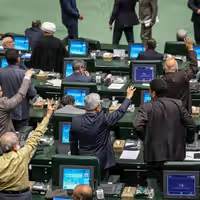
A bill before Iran’s parliament that would impose new restrictions on contacts with foreign media, universities and organizations has drawn widespread objections over its potential impact on routine academic, cultural and civil-society activity.
Lawmakers approved the bill’s general principles Sunday by 183 votes to four, with five abstentions among 258 members present. Its individual provisions must still be considered and approved separately.
The latest publicly available draft contains 19 articles, although references during Sunday’s parliamentary debate to Articles 26 and 27 indicate that lawmakers may be considering a revised text.
Bill targets broader forms of foreign influence
Supporters say a new law is needed because existing legislation focuses primarily on espionage, while foreign infiltration can take broader forms.
Hassan Ghashghavi, spokesman for parliament’s National Security and Foreign Policy Committee, said Iran already had laws covering espionage but faced a legal gap on infiltration.
Ghashghavi said work on the proposal began before the 12-day war and that relevant state bodies had participated in reviewing it.
The published draft gives the Intelligence Ministry and the Revolutionary Guards’ Intelligence Organization roles in identifying prohibited foreign links and activities. Cases under the proposed legislation would be heard by Revolutionary Courts.
Proposed penalties include prison terms, deprivation of social rights, dissolution of legal entities and confiscation of assets.
The reformist newspaper Sazandegi wrote that the proposal “not only fails to provide a proper definition of infiltration, but is also a warning sign of intensified censorship, greater restrictions and a widening social divide in the country.”
The newspaper questioned why legislation intended to counter foreign infiltration extended to scientific, media, cultural and civic activity rather than concentrating on breaches within sensitive state institutions.
Sociologist Mohammad Rahbari wrote that if the bill is approved in its reported form, “it would be as if parliament had shot itself in the foot,” arguing that the proposed offenses are defined so broadly that even parliament’s own research center could fall within their scope.
Social media activist Hossein Ghatib wrote that “the path to combating infiltration is not to take revenge on society,” arguing that shortcomings in official security structures should not result in restrictions on “university professors, journalists, artists, researchers, students and ordinary citizens.”
Foreign media and embassy contacts
Article 6 of the published draft would prohibit interviews, participation in discussions or “any communication” with media designated as hostile, including US and Israeli outlets and media funded by either country.
Violations would carry a sixth-degree prison sentence, which under Iran’s penal code ranges from more than six months to two years. Parliament has not approved the provision.
Interviews with other foreign media would have to be notified through a system run by the Intelligence Ministry, with failure to do so subject to the same proposed punishment.
Article 7 would criminalize sending video, photographs, audio or “any data” to non-Iranian media or people engaged in media activity outside the country.
The proposed punishment would increase in circumstances the text describes as crisis, unrest or disorder, or when information was sent under a cooperation agreement or with the intent of acting against national security.
The wording could potentially apply beyond professional journalists to people who send images or video of events inside Iran to media organizations abroad.
Iranian daily Shargh wrote that the proposed restrictions could expose foreign-policy journalists, international-relations specialists, translators, academics and businesspeople to prosecution because their work routinely requires contact with foreign institutions.
The newspaper also questioned whether authorities could realistically process permits for the large number of diplomatic, academic and commercial contacts taking place each day.
Article 8 would require individuals and organizations to notify authorities and obtain written permission from the Foreign Ministry or Iranian diplomatic missions for many contacts with foreign embassies, international organizations and non-Iranian institutions, with limited exceptions for personal and consular matters.
Academic and civil-society activity
Article 3 of the published text would prohibit providing “information, reports or statistics” to non-Iranian institutions or foreign nationals without Intelligence Ministry authorization.
The provision itself does not limit those categories to classified information.
Civil-society organizations would also be directly covered by the bill. Article 4 would prohibit non-governmental organizations, associations, political groups and other legal entities from receiving money, contracts, commissions or other financial benefits from foreign governmental or non-governmental bodies without authorization from a state committee.
Proposed penalties include imprisonment and fines, dissolution of organizations and bans of five to 15 years on cultural or social activity for their managers.
In academia, the draft would require the Intelligence Ministry to publish a list of approved foreign universities and research institutions for scholarships, contracts and scientific events.
Cooperation with institutions outside that list could carry criminal penalties if the provision is approved.
Cultural and educational work could face penalties
Other articles of the published text cover films, television series, documentaries, theater, music and books produced with the direction or support of foreign entities specified in the bill.
Works deemed to present a “dark image of Iran” or challenge religious principles could bring financial penalties or professional restrictions if the provisions are ultimately approved.
The draft would also allow prosecutors, based on material supplied by security agencies, to stop production of some works before completion.
Asr-e Iran questioned how authorities would define a “dark image of Iran,” asking whether portrayals of poverty, addiction, discrimination, corruption or migration could fall within that category.
“A country that is afraid of seeing its own wounds is not a healthier country; it may simply have broken its mirrors,” the outlet wrote.
In-person and online courses and workshops could also fall under the legislation if authorities considered them incompatible with “Iranian culture” and linked them to foreign entities covered by the bill.
Participants could also face punishment under the published text if they knew of the organizers’ stated purpose.
Another provision would criminalize certain forms of cooperation with foreign intelligence services, foreign governments, international organizations or non-Iranian individuals and entities to implement the UN 2030 Agenda or international instruments Iran has not formally undertaken to implement under its constitutional procedures.
Scope of bill draws criticism
Osman Salari, a member of the presidium of parliament’s Judicial and Legal Commission, said much of the proposal concerned criminal and judicial matters and argued that the judiciary and his commission had not been sufficiently consulted in its preparation.
Supporters argue that existing rules are fragmented and that a broader law is needed to establish a single framework for countering what the Islamic Republic describes as foreign infiltration.
Individual provisions remain unsettled
Article 1 of the published draft would also punish certain policy, legislative or executive proposals made under the supervision, direction, training or guidance of specified foreign intelligence services, governments or organizations when they result in harms defined by the text.
Those harms include damage to Iran’s security or independence and, under specified circumstances, undermining public trust in the political system, reducing election participation or directing votes toward a particular group or political current.
Other provisions would increase penalties for some economic crimes committed under foreign direction.
Iran enacted separate legislation in October 2025 increasing punishments for espionage and cooperation with Israel and states it designates as hostile. Supporters of the new proposal argue that “infiltration” requires a broader legal framework than espionage alone.
The new bill has yet to be considered article by article. Parliament must also determine the procedure for its further examination, and any final text it approves would require Guardian Council review before becoming law.
Salari said reports about punishments contained in the circulated draft should not be treated as final because lawmakers have not yet considered the individual provisions.
The provisions may therefore change during parliamentary scrutiny. What parliament has approved so far is the principle of legislating against what it describes as foreign infiltration, not the individual restrictions or penalties contained in the publicly available draft.
US President Donald Trump boards Air Force One in a file photo posted by the White House on X on Aug. 9, 2026.
The 60-day period associated with the Iran-US interim peace deal ended Monday without a breakthrough, with Washington rejecting an extension and a senior Iranian official saying the US had a few weeks to meet the agreement’s terms before further talks.
President Donald Trump said he did not expect Iran to agree to the kind of deal he considered necessary and again made preventing Tehran from obtaining a nuclear weapon the central US demand.
“They’re not going to make the kind of a deal that I feel is necessary,” Trump said Monday. “Iran cannot have a nuclear weapon. And they won’t have a nuclear weapon.”
Asked whether Washington wanted to extend the interim agreement, Trump replied: “No.”
He also said the United States had “total control” over the Strait of Hormuz through its naval blockade.
Tehran disputes 60-day deadline
Foreign Ministry spokesperson Esmaeil Baghaei disputed the characterization of Monday as the expiry of the memorandum itself, although the text of the agreement says the two sides committed to achieving a final deal within a maximum of 60 days, extendable by mutual consent.
Baghaei insisted that the 60-day period linked to the Islamabad memorandum had been intended for negotiations and was no longer relevant because Washington had breached the agreement.
He said the memorandum contained no formal 60-day deadline and that Iran would not make decisions in response to ultimatums.
Foreign Minister Abbas Araghchi had said Friday that the memorandum referred to an “end to the war,” rather than a 60-day ceasefire requiring an extension.
Iran gives US ‘a few weeks’
A senior Iranian official told Reuters that Iran had set a period of “a few weeks” for Washington to fully implement the memorandum before further negotiations could take place.
“Within the short period of a few weeks set by Iran, all the agreement’s provisions must be implemented by the US. This is a precondition for further negotiations with the US,” the official said.
Reuters reported, citing the official, that Iran had adopted a “fully offensive” posture and would be prepared to escalate in the Strait of Hormuz and across the region if diplomacy failed.
The official said Tehran’s timeframe would be conveyed to Washington and regional governments through mediators.
Contacts continue without agreement
Trump also confirmed that his administration had established a direct backchannel with the Revolutionary Guards and said he was “not in a hurry” to end the war. The IRGC later denied that talks with US officials were under way.
Trump envoy Jared Kushner said later Monday that US conversations with different parts of the Iranian government were probably “more robust than ever,” but that the two sides had yet to reach an understanding.
Oil prices also rose Monday as investors grew more pessimistic about efforts to end the Iran war and shipping through the Strait of Hormuz remained constrained.
WTI settled 2.5% higher at $84.50 a barrel, while Brent rose 2.7% to $90.87, the Wall Street Journal reported. Gains accelerated after Iranian state media reported that an Emirati oil tanker had been seized in the strait.
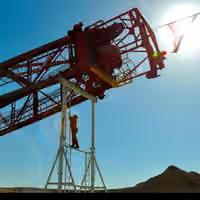
File photo released by ISNA in September 2013 shows a worker during the installation of an oil rig in Changuleh, Mehran county, Ilam province, western Iran.
Donald Trump’s maximum pressure is usually scored by counting tankers and tracking the rial, but Iran’s budget points to a deeper cost: more than $80 billion in NIOC bank debt and sovereign-fund arrears, repeatedly deferred as Iranians shoulder the burden.
On August 5, a state bank froze the accounts of the National Iranian Oil Company, NIOC, over about $1 billion owed to the sovereign wealth fund, two years past due. A separate case was already running: a $1.5 billion tax assessment the company says it simply cannot pay. Enforcement on that one stopped only when the presidency intervened.
The episode matters because the law shielding the company is also where its condition is recorded. NIOC publishes no audited accounts, and Iran's budget shows state companies only in aggregate, leaving its debt to be reconstructed from budget provisions and disclosures by other state institutions.
This year's budget sets the amount of NIOC debt to the central bank and commercial banks being deferred at 55 billion euros, about $63.5 billion, covering principal and interest on financing for upstream oil and gas development. It appears as a single sentence at the bottom of a table in which every other figure is in rials or percentages, renewed every year since 2019.
Iran's sovereign wealth fund, the National Development Fund, has separately said NIOC is its largest debtor, with $17 billion in unpaid loans.
Those two categories alone amount to more than $80 billion. No single official document presents them as one consolidated NIOC debt figure.
Iran's entire general budget this year converts to roughly $37 billion at the open-market rate. For scale, the deferred bank debt alone is about 1.7 times what the government plans to spend in a year.
That burden grows without anyone borrowing another dollar. The debt is in foreign currency, and the rial has fallen from about 900,000 to the dollar in early 2025 to nearly 2 million today, a slide President Trump celebrated in August as his administration "destroying Iran's currency." Each step down makes the same $63 billion heavier against NIOC's rial costs and the state's domestic revenues.
That burden grows in rial terms without anyone borrowing another dollar. The debt is in foreign currency, and the rial has fallen from about 900,000 to the dollar in early 2025 to nearly 2 million today, a slide President Trump celebrated in August as his administration "destroying Iran's currency.” Each step down increases the rial value of the same $63 billion obligation and makes it larger relative to the state's domestic revenues.
Maximum pressure is usually scored from the outside: barrels tracked leaving the Persian Gulf, the rial's slide, the lengthening sanctions lists. By that scorecard the campaign is working.
A clearer measure is the condition of the company at the center of the sanctioned trade, and by that measure the campaign has worked more completely than the scorecard shows. The pressure did not stop Iran's oil. It changed the terms of the business, and the new terms have broken the company that produces it, in every sense but the accounting one.
The business model was set at the top. After the United States withdrew from the nuclear deal in 2018 and reimposed sanctions, Ali Khamenei told officials not to leave the economy waiting on "decisions to be made by others." The objective instead was to plan with the sanctions in place and, in his formulation, to neutralize them.
The oil ministry's version of neutralization was to keep production alive with domestic contractors, the Revolutionary Guard's companies among them. On its own terms, that part worked. Output that had fallen below 2 million barrels a day in 2020, the lowest in almost four decades by American government estimates, was rebuilt to about 3.6 million by mid-2024, a recovery the oil minister boasted of publicly.
Selling those barrels was another matter.
"We have unofficial or unconventional sales, all of which are secret," then-oil minister Bijan Zanganeh said in 2019, "because if they are made known America would immediately stop them." His deputy called it the grey market.
In practice, that meant selling at sanctions-driven discounts that have varied widely over time, reaching $10 to $15 a barrel below Brent through 2024 and 2025, particularly to China's independent refiners; using a shadow fleet, ship-to-ship transfers and obscured vessel identities; relabeling Iranian crude as originating elsewhere; and paying intermediaries to keep the chain moving. China has at times taken roughly 90 percent of Iran's exported crude.
Payment itself became another layer of the sanctions trade. Iranian oil proceeds have been trapped or restricted in foreign banking systems, while other sales have been settled through barter or in currencies that are difficult to repatriate freely.
India created a rupee payment mechanism for Iranian crude in 2019, and the channel stalled the same year when Indian purchases stopped. Roughly $6 billion in Iranian oil proceeds frozen in South Korea were eventually transferred to restricted accounts in Qatar as part of the 2023 prisoner exchange.
Every additional discount, commission and restriction reduces what reaches Iran. NIOC's statutory share of crude and condensate export proceeds is set at 14.5 percent, so lower realized export revenue narrows the company's own take as well.
The difference between what the model earned and what production cost was covered on credit, in foreign currency, from the central bank, state banks and the sovereign wealth fund, with parliament's authorization.
By January 2019 the state knew in writing that the arrangement was not paying for itself. The parliament's research arm reported that NIOC, then about $50 billion in debt on its own count of the previous year, could not repay what it owed. The party line continued anyway: the same parliament approved fresh lending in the same budget, and two months later wrote the first deferral into law.
The dollar figures were tracked for two more years, to about $60 billion in March 2020 and about $70 billion in March 2021. Then that series went quiet.
The liabilities themselves did not vanish from the record. Two years later the Economy Ministry put NIOC's debts for 2021 at 1,683 trillion tomans, the largest of any state company in Iran, ahead of Bank Sepah and Bank Melli. At the exchange rate of the day, that is the same $60 to $65 billion the dollar series had been reporting.
What disappeared was the ability to follow it: a comparable figure, year by year, in the currency the money was owed in. The largest corporate debt in Iran's history was reduced to one renewable sentence that for six years carried no number at all. When a number finally surfaced this February, it settled what the silence had left open. The bank debt did not go away. It was rolled forward.
The meter still runs, though not at one rate. The sovereign fund's published terms for foreign-currency oil and gas facilities are 3.5 percent for the fund plus 2.5 for the agent bank, 6 percent all-in. On the $17 billion it is owed, that alone is close to $1 billion a year, almost exactly the size of the claim that froze the company's accounts in August.
The central bank has never published its contract rate, so the future cost can only be estimated. If even a 4 percent rate were applied to the $63 billion outstanding balance, it would add more than $2.5 billion in interest over a year; at the sovereign fund's 6 percent rate, the figure would approach $3.8 billion.
What the budget does establish is that the deferred bank debt already consists of principal and interest. The cost of carrying the old debt has become part of the debt.
For comparison, $1.5 billion in foreign currency is allocated for medicine this year, in a spring when pharmacy prices jumped several hundred percent, cancer and dialysis drugs ran short, and officials blamed scarce foreign currency. Depending on the rates applied to NIOC’s different debts, the annual interest burden could exceed that amount by several billion dollars.
An Iranian who misses a single loan installment pays the contract rate plus a 6-point penalty. The oil company's interest simply accrues, uncollected, year after year. A deferral, in the end, is a bet that a better year is coming, one with a surplus large enough to settle old bills. The Islamic Republic has been promising that better year that is yet to come for forty-seven years.
Because the loans are neither collected nor written off, the central bank and the state banks carry them as sound assets, the same accounting that keeps Iran's insolvent banks upright. When those banks come up short, they overdraw at the central bank, and that is where base money is created.
The transmission is not mechanical, but it is the route by which a single failed lender, Bank Ayandeh, accounted for about a quarter of the growth in Iran's monetary base in 2022-23. The bill reaches Iranians as inflation: the tax no one votes on, taking its largest share from the poorest.
Fifteen years of records say NIOC could not pay when conditions were merely bad. With its fields bombed and its exports blockaded, repayment is beyond reach in any scenario.
And the pressure is still tightening. On August 13, Treasury Secretary Scott Bessent, who runs the Economic Fury campaign against the Islamic Republic, promised measures "like have never been seen in the history of the economic isolation of a country," on top of a blockade meant to keep anything from moving in or out of Iranian ports. Whatever they turn out to be, they are aimed at the only revenue that could ever service this debt.
Nor does the optimistic case rescue the company. Even a full lifting of sanctions would not change the arithmetic quickly, because a company with damaged fields and war-hit infrastructure would have to borrow more before it could export more.
Maximum pressure set the terms of this downfall, but the decisive choices were Tehran's: to keep pumping at any margin, to stop publishing a comparable foreign-currency debt figure after 2021, and to push the bill forward one year at a time.
The company that once symbolized Iran's oil wealth was not felled by a rival or a market. It was sacrificed, quietly, by its own state, to the nuclear program and the regional ambitions that brought the sanctions, and to the business model built to outlast them, and the receipt is one sentence long, perpetually renewed every year.
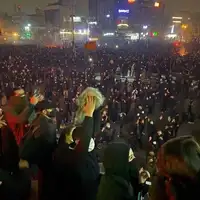
A placard held by an Iranian protester reads: “Neither Gaza nor Lebanon, my life for Iran.”
An Iranian state television presenter has sparked widespread criticism after saying “southern Iran be sacrificed for southern Lebanon” while dismissing criticism over the damage caused by recent US airstrikes on Iran’s southern provinces.
Reyhaneh Ghasemizadeh accused government opponents of displaying “fake concern for Iran” before making the controversial remark in footage widely circulated on social media Monday.
Iran’s state broadcaster said her comments had been taken out of context and released a longer version. In it, Ghasemizadeh accused critics who had called for Donald Trump’s help of now claiming concern for southern Iran, saying: “They post claims of patriotism... saying, ‘Our hearts ache for the south.’ Southern Iran, sacrificed for southern Lebanon.” She then accused the same critics of celebrating reports that 168 students in Minab had been killed on February 28.
Islamic Republic supporters argued online that the disputed phrase was not Ghasemizadeh’s own view, but a quotation or paraphrase of what she was attributing to government opponents. Most visible comments under widely shared versions of the clip, however, rejected that interpretation, saying her delivery did not make clear she was quoting dissidents.
The remarks touched a longstanding political fault line in Iran over the Islamic Republic’s support for Hezbollah in Lebanon and other members of what Tehran calls the “Axis of Resistance.”
“Neither Gaza nor Lebanon, my life for Iran” has long been among the slogans chanted in antigovernment protests in Iran.
It first gained prominence during the 2009 Green Movement and has repeatedly resurfaced during subsequent waves of anti-government demonstrations.
It was most recently heard during nationwide protests beginning in December 2025, including in Tehran and other cities. The slogan has become shorthand among protesters for opposition to Tehran directing financial and military resources toward regional allies while Iran faces economic hardship at home.
Ghasemizadeh’s comments also come weeks after southern Iran bore the brunt of a sustained US bombing campaign following renewed fighting around the Strait of Hormuz.
US forces carried out 13 consecutive nights of strikes in July, hitting military and other infrastructure across Hormozgan, Khuzestan and Sistan & Baluchestan provinces, including around Bandar Abbas, Jask, Chabahar and Qeshm. Washington said the campaign was intended to degrade Iran’s ability to threaten commercial shipping.
Iranian authorities reported deaths, damaged bridges and transport links, as well as power and water disruptions in parts of the south, fueling public concern over the civilian cost of the renewed conflict.