• العربية
  • فارسی
Brand
  • Iran Insight
  • Politics
  • Economy
  • Analysis
  • Special Report
  • Opinion
  • Podcast
  • Iran Insight
  • Politics
  • Economy
  • Analysis
  • Special Report
  • Opinion
  • Podcast
  • Theme
  • Language
    • العربية
    • فارسی
  • Iran Insight
  • Politics
  • Economy
  • Analysis
  • Special Report
  • Opinion
  • Podcast
All rights reserved for Volant Media UK Limited
volant media logo

Pentagon revokes former Air Force secretary’s access to classified information

Aug 7, 2026, 23:30 GMT+1

The Department of War revoked former Air Force Secretary Frank Kendall’s eligibility to access classified information and hold sensitive positions, Pentagon spokesman Sean Parnell said on Friday.

“Effective immediately, the Department of War has REVOKED former Secretary of the Air Force Frank Kendall’s eligibility for access to classified information and his ability to hold any sensitive position. This action follows his unauthorized disclosure of classified information regarding Air Force One’s capabilities to a media outlet. Safeguarding classified information is a non-negotiable duty. Those who violate that trust forfeit the privilege of access and any role requiring it,” he posted on X.

Most Viewed

A Khamenei in-law is openly recruiting to replace the Islamic Republic
1

A Khamenei in-law is openly recruiting to replace the Islamic Republic

2
VOICES FROM IRAN

Iranians turn on Pezeshkian over protest death toll comments

3

Mecca pact ties three Sunni powers together as Iran-backed attacks loom

4

UN experts say Iran steps up repression of ethnic minorities

5

US imposes new Iran sanctions as officials say Hormuz deal is near

Banner
Banner
Banner

Spotlight

  • US miscalculated Iran’s resilience and hurt deal prospects, expert says
    ANALYSIS

    US miscalculated Iran’s resilience and hurt deal prospects, expert says

  • What the Pentagon learned from the Iran war
    INSIGHT

    What the Pentagon learned from the Iran war

  • Iran hardliners push renewed hijab crackdown despite widespread defiance

    Iran hardliners push renewed hijab crackdown despite widespread defiance

  • A Khamenei in-law is openly recruiting to replace the Islamic Republic

    A Khamenei in-law is openly recruiting to replace the Islamic Republic

  • Executions in Isfahan renew calls to end German city partnership

    Executions in Isfahan renew calls to end German city partnership

  • Iran's energy crisis is political, not seasonal
    ANALYSIS

    Iran's energy crisis is political, not seasonal

•
•
•

More Stories

Ending Iran war could expose regime to its greatest threat yet, experts say

Aug 7, 2026, 22:08 GMT+1
•
Negar Mojtahedi
100%
Iran's President Masoud Pezeshkian (left), Parliament Speaker M.B. Ghalibaf, and Judiciary Chief Mohseni-Ejei attend a funeral ceremony for slain Supreme Leader Ali Khamenei in July 2026.

Ending the Iran war could expose the Islamic Republic to one of its greatest vulnerabilities, experts say, as Tehran confronts a battered post-war economy that may strain its ability to finance the institutions underpinning its rule.

From a strictly economic perspective, former US Treasury official and sanctions strategist Miad Maleki says the greater danger to the regime may emerge once the fighting stops and it must govern a country burdened by soaring inflation, reconstruction costs and years of economic decline.

"If the conflict ends today, then you're going to see the economic effect of the war doing its work," Maleki told Eye for Iran.

"That would be very scary if I was an Iranian regime official, having to face the reality of a post-war economy."

Maleki argues Iran is already inside what he describes as a "tipping zone," where years of inflation, currency depreciation and economic mismanagement have steadily eroded purchasing power.

The question, he says, is no longer simply whether the government can continue paying salaries, but whether those salaries still buy enough to sustain loyalty.

"The salary might keep coming," he said. "You just won't be able to afford very basic needs."

The scale of that pressure is reflected in official consumer-price data.

In June, food and non-alcoholic beverage prices were nearly 134% higher than a year earlier, while prices for oils and fats rose about 278% and meat about 172%, according to data from the Statistical Center of Iran.

Those increases squeeze not only ordinary households, counterterrorism and security specialist Roger Macmillan argues, but also lower-ranking members of the Basij, IRGC conscripts and their families—people drawn from the same society on which the state relies to maintain internal security and suppress dissent.

"The real question isn't how much damage a bomb can do," he said. "It's what happens when the money stops moving."

Iran's financial center of gravity

Military pressure has dominated discussion of Iran for months, with much of the debate centered on missile stockpiles, drone production and how long it might take Tehran to rebuild its military capabilities.

Macmillan argues that focus overlooks something more fundamental.

"They are built to absorb military pressure," he said. "But are they able to absorb payroll pressure?"

His argument is not that economic pressure alone will weaken the regime. Rather, he says policymakers should focus on disrupting the broader financial ecosystem that allows the Islamic Republic to function, from government payrolls to military-linked economic networks.

"We need to be looking at the financial center of gravity, which is not just the payroll but also the military bonyads," he said.

Bonyads are powerful quasi-official foundations that expanded after the 1979 Islamic Revolution, with some of the largest developing extensive holdings in sectors including banking, construction, manufacturing, agriculture and energy.

Major foundations enjoy significant economic privileges and limited public oversight, and several are overseen by or closely connected to institutions under the Supreme Leader.

Some have also served as important patronage networks and maintained extensive economic links with Iran's political and security establishment.

For Macmillan, the question is not simply how much revenue those networks generate. It is whether they can continue supporting rank-and-file security forces if inflation keeps eroding wages while the government takes on the additional burden of rebuilding a post-war economy.

"What we need to look at is how we can remove the will, shatter the cohesion and the will of the foot soldiers from the Basij and from the IRGC, and separate them from the state," he said.

The argument represents a different way of thinking about pressure on Iran.

Rather than asking only how much military capability can be destroyed, Macmillan and Maleki argue policymakers should also consider how much financial strain the Islamic Republic can absorb before maintaining the institutions that enforce its rule becomes increasingly difficult.

Peace itself could reduce some war-related economic pressures, particularly if it improves trade conditions or is accompanied by sanctions relief. But Maleki argues it would also force Tehran to confront accumulated economic problems while meeting the costs of reconstruction.

For him, that may be precisely where the regime is most vulnerable.

"The most punishing thing they can do to this regime is send it back to govern Iran in a state of peace and face the reality they had to kill their way out of," Maleki said.

US imposes new Iran sanctions as officials say Hormuz deal is near

Aug 7, 2026, 21:49 GMT+1
100%
The Wasp-class amphibious assault ship USS Kearsarge (LHD 3) transits the Strait of Hormuz.

The United States imposed fresh sanctions targeting Iran’s financial networks Friday even as US officials said progress had been made toward a deal with Tehran over the Strait of Hormuz and it could be clinched as early as the weekend.

The US Treasury targeted currency exchange houses, shell companies and financial facilitators that Washington said helped Iran move hundreds of millions of dollars through the international financial system.

The State Department said the measures targeted networks Iran used to access oil revenue, evade sanctions and move funds through front companies.

It added that the new sanctions were intended “to cut the financial lifelines that sustain Iran’s ruling elite.”

The statement said Washington would continue targeting banks, exchange houses and other facilitators it says Iran uses to move funds and evade sanctions.

Despite the new sanctions, US officials insist that progress has been made in talks over the Strait of Hormuz.

There has been progress between Oman and Iran over the strait and a deal is expected soon, Reuters reported Friday, citing a US official.

The official said the US would lift its blockade of Iranian ports once an agreement was announced to restore commercial shipping through the strait without impediments.

Bessent says ceasefire could come soon

US Treasury Secretary Scott Bessent separately said a 30- to 60-day ceasefire agreement with Iran could come “shortly, maybe even today, tomorrow,” adding that a deal could reopen the Strait of Hormuz and bring energy prices down.

Bessent also said the strait would “never” return to the way it was, saying Iran had used or tried to use it as a choke point.

“What we are going to see over the next two years, the strait is going to become irrelevant. It is going to become just another body of water,” Bessent said.

He added that “more than 50 or 70%” of the energy currently moving through the strait would instead go through underground pipelines.

Earlier Oman proposal

The latest progress follows weeks of talks between Iran and Oman over a new arrangement for commercial shipping through the Strait of Hormuz.

Iran had earlier rejected an Omani proposal for a 50-50 arrangement dividing the inbound and outbound routes between the two sides, saying it did not sufficiently address Tehran’s security concerns.

Tehran instead proposed that one shipping lane run entirely through Iranian territorial waters and part of the other also pass through Iranian waters, allowing Iran to maintain oversight over traffic in both directions.

US actions would remain performance-based and tied to Iran’s implementation of its commitments, the US official told Reuters.

US miscalculated Iran’s resilience and hurt deal prospects, expert says

Aug 7, 2026, 20:25 GMT+1
•
Kambiz Tavana
100%
Paul J. Saunders, President and CEO, Center for the National Interest

Washington likely underestimated Iran’s ability to withstand the initial US-Israeli strikes, making a negotiated settlement harder to achieve and deepening mistrust, foreign-policy expert Paul Saunders told Iran International.

The United States appeared to believe that military force would quickly weaken the Iranian government and compel Tehran to accept an agreement closer to US terms, Paul Saunders, president and CEO of the Center for the National Interest, said in an interview in Washington DC.

“I think the administration probably … overestimated how easy it would be to use force to bring about a successful agreement,” Saunders said.

Washington and Tehran remain divided over efforts to end the conflict, with the Strait of Hormuz at the center of competing military and diplomatic calculations. Recent reports have offered conflicting accounts of whether an agreement to reopen the waterway is imminent.

Strikes complicated diplomacy

“Targeting Iran’s leadership did more than escalate the military campaign,” Saunders said. “It also posed a direct threat to the survival of the Islamic Republic, making it harder for Washington to persuade Tehran to compromise.”

“I think that, from my point of view, it would have been better not to execute the strike on the Iranian leadership,” Saunders said, adding that the decision increased mistrust and left Washington in a weaker position to negotiate after the initial military action.

The US-Iran Memorandum of Understanding, signed in June, was a 14-point interim framework to end hostilities, restore commercial passage through the Strait of Hormuz, remove the US naval blockade and negotiate a final agreement within 60 days.

In July, Iran suspended implementation of its commitments under the MoU, accusing Washington of effectively abandoning its own obligations.

“In order to get a deal, we needed to have a government to negotiate with,” Saunders said. “When that government is really damaged and destabilized … will that new regime be sufficiently powerful that it will be able to make concessions to the United States?”

Trump has described Iran as being under a “third regime,” arguing that successive layers of the country’s leadership were killed in US and Israeli strikes and that the officials now in charge were different and more reasonable than their predecessors.

Iran’s internal response

Saunders said the political effects of the war extended beyond negotiations to Iran’s domestic response. He said it was predictable that Iranian society would rally behind the state when facing an external attack, even if many people remained unhappy with their government.

“Regardless of how angry or frustrated people might be with their own government, the only thing that they actually want less than their own government interfering in their lives … is someone else’s government doing it,” Saunders said.

“The Iranian government is responding to a threat to its survival, while Iranian society is reacting to an external attack. At the same time, the US president and the American public are weighing how much risk and cost the conflict justifies,” he added.

The conflict is important to Washington but not existential for the United States, Saunders said. He added that the administration had shown sensitivity to growing public concern over the costs of continuing the campaign.

Hormuz remains central

The Strait of Hormuz remains central to Iran’s leverage and to efforts to end the conflict. Commercial traffic through the waterway has fallen sharply, while Iran is also bearing substantial economic costs from the disruption.

Saunders said traders had so far expected the strait to reopen, limiting the immediate impact on global oil prices. But he warned that the economic consequences could become far more serious if the disruption persisted and refiners were forced to adapt to reduced supplies.

What the Pentagon learned from the Iran war

Aug 7, 2026, 19:45 GMT+1
•
Mehdi Beigi
100%
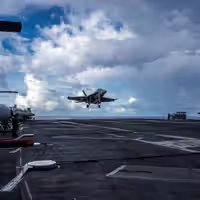
یک هواپیمای سوپر هورنت F/A-18F متعلق به اسکادران ضربتی VFA-41 در حال فرود با قلاب روی عرشه ناو هواپیمابر یو‌اس‌اس آبراهام لینکلن در اقیانوس آرام است.

President Donald Trump's latest order to investigate leaks about US munitions stockpiles may look like another dispute between the White House and the American media. In Tehran, it is being read as vindication.

Iran's military and state media have spent months portraying the depletion of American interceptors and precision weapons as evidence of a newfound way to impose costs on a vastly more powerful military.

The United States has not run out of weapons, and the Pentagon does not disclose exact inventories. But beneath the propaganda is a real strategic argument.

Iran does not need to match the United States missile for missile. It needs to make the United States expend expensive, slow-to-replace weapons at a rate that becomes difficult to sustain.

Washington increasingly appears to be treating that challenge as an industrial problem, not simply a battlefield one.

Tehran is not hiding the calculation

The clearest evidence comes from the IRGC itself. In a July 23 statement announcing an attack on a US base in Kuwait, the Revolutionary Guards said they would not allow Washington to use what they called "deceptive ceasefires" to replenish its oil and munitions stockpiles before resuming attacks.

The IRGC was not simply claiming to have damaged American forces. It was identifying the time required to replenish US stocks as a factor in how Iran viewed ceasefires and the continuation of the war.

On March 10, IRGC spokesman Ali Mohammad Naeini told American officials that Iran knew their ammunition stocks were being depleted. In April, Aerospace Force commander Majid Mousavi claimed Iran was replenishing its missile and drone capacity faster than the United States could replace weapons sent to the region.

Those statements cannot establish the actual condition of either country's arsenal. They do, however, show that Iranian commanders are treating ammunition consumption as part of the strategic contest.

On July 26, the hardline daily Kayhan ran a report referring to the "running dry" of Pentagon weapons stocks, using American media reports to challenge Washington's claims of overwhelming military power. Tasnim has similarly highlighted estimates of depleted Patriot, THAAD, Tomahawk and other missile inventories.

The claims are propagandistic, but they take aim at a genuine vulnerability.

Iran's advantage

Iran's military model was shaped partly by necessity. A May 13 analysis by the Carnegie Endowment traced Tehran's emphasis on ballistic missiles and drones to decades of sanctions and restricted access to Western military technology.

Rather than attempting to recreate an American-style force built around advanced aircraft and expensive precision systems, Iran invested heavily in weapons it could manufacture domestically and deploy in large numbers.

Carnegie cited estimates putting the cost of a Shahed-136 drone at roughly $20,000 to $50,000. Iranian ballistic missiles are substantially more expensive—roughly $1 million to $2 million by some estimates—but can still cost far less than the defensive systems used against them.

That does not mean a $30,000 drone automatically forces the launch of a multimillion-dollar Patriot interceptor. Air defense is layered. Fighters, guns, electronic warfare and cheaper interceptors can also be used.

Iran can also threaten an array of military and energy targets across the region with weapons flying at different speeds and altitudes. The defender must keep radars active, aircraft airborne and sufficient interceptors available for the threats that matter most.

Iran therefore does not have to win every exchange. It can fail to penetrate most defenses and still impose costs through volume, persistence and geography. That is the part of Iran's approach that an inventory count alone misses.

Politically sensitive numbers

Reuters reported on August 4, citing three people familiar with US military data, that the Army had consumed much of its stock of long-range ground-launched precision missiles during five months of war. Two sources said "virtually all" available ATACMS and Precision Strike Missiles had been used.

The Pentagon has not confirmed those numbers.

Three days later, The Wall Street Journal reported that Trump had ordered investigations into leaks about US munitions stockpiles. According to the report, the administration is seeking $52.9 billion for munitions and another $21 billion specifically to replace stocks depleted during the Iran war.

Trump publicly insists the United States retains "massive" quantities of ammunition. The two positions are not necessarily contradictory. The US military can have enough ammunition to continue current operations while simultaneously concluding that its inventories and production rates are inadequate for another major war.

That matters because Iran is not the Pentagon's only concern, and a potential conflict with China would place vastly greater demands on US stocks.

Future problems

The United States has spent years preparing for the possibility of conflict in the Indo-Pacific while simultaneously supplying Ukraine and maintaining commitments in Europe and the Middle East.

Every Patriot interceptor, Tomahawk or long-range precision missile used against Iran is therefore part of a larger calculation: What remains available if another crisis begins before the first one ends?

That is why the most revealing evidence is not the disputed number of missiles left in storage. It is what Washington is doing to its factories.

On January 6, the Pentagon announced a seven-year agreement aimed at increasing the annual production capacity of the PAC-3 MSE Patriot interceptor from roughly 600 to as many as 2,000.

On July 27, L3Harris announced agreements designed to nearly triple production of propulsion components for PAC-3 and quadruple propulsion production for THAAD. The Pentagon has also brought new suppliers into missile production and launched a program for lower-cost, air-launched cruise missiles that can be manufactured at greater scale.

These are not signs that American military power has collapsed. They are signs that the Pentagon believes industrial capacity itself has become a weapon.

The bigger picture

Iranian state media have turned the US stockpile debate into evidence that Washington has been defeated. That conclusion goes beyond what the public evidence supports.

The United States retains enormous military advantages in intelligence, air power, logistics, precision strike and global deployment. Iran has also suffered severe military, economic and human losses during the war.

But Tehran does appear to have demonstrated something narrower and strategically significant. A weaker state does not necessarily have to compete with America's most advanced technology. It can attack the economics and tempo behind that technology.

Michael Duffey, the Pentagon official responsible for acquisition and sustainment, recently described the shift in American thinking in unusually direct terms. For decades, he said, the United States benefited from its ability to engineer the world's most sophisticated weapons.

"We're no longer in that global environment," Duffey said, arguing that the Pentagon needs not only superior technology but speed and volume.

The argument over whether America's missile stocks are "running out" will continue, particularly while the actual numbers remain classified. The more consequential change is already visible.

Iran spent decades building a military around the assumption that it could not compete with the United States in sophistication. Washington is now spending billions to ensure that its technological superiority does not leave it vulnerable on quantity.

The next arms race is no longer only about who can build the better missile. It is also about who can build the next one fast enough.

Iran hardliners push renewed hijab crackdown despite widespread defiance

Aug 7, 2026, 16:36 GMT+1
•
Maryam Sinaiee
100%

Iranian hardliners are intensifying pressure on authorities to enforce compulsory hijab, as recent cafe closures and online campaigns raise fears of a renewed crackdown despite widespread defiance of the dress code.

Last week, hardline lawmaker Mohammad Naghd-Ali told parliament that another member had told him he cries after every parliamentary session because of the current state of women's dress.

Naghd-Ali fiercely criticized President Masoud Pezeshkian's administration for refusing to implement the controversial hijab law approved in 2024, saying the government was allowing what he described as "nudity” and “immorality" to spread.

Although the new legislation was finalized in 2024, its implementation has been suspended following a decision by the Supreme National Security Council, reportedly out of concern that enforcing it could trigger unrest similar to the nationwide protests that erupted after Mahsa Amini's death in 2022.

Existing compulsory-hijab rules, however, remain legally in force.

Hardline activists have likewise blamed Pezeshkian for what they portray as the country's cultural decline.

"If Pezeshkian's incompetent and secular government continues for another two years, even today's level of dress will become something people long for," conservative commentator Hassan Abbasi wrote on social media. "Pezeshkian is standing against God's command on hijab and wants to return Iran's cultural climate to the Pahlavi era."

Social media campaign seeks broader crackdown

Hardline activists have also intensified an online campaign demanding tougher enforcement.

In recent days they have circulated videos showing unveiled women in tight-fitting sleeveless tops serving customers at a well-known restaurant in Tehran—scenes that would have been almost unimaginable in the capital and other cities until only a few years ago. Such activists frequently describe these styles as "nudity" or "body display."

One hardline X user, allegedly tied to a state institution, wrote: "The first step in confronting unveiled women is confronting cafes and establishments that violate social norms." According to the post, enforcement is currently focused mainly outside Tehran but will gradually expand across the capital.

Hardline journalist Fereshteh Sadeghi similarly shared a photograph of an unveiled woman shopping outside Tehran and criticized those arguing that hijab should not be discussed while the country faces broader security challenges.

"They tell us not to talk about hijab in the middle of a war and not even to take pictures. Then when are we allowed to speak?" she wrote.

Yet Sadeghi also acknowledged the state's failure to restore widespread headscarf compliance.

"The battle to force the hijab back onto women is over; you can't force the hijab on their heads," she wrote in another post, while arguing that authorities should at least establish dress regulations to prevent what she called "body display."

Hijab as a political symbol

For many hardliners, compulsory hijab is not only a religious obligation but also a defining political symbol of the Islamic Republic.

"Hijab is the flag of Islam. Muslim society is recognized through hijab," conservative social media activist Alireza Akbari wrote.

Supporters of compulsory veiling frequently cite a ruling by Supreme Leader Ali Khamenei, who described unveiling as forbidden both religiously and politically.

Journalist Mehrdad Khadir argued in an article published by Asr-e Iran that women's dress is no longer among the public's primary concerns.

"The way women and girls dress is not a concern for the majority of people," he wrote. "The face of the city has changed, and it will not return to what it once was."

According to Khadir, the country's real concerns are the threat of war and the collapse in living standards.

"In the current circumstances," he wrote, "it is unlikely—indeed impossible—that the authorities would surrender their judgment to those tears and turn an issue that has effectively been settled back into a national crisis. If there is anything worth crying over, it is the collapse of people's purchasing power."

Resistance through everyday life

Although enforcement has eased in many areas over recent years, critics argue that this should not be mistaken for legal liberalization because compulsory hijab laws remain fully in force even if they are not consistently applied.

The social landscape has nevertheless changed dramatically. Many women who continue to wear the hijab have also moved away from the traditional all-black chador and highly conservative appearance. Styles often described online as “hijab style” combine headscarves with colorful clothing, modern designs and fashion accessories.

Hardliners reject these styles as well, arguing that they contradict hijab's original purpose of discouraging attention and preserving modesty.

Opponents of compulsory veiling, meanwhile, say the increasingly visible presence of unveiled women reflects persistence rather than freedom.

"The type of clothing women wear in public still depends on the neighborhood, how they travel, even the day and time," one X user wrote. "The fact that we now see bolder styles is the result of the relentless struggle of brave women who accept the risks of dressing that way. Nothing has actually been liberated."