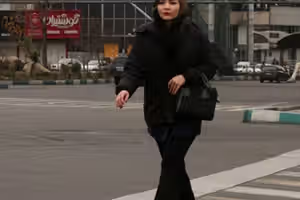
Tehran hospital nurses beaten, dismissed after labor protest

Nurses at a Tehran hospital were beaten and detained, with scores dismissed or suspended, after staging a strike over poor working conditions, Iran International has learned.
Nurses at a Tehran hospital were beaten and detained, with scores dismissed or suspended, after staging a strike over poor working conditions, Iran International has learned.
Nursing staff at Fayazbakhsh Hospital began a strike and held gatherings on July 30, demanding action over overwhelming workloads, severe staff shortages, low wages and mounting financial pressures.
Several nurses were beaten and detained during the crackdown, while their mobile phones were confiscated to prevent them from communicating or sharing information. Hospital authorities subsequently issued dismissal and suspension orders for many of the protesting nurses.
The exact number of nurses dismissed, suspended or detained was not immediately clear. Iranian authorities and the hospital administration have not publicly commented on the measures.







The figures, presented at a public event hosted by the University of Tehran's Faculty of Urban Planning, offer the most detailed breakdown yet of damage across the capital following the conflict.
The report says District 4 in northeastern Tehran recorded the highest number of strikes, followed by District 21 in the west, District 1 in the north and District 22 in the northwest.
"The number of strikes in District 4 alone exceeded the combined total recorded in some provinces," Hossein Nouhi, a certified construction expert in Tehran's municipality, said during the event.
According to the report by Tehran Municipality's Urban Planning and Architecture Department, District 4 was hit 90 times, District 21 Tehran sustained 62 strikes, District 1 recorded 57 and District 22 recorded 55. District 17 in southwestern Tehran was the least affected, with three reported strikes.
Housing damage
The municipality said 50,849 residential units across Tehran sustained damage ranging from broken windows and doors to complete destruction.
Around 40,000 homes required minor repairs, about 8,900 suffered more extensive architectural damage, 415 buildings required structural reinforcement or reconstruction and 2,042 homes were completely destroyed and must be rebuilt, according to the report.
District 4 recorded the largest number of damaged residential units with 7,948, followed by District 2 with 4,037, District 15 with 3,490, District 11 with 3,432, District 21 with 3,205 and District 7 with 3,196.
The report also found that District 7 had the highest number of completely destroyed homes, with 429 units, followed by District 4 with 325 and District 11 with 248.
Estimated economic and environmental costs
Nouhi put the country's economic losses from the 40-day conflict at an estimated $280 billion, excluding psychological impacts and the cost of restoring industrial production. He argued that the conflict highlighted the need to require shelters in new high-rise developments.
Separately, geologist Mehdi Zare’ estimated that military strikes generated around 10 million metric tons of debris across affected urban areas by August 1. He said the waste includes concrete, steel, glass, asbestos and industrial pollutants that could create long-term environmental and public health risks.
Zare’ also said the demolition and cleanup process released millions of tons of greenhouse gases, adding to the environmental impact of the conflict.
The report described the trend as the emergence of a "survival economy," in which even the smallest household possessions have become tradable assets as families struggle with soaring inflation and shrinking purchasing power.
Online classified advertisements, according to ILNA, increasingly feature offers to sell used work shoes and clothing, empty perfume bottles and natural hair for extensions, alongside listings advertising the rental of property deeds, salary slips and other financial guarantees.
From laptops to perfume bottles
The agency also highlighted growing demand for laptop rentals, with users seeking temporary access to devices for basic tasks such as typing documents, using Microsoft Office software or attending online classes.
"What may initially appear strange or even humorous actually reflects declining purchasing power, changing consumption patterns and households' efforts to generate cash," ILNA wrote.
The shift, The report said, illustrates how ownership is increasingly giving way to renting, while everyday items are being used until the very end of their economic value.
The findings come as inflation continues to weigh on Iranian households. According to the Statistical Center of Iran, annual inflation reached 66% in the Iranian month ending in late July, while year-on-year inflation stood at 87.9%.
A 'survival economy'
The growing number of advertisements, the report said, reflects a broader transformation in household finances, where assets once considered worthless or purely personal are increasingly being converted into immediate sources of income.
The agency said many sellers now bundle together low-value household items to improve their chances of making a sale, while advertisements offering natural hair have also become more common, with prices ranging from negotiable sums to several million rials depending on length, color and quality.
The report follows other recent signs of mounting financial pressure, including the spread of installment payments for healthcare and pharmaceuticals, as many Iranian families struggle to cover everyday expenses.
The expansion of the market for second-hand goods, rentals and personal assets, ILNA said, reflects a growing effort by households to generate cash in an economy where almost anything can become a source of income.
Omid Behzad and Pouria Safvat, the judiciary's news outlet said, were executed on Monday, after Iran's Supreme Court upheld their death sentences.
According to Mizan, the two men transmitted “coordinates, images and information about Iranian military and security sites to officers from Israel's Mossad intelligence agency and affiliated communication channels” during the 12-day and 40-day wars in 2025 and 2026.
The pair, the report said, were identified and arrested by the Islamic Revolutionary Guards Corps' intelligence organization but did not specify when, where or how they were detained.
The judiciary outlet also said Behzad maintained direct contact with the administrator of a Telegram channel linked to Israel and supported the US and Israeli military campaign against the Islamic Republic.
Mizan cited Behzad's confessions as evidence, although rights groups have for years documented that Iranian authorities have extracted confessions under coercion, torture or harsh detention conditions.
Iranian authorities use broadly worded charges such as espionage, acting against national security, armed rebellion, enmity against God and corruption on earth to crush dissent and remove political opponents.
Human rights organizations say these labels are routinely applied to protesters, dissidents and political prisoners to portray them as security threats and provide a legal pretext for execution.
Amnesty International, Human Rights Watch and UN experts have documented repeated cases in which such convictions were issued by revolutionary courts after grossly unfair or highly expedited proceedings, with defendants denied meaningful access to lawyers and verdicts based on torture-tainted forced confessions.
Charges against Safvat
Safvat, Mizan said, photographed Iranian air defense systems from rooftops during the 12-day war and sent the images through communication channels linked to Israel.
The outlet said some of the locations he photographed were later bombed. Without providing evidence, it also alleged Safvat had direct contact with Mossad in some instances and sent messages to Iran International.
The court, according to Mizan, sentenced both men to death based on what it described as “explicit confessions, technical evidence, recovered messages and other evidence.” The sentences were upheld by the Supreme Court before being carried out on Monday.
Wider crackdown
Iran has intensified arrests, prosecutions and executions in recent months, with authorities sentencing or executing dozens of people on charges including espionage, involvement in protests and membership of the exiled opposition group Mujahedin-e Khalq (MEK).
Human rights groups and activists say the authorities have expanded the crackdown following recent military confrontations, arguing that the campaign is intended to deter renewed public unrest over Iran's deepening economic and political crises.
Iran's latest wave of public hangings of protesters amounts to "killings" and "murders" that form part of a continuing crime against humanity, former United Nations prosecutor Professor Payam Akhavan told Iran International's Eye for Iran.
“What we actually have in Iran are arbitrary executions. These are killings. They are murders,” Akhavan said. "Specifically, the case can be made that this is a crime of extermination, given the large scale of the killings."