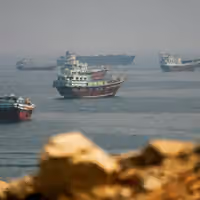
Authorities and state-affiliated media reacted forcefully to reports in US media that President Donald Trump is considering a broad military campaign against Iran as early as this weekend amid escalating tensions over the Strait of Hormuz.
The Wall Street Journal and CNN reported that the White House has reviewed plans for large-scale strikes against Iran’s energy infrastructure, although Trump has not given final authorization and diplomacy remains an option.
US embassies across the Middle East, including in the UAE, Jordan, Iraq and Israel, urged Americans on Saturday to consider leaving the region or be prepared to depart if tensions escalate, warning of possible Iranian attacks, flight disruptions and airspace closures.
Israel also raised its defense alert level as an Israeli official told Channel 12 that Trump was closer than ever to approving a significant strike on Iran.
Tehran warns of devastating retaliation
Statements by Iranian officials and reports from outlets affiliated with the Revolutionary Guards indicate that Tehran is preparing for the possibility of a broad US military campaign.
Iran’s Foreign Ministry warned regional countries Saturday against allowing the United States and Israel to use their territory or facilities for attacks on Iran, saying Tehran would target the locations from which any such attacks were launched.
“The defensive strikes of our courageous armed forces continue at full force,” the ministry said, citing the naval blockade of Iranian ports and commercial shipping, attacks across the country, intensified economic pressure and unlawful threats.
Major General Ali Abdollahi, commander of Iran’s Khatam al-Anbiya Central Headquarters, also warned regional governments against supporting Washington.
“Any country that makes itself a defensive shield for criminal, aggressor America will burn in the fire of war,” he said.
Tasnim News Agency, citing what it described as a senior security official, said Iran had prepared “an extensive response” targeting “the Israeli regime’s vital infrastructure and America’s energy infrastructure in the region.”
Nour News, an outlet close to Iran’s Supreme National Security Council, described threats against Iranian infrastructure as “blackmail against global energy security” and warned that Saudi Arabia, Qatar, the United Arab Emirates and Israel could become targets if Iran’s energy facilities are attacked.
“The first missile will mark the beginning of a crisis that no one will be able to contain,” the outlet wrote.
Outreach to mediators
Iranian Foreign Minister Abbas Araghchi spoke Saturday with Pakistan’s army chief, Field Marshal Asim Munir, and the foreign ministers of Turkey and Saudi Arabia about regional developments and the risk of further escalation.
Araghchi warned that any new US or Israeli attack, or support from regional countries, would face a “decisive and proportionate response,” saying Iran was prepared to defend its sovereignty, territorial integrity and security. He added that those responsible would bear the consequences.
The warnings came as figures close to Iran’s political establishment portrayed the crisis as rooted in disputes that go well beyond the immediate military standoff. Ali Gholhaki, an activist close to Parliament Speaker Mohammad-Bagher Ghalibaf, said the conflict extends beyond maritime access or Iran’s frozen assets.
The United States is demanding a long-term—or even permanent—suspension of uranium enrichment and the transfer abroad of roughly 400 kilograms of enriched uranium, conditions Tehran refuses to accept, he wrote.
Gholhaki argued that even a large-scale conventional bombing campaign against Iran’s remaining nuclear facilities or attacks on the country’s energy infrastructure would be unlikely to alter Tehran’s strategic calculations.
“Conflict is inevitable. Escalation can only be avoided if one side makes a clear retreat,” he wrote.
Long fuel queues reflect public concern
The prospect of military escalation has also affected public sentiment.
Witnesses in Tehran reported unusually long queues at petrol stations amid rumors of a major US attack, while videos shared on social media showed motorists rushing to fill their tanks in anticipation of possible disruptions.
Social media users attributed the congestion largely to growing anxiety over the prospect of war.
Online debate exposes divisions
Iranian social media reflected both calls for retaliation and concern about the consequences of a regional war.
Ebrahim Rezaei, a hardline member of parliament’s National Security and Foreign Policy Committee, rejected suggestions that Iran could be subdued through a surprise attack.
“If Iran is struck, we will return the entire region and its facilities to the Stone Age,” he wrote, adding: “It is in your interest not to commit such stupidity.”
His remarks drew criticism from reformist journalist Mohammad Aghazadeh, who responded: “Even if that happens, what about the Iranian people? What about their own return to the Stone Age and their suffering?”
Another user questioned the logic of threatening neighboring Arab states, asking how mutual destruction would ultimately harm the United States or Israel.
Reformists urge diplomacy ‘before it is too late’
Several reformist commentators urged both sides to pursue negotiations before the conflict reaches an irreversible stage.
Journalist Mohammad Sohofi cautioned against both complacency and panic, writing that people should fear “the surrender of rational judgment to illusions” more than reports of US military plans.
Veteran journalist Ahmad Zeidabadi argued that the current moment may represent the last opportunity for diplomacy.
“If the dispute is to be resolved through negotiation and agreement, now is the time,” he wrote.
He warned that if Iran’s energy infrastructure is attacked and Tehran retaliates against regional energy facilities, “nothing will ever be the same again,” adding that people would experience “the kind of life previously depicted only in horror films.”