IRGC says it struck two tankers attempting to transit Strait of Hormuz
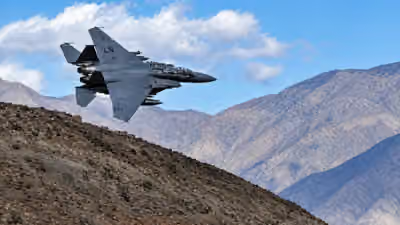
Iran's Islamic Revolutionary Guard Corps (IRGC) said on Friday it struck and halted two oil tankers that it said had attempted to pass through the Strait of Hormuz via an "unauthorized route" under US military air escort.
In a statement, the IRGC said four other tankers turned back after the incident.
The IRGC accused the tankers of ignoring Iranian warnings and said the vessels had attempted to transit the waterway after being "misled" by the US military's Central Command (CENTCOM).
A poster released by the US State Department's Reward for Justice program, July 30, 2026
The United States has offered a reward of up to $15 million for information that disrupts the financial mechanisms of Iran's Revolutionary Guards (IRGC), focusing on a company Washington says plays a key role in producing drones used by Tehran and its regional allies.
The State Department's Rewards for Justice program announced Thursday that it was seeking information on Kimia Part Sivan Company (KIPAS), which it described as the drone-production arm of the IRGC's overseas Qods Force.
According to the statement, KIPAS has conducted unmanned aerial vehicle (UAV) flight tests for the IRGC-Qods Force, provided technical assistance for drones transferred to Iraq for use in IRGC operations, and procured critical UAV components from companies outside Iran.
Washington also named six senior KIPAS officials—Hasan Arambunezhad, Abolfazl Ramazanzadeh Moshkani, Mehdi Ghaffari Naghneh, Reza Nahar Dani, Abbas Sartaji and Hadi Jamshidi Zavaraki—saying they had been involved in the testing, development and supply of drones, particularly for Iranian-aligned armed groups in Iraq, Yemen and Syria.
The officials were sanctioned by the U.S. Treasury Department in April 2024 for acting on behalf of the IRGC-Qods Force, while KIPAS itself was designated in 2021 under U.S. counterterrorism authorities for providing material support to the organization.
The announcement marks the latest step in Washington's expanding "maximum pressure" campaign against Tehran, which has intensified in recent weeks as the United States and Iran remain locked in a confrontation over the Strait of Hormuz.
The Trump administration has increasingly paired military pressure with financial measures aimed at disrupting the IRGC's access to revenue and procurement networks.
On Thursday, the United States sanctioned international networks accused of supporting Iran's Mahan Air, saying the airline facilitated logistics and procurement for the IRGC.
A day earlier, Treasury imposed sanctions on companies and tankers it accused of helping Iran profit from commercial shipping through the Strait of Hormuz by forcing vessels to purchase IRGC-linked maritime insurance.
The Rewards for Justice statement said proceeds from Iran's sales of military equipment, including drones exported to Russia and supplied to regional armed groups, help finance the IRGC-Qods Force's activities abroad.
Washington accuses the force of supporting groups including Hamas, Hezbollah and Iran-backed militias in Iraq, allegations Tehran rejects.
Under the reward program, the United States is seeking information that would disrupt the IRGC's financial networks rather than information leading directly to arrests.
The reward of up to $15 million is among the largest routinely offered under the program for intelligence related to Iranian security organizations.
An image of a home-made steak that an Iranian user posted on X
A social media exchange about steak struck a chord among Iranian users this week, turning one young user's dream into a broader conversation about economic hardship and political frustration.
Replying to a couple who shared photos of a home-cooked steak after losing weight together, the 20-year-old user wrote: "Please don't laugh at me, but one of my dreams is to eat steak once in my life."
The exchange quickly spread across Persian-language social media, drawing more than 750,000 views and over 11,000 likes.
When the couple later revealed their meal had cost around 1.5 million tomans, the user replied: "Sister, I live for three weeks on 1.5 million... what are you talking about?"
Others responded with a mixture of empathy and anger.
"We're not laughing," one user wrote. "We're cursing the ones responsible for making steak one of our dreams."
Another observed that with meat costing around two million tomans per kilogram, "it's clear most of society has never eaten steak."
The exchange reflected a broader reality: for many Iranians, red meat has shifted from an ordinary part of the diet to an occasional luxury—or, for some, an aspiration.
In June 2025, Masoud Rasouli, secretary of the Meat Production and Packaging Association, said annual meat consumption had fallen had fallen to as little as seven kilograms per person from a previous average of 18 kilograms.
While some people still managed to consume around 20 kilograms a year, he said, others no longer ate red meat at all.
The decline has continued amid persistent inflation, repeated currency depreciation, the removal of preferential exchange rates for many essential imports, and the economic effects of conflict and sanctions.
Although the minimum wage rose by around 60 percent in March 2026, analysts say it has failed to keep pace with the cost of a basic nutritional basket, while many households already spend between 50 and 70 percent of their income on housing.
One reply captured the gradual narrowing of everyday diets:
"The most luxurious thing I've eaten in about seven months was an Italian pizza. Honestly, these days I can't even afford grilled chicken."
The shift is visible across many households. Families that once regularly bought red meat have increasingly turned to chicken, then eggs, and in some cases to cheaper staples as rising prices steadily narrowed their choices.
The viral exchange did not reveal an unknown hardship. It simply gave it a sentence, offering many users another way to express both economic despair and political frustration.
One comment perhaps best captured the connection many Iranians drew between everyday hardship and the country's political order:
"Iran will be free soon, and then I'll treat you to a proper steak, God willing."
Smoke rises from a warehouse of Russian online retailer Wildberries that the Regional Governor Oleg Melnichenko says is following a Ukranian drone attack, in Priovrazhnoe, Penza Region, Russia, July 30, 2026 in this screengrab taken from a social media video.
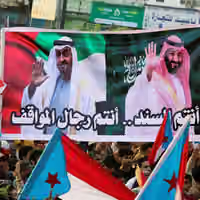
Signs of reluctance to widen the conflict are emerging in Tehran, with conservative politicians and media urging restraint even as they accuse the United States and Israel of orchestrating Ukraine's attack on an Iranian vessel.
The New York Times reported Wednesday that Iran had considered retaliating by striking a Ukrainian port before diplomatic efforts helped defuse the crisis, reinforcing the impression that, despite its rhetoric, Tehran is seeking to avoid opening another front.
Establishment figures have largely portrayed the attack as part of a broader US and Israeli effort to widen the conflict, warning Tehran against responding in a way that would play into that strategy.
Mohsen Sani, a member of parliament's National Security and Foreign Policy Committee, argued that the attack on the Iranian vessel and recent strikes against Iraq's Popular Mobilization Forces should be viewed within the same strategic framework.
"The United States is trying to pursue its objectives through proxy actors such as Ukraine and Saudi Arabia," he told the conservative news website Tabnak.
‘International dimension’
Former Iranian ambassador to Kuwait Mohammad Irani likewise accused Israel of encouraging Kyiv to open a new front against Tehran.
"The coming together of Netanyahu and Zelensky, in my view, represents the formation of a new front of confrontation or preparations for a new regional order," he told ILNA.
Irani nevertheless argued that Tehran should avoid creating conditions that would draw additional countries into the conflict.
"Because of pressure from Trump, Israel's hands are temporarily tied. They therefore want to bring another party into the confrontation so that the conflict expands beyond the region and acquires an international dimension," he said.
"If an immediate response is considered, every possible consequence and every option that could be used against us must also be taken into account so that the opposing side does not achieve greater cohesion."
A Western trap
Nour News, a media outlet closely aligned with Iran's Supreme National Security Council, argued that Ukraine's actions formed part of a coordinated US strategy stretching "from Yemen to the Caspian Sea," designed to increase pressure on Iran while allowing Israel time to recover militarily and politically.
In a separate editorial, the outlet argued Kyiv's subsequent diplomatic outreach—including Foreign Minister Andrii Sybiha's assurances to Abbas Araghchi that Ukraine sought no escalation—reflected concern over Iran's deterrence capabilities rather than a genuine attempt at reconciliation.
The conservative daily Resalat likewise argued Washington was attempting to use Ukraine as another proxy against Iran while warning that escalation in the Caspian Sea could ultimately draw Russia more directly into the conflict.
The moderate conservative newspaper Jomhouri-ye Eslami similarly urged Tehran not to fall into what it described as a Western trap, arguing that reducing tensions with Kyiv would better serve Iran's interests than opening another front.
Little appetite for escalation
Javid Ghorbanoghli, Iran's former ambassador to South Africa, said another Ukrainian attack was unlikely, arguing that Tehran had already signalled it would respond to any repeat incident.
"It is highly unlikely that Tehran seeks to expand the war," he said. "Iran prefers not to allow its already tense relations with European countries to deteriorate even further."
He added that Iran's political establishment was trying to avoid opening new fronts that could generate additional political and economic pressure.
Russia analyst Rouhollah Modabber argued the attack was intended to disrupt the International North-South Transport Corridor and undermine Iran's economic cooperation in the Caspian region.
He also claimed President Volodymyr Zelensky publicly accepted responsibility in an effort to secure additional US military and financial support.
The headquarters of Iran's state broadcaster, IRIB in northern Tehran, undated file photo
Iran's state broadcaster has ignored a formal order from its own watchdog to stop censoring senior officials, highlighting the gap between the country's formal institutions and where authority is exercised in practice.
The Islamic Republic of Iran Broadcasting (IRIB) has refused to comply with a ruling by the IRIB Supervisory Board ordering it to stop censoring President Massoud Pezeshkian, Foreign Minister Abbas Araghchi, Parliament Speaker and chief nuclear negotiator Mohammad Bagher Ghalibaf.
The dispute has drawn criticism from government officials and reformist and moderate newspapers while prompting little public sympathy.
Instead, many Iranians mocked the complaints, saying state television had long ignored ordinary people and was now simply extending the same treatment to members of the political establishment.
Before the Supervisory Board issued its ruling, government spokeswoman Fatemeh Mohajerani said the public expected the national broadcaster to uphold professional ethics, democratic principles and the national interest.
"All tastes and viewpoints must be reflected in the national broadcaster's narrative," she said.
Little public sympathy
On social media, many users joked that it was refreshing to see senior officials finally experiencing the neglect ordinary citizens had long endured from state television.
A Tehran-based journalist summed up the mood more bluntly, saying most people did not care whether politicians appeared on television; they wanted to see themselves and their own problems reflected instead.
For years, many Iranians have complained that IRIB neither reflects their lives nor represents their concerns.
Critics say television dramas rarely portray people like themselves, while supposedly spontaneous interviews on political and social issues feature only carefully selected voices. Others note that cooking programmes routinely feature meals beyond the reach of many families.
Meanwhile, IRIB responded to Araghchi's complaint with a sarcastic remark, saying it was "impossible to give him 24/7 coverage."
A watchdog without teeth
Earlier this week, the IRIB Supervisory Board formally warned the broadcaster over its repeated censorship of senior officials.
Board secretary Mohammad Mirzaei said "necessary cautions were issued" and that IRIB had pledged to implement reforms and prevent similar incidents from recurring. Deputy political director Hassan Abedini also publicly promised fairer coverage of officials' remarks and activities.
Yet the broadcaster showed no sign of changing course, declining even to report the Supervisory Board's meeting—a story carried by nearly every major Iranian news agency.
Established under Article 175 of Iran's Constitution, the Supervisory Board brings together representatives of the executive, parliament and judiciary to oversee IRIB's editorial conduct.
It can issue warnings, but ultimate authority over the broadcaster, including appointing its chief, rests with the Supreme Leader.
Current IRIB chief Payman Jebelli and his management team have long faced criticism over partisan editorial policies, discrimination and censorship directed at both ordinary citizens and politicians outside the ultraconservative camp.
Leadership under scrutiny
Jebelli's five-year term expires in less than a month, raising questions over whether Supreme Leader Mojtaba Khamenei will retain the current management or appoint a new leadership team.
The latest dispute comes amid an unusually coordinated campaign by media close to the Pezeshkian administration.
Last week, the reformist dailies Etemad and Shargh, together with the government's own newspaper Iran, accused IRIB of systematically censoring senior officials and promoting voices at odds with government policy.
Iran newspaper also alleged that the broadcaster censored remarks by Judiciary Chief Gholamhossein Mohseni Ejei praising Pezeshkian.
The episode has exposed more than a dispute over television coverage. It has highlighted the growing gap between Iran's formal institutions and the centres of authority that increasingly operate beyond their reach.
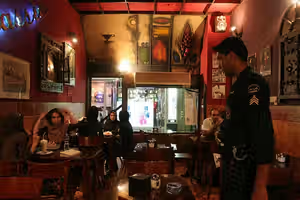
Demolished sidewalk planters outside cafes on Sanaei Street in Tehran.
In the quiet hours of Wednesday morning, municipal crews swept through Sanaei Street in central Tehran with sledgehammers, reducing sidewalk planters, benches, and concrete borders outside local cafes to rubble.
Just days earlier, authorities had affixed heavy metal seals to the doors of several cafes that had become popular gathering places for young people - 1401, Theory, Jo Cafe, Dobareh, Sam Cafe, Maan, and Nook. Now, even the physical footprint of these gathering spots was being erased.
The scene along Sanaei is not an isolated urban redevelopment project; it is the visible edge of an expanding domestic front. As the Islamic Republic navigates profound geopolitical vulnerability, military standoff, and international isolation, its security apparatus has turned inward with renewed vigor. The target is the physical fabric of daily life—the informal, everyday spaces where citizens meet, breathe, and quietly subvert official ideology.
The erasure of the 'Patogh'
In Iranian urban culture, the patogh - a hangout spot, whether a neighborhood coffee shop, a shaded bench, or a specific street corner- holds a special resonance. Central Tehran, with its historical universities, cultural venues, and tree-lined avenues, has long served as a sanctuary for students and young professionals seeking conversation away from state surveillance.
Cafes in this district do not merely sell coffee; they operate as vital breathing rooms in a pressure-cooker society. They are spaces where women routinely drop their headscarves, where independent acoustic music plays quietly, and where social networks form organically.
To the security state, these hubs represent something far more dangerous than simple rule-breaking: they are unmonitored incubator spaces for civil defiance.
By dismantling the planters and outdoor ledges where young people once congregated, the state is conducting a campaign of physical depatterning. The objective is simple: raise the friction of gathering, eliminate opportunities for unscripted human interaction, and force citizens back into the isolation of private homes.
The systematic clearing of social life is not confined to central Tehran's bohemian quarters. In the northern district of Tajrish—a bustling commercial hub anchored by its traditional bazaar, the Imamzadeh Saleh shrine, and the thoroughfares leading toward the Saadabad Palace—a parallel push is underway.
Here, the crackdown targets street musicians, artisans, and informal vendors whose presence gives the district its distinctive kinetic energy.
"Plainclothes men carrying two-way radios came up to me last week while I was playing," a young handpan musician who performed near Tajrish Square told Iran International. "They told me bluntly: 'The time for these antics is over. There will be none of this in the streets anymore.'"
For many, performing or vending in Tajrish was not a lifestyle choice, but a last resort. Following the internet blackouts imposed during recent nationwide unrest, thousands of small online businesses, home-craft pages, and digital storefronts collapsed overnight. Young artisans, women-headed households, and unemployed graduates migrated to the pavements of Tajrish to sell handmade goods or play music for passing crowds.
Now, even that economic and social retreat is being shut down. Vendors near the shrine report periodic sweeps by security personnel and vigilantes ordering them to pack up their "sinful stalls" under threat of physical violence.
What makes this campaign so striking to Tehran residents is its stark selectivity.
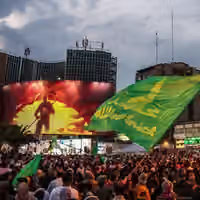
While young people face sledgehammers and security sweeps for sitting on a sidewalk ledger or strumming a guitar, state-aligned groups enjoy unrestricted access to the city’s major arteries. For months, heavily subsidized groups have set up nightly ideological gatherings, loud ceremonial processions, and roadside stands with full logistical backing from the state.
This spatial double standard reveals the regime's broader urban philosophy: public space in Iran is not a shared civic commodity, but a state monopoly. The streets are permitted to be loud, crowded, and disruptive—provided that noise serves the government's narrative. The moment a street corner becomes a site for quiet civilian autonomy, it is treated as a security threat.
The historical pattern: Internal repression as external defense
This tightening grip on everyday life follows a familiar pattern in post-revolutionary Iran. Historically, whenever the Islamic Republic faces severe external threats or internal crises, its immediate response is to signal total domestic control.
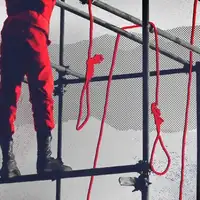
The destruction of cafe seating and the silencing of street performers occur alongside a sharp escalation in judicial violence, including a surge in executions and political detentions. The message directed at society is unified across every medium: the state retains absolute authority over who walks the street, who speaks, and who lives.
Yet, despite the shattered concrete on Sanaei Street and the quieted plazas of Tajrish, Tehran's urban ecosystem remains stubbornly resilient. The urge to assemble, connect, and reclaim small fragments of normal life has repeatedly outlasted physical destruction—proving that while a government can tear up a sidewalk, controlling the social life that flows over it is a far more difficult task.