• العربية
  • فارسی
Brand
  • Iran Insight
  • Politics
  • Economy
  • Analysis
  • Special Report
  • Opinion
  • Podcast
  • Live TV
  • Iran Insight
  • Politics
  • Economy
  • Analysis
  • Special Report
  • Opinion
  • Podcast
  • Live TV
  • Theme
  • Language
    • العربية
    • فارسی
  • Iran Insight
  • Politics
  • Economy
  • Analysis
  • Special Report
  • Opinion
  • Podcast
  • Live TV
All rights reserved for Volant Media UK Limited
volant media logo

IRGC says it destroyed US radar, air defenses in Bahrain

Jul 21, 2026, 03:06 GMT+1

The IRGC said Monday it destroyed a US air defense system and radar in Muharraq and targeted a US Patriot air defense system in Riffa in a coordinated missile and drone attack, Fars News reported.

Most Viewed

Iran's central bank says it is not hyperinflation. Economists are not convinced
1
INSIGHT

Iran's central bank says it is not hyperinflation. Economists are not convinced

2

Iran state TV airs threat against Trump’s son Barron

3
VOICES FROM IRAN

Iranians voice economic despair as dollar hits 2 million rials

4

IRGC chief backs state broadcaster amid clashes with Pezeshkian, Ghalibaf

5

Iran security chief hints at nuclear doctrine shift after US attacks

Banner
Banner
Banner

Spotlight

  • Will Iran bend or escalate as US launches economic war?
    PODCAST

    Will Iran bend or escalate as US launches economic war?

  • Iran leader’s absence gives war camp room to shape policy
    ANALYSIS

    Iran leader’s absence gives war camp room to shape policy

  • Iran's central bank says it is not hyperinflation. Economists are not convinced
    INSIGHT

    Iran's central bank says it is not hyperinflation. Economists are not convinced

  • Ghalibaf's hunger warning sparks hardline backlash over showing weakness
    INSIGHT

    Ghalibaf's hunger warning sparks hardline backlash over showing weakness

  • Iran crude loadings plunge to one-seventh of pre-war level as blockade bites
    ANALYSIS

    Iran crude loadings plunge to one-seventh of pre-war level as blockade bites

•
•
•

More Stories

Beyond espionage: Araghchi says spies seek to shape Iran's decisions

Jul 21, 2026, 02:24 GMT+1
•
Negar Mojtahedi
100%
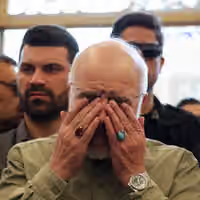
Senior Iranian officials pay their respects before the coffin of Supreme Leader Ali Khamenei during funeral ceremonies in Tehran. Foreign Minister Abbas Araghchi is seen at far left, July 2, 2026

Foreign intelligence penetration of Iran is hardly a secret. But Iranian Foreign Minister Abbas Araghchi has now suggested the operation goes beyond locating officials or stealing information and seeks to influence decision-making inside the Islamic Republic itself.

The remark marked a subtle but significant shift. Iranian officials have long acknowledged espionage and intelligence breaches, particularly after the precision with which senior commanders, nuclear scientists and political leaders have been located and targeted exposed profound vulnerabilities within Iran's security establishment.

Speaking in the first part of a nearly 90-minute podcast interview, Araghchi suggested foreign intelligence activity inside Iran may be something more ambitious than gathering intelligence: shaping the decisions of the state itself.

He made the remarks when asked by establishment podcaster Javad Mogoei about the opening hours of the war, when coordinated strikes killed Iran's supreme leader along with several senior military, security and political figures.

"I believe this security breach is not limited merely to infiltration and obtaining information," Araghchi said.

"Sometimes it also exists in influencing the decision-making process itself. And even more importantly, it extends to shaping our psychological environment and public perception."

Araghchi did not identify any foreign intelligence service or explain how such influence might operate, although Israel appeared to be the implied actor in the discussion.

To Alex Vatanka, a senior fellow at the Middle East Institute, that distinction was the most revealing part of the interview.

"The job of these assets isn't just to leak the location of leaders in a certain place to be killed," Vatanka told Iran International. "It is to influence decision-making. It's to influence the policy process."

Vatanka believes Araghchi's remarks were directed as much at Iran's internal political debate as at foreign intelligence operations.

"He's hinting that elements inside the regime are openly arguing for policies that the enemy—the United States and Israel—prefer," he said. "Is he talking about the pro-war hawks? Is this part of scoring points against one another? Could well be."

"These things are obviously not accidental," he added. "This is very much messaging at a moment of war."

Mogoei nevertheless raised another possibility, invoking Masoud Kashmiri, the alleged infiltrator who rose through the ranks of the Islamic Republic before the 1981 bombing that killed President Mohammad Ali Rajai and Prime Minister Mohammad-Javad Bahonar.

"Perhaps we have another Kashmiri," he suggested.

Araghchi did not endorse the comparison, saying Iran's adversaries had become familiar with the supreme leader's routine and that the Intelligence Ministry meeting may simply have coincided by chance.

Whether Araghchi was describing a sophisticated foreign influence operation or speaking more broadly about the effect of outside pressure on Iran's internal politics is where analysts begin to diverge.

Omid Memarian, an Iran analyst at DAWN, said one possible manifestation of the kind of influence Araghchi described would be officials advocating policies that prolong the war despite the damage continued conflict causes to the Islamic Republic's own interests.

"Some of the decisions they are making are exactly the things that Israelis might wish for," Memarian told Iran International.

"When it comes to Iran's national security and national interests, they don't make sense,” he added. "We see the smoke. We don't see the fire."

Behnam Ben Taleblu, senior director of the Iran Program at the Foundation for Defense of Democracies, said Araghchi's comments should also be viewed through the lens of Iran's internal political rivalries.

"That doesn't mean these guys are doves by any measure," Taleblu told Iran International. "But it does mean that they have different views about how best to preserve, protect and defend the Islamic Republic."

Taleblu said public acknowledgments of security failures are often aimed less at the Iranian public than at rival political factions or security institutions, with officials defending their own approach while criticizing competing strategies.

He said Araghchi's comments also highlighted a less discussed aspect of intelligence operations: their ability to shape leaders' perceptions rather than merely gather information.

"Influence is to shape their decision-making, perhaps by lulling the Supreme Leader's office into a false sense of security and back into the routines that existed before," he said.

Qatar, Pakistan push Iran-US diplomacy as war escalates

Jul 20, 2026, 23:38 GMT+1
•
Maryam Sinaiee
100%
Iran's interior minister Eskandar Momeni meets Pakistani counterpart Mohsin Naqvi in Islamabad, Pakistan, July 20, 2026

Qatar and Pakistan have launched a joint effort to revive Iran-US diplomacy as military exchanges entered their ninth day, while Tehran confirmed receiving new mediation proposals even as hardliners continued to oppose negotiations.

Pakistan and Qatar urged Tehran and Washington on Monday to halt hostilities and resume implementation of a previously signed memorandum of understanding.

Iranian Interior Minister Eskandar Momeni traveled to Islamabad on Monday carrying a message from President Masoud Pezeshkian as part of the mediation effort. Regional media reported he was also expected to meet Pakistan's army chief, Field Marshal Asim Munir.

According to Israel's Channel 14, Qatar proposed that the United States suspend further military strikes while Iran reopens both the northern and southern shipping lanes through the Strait of Hormuz for a 10-day period. The proposal has not been independently verified.

Tehran confirms new proposals

Foreign Ministry spokesman Esmail Baghaei confirmed during his weekly press briefing that Iran had received new proposals from mediators aimed at ending the confrontation, although he did not disclose their contents.

His remarks marked Tehran's first public acknowledgment that fresh diplomatic initiatives were under consideration following the latest escalation.

President Masoud Pezeshkian also defended both the memorandum of understanding and the prospect of diplomacy during remarks to the Supreme Judicial Council, rejecting accusations that Iran had compromised its national interests.

"Not only was no concession made against the country's interests, but Iran achieved major gains, and there is not a single provision that creates a one-sided benefit for the United States," he said.

"If economic pressure leads to growing social discontent, the tremendous social capital that people have created in support of the system could be damaged."

Political analyst Hossein Ghatib argued that diplomacy should remain an option despite the fighting, but warned against any temporary ceasefire that merely postponed another round of conflict.

"The next agreement should not be based on concessions before guarantees," he wrote on X. "Instead, it should rest on the principles of guarantees before concessions, verification before trust, and concrete action before the next step."

Fighting continues

The diplomatic activity unfolded against a widening military campaign across Iran and the Gulf.

Iran launched additional missile and drone attacks targeting Kuwait and Bahrain, while a Greek shipping company said two tankers under its management had been struck by unidentified projectiles while transiting Omani coastal waters.

Iranian media also reported attacks in East Azerbaijan, West Azerbaijan and Bushehr provinces, followed later in the day by a strike on the Shiraz Electronics Industries complex.

Iranian Army spokesman Mohammad Akraminia said "reason dictates that the war continue until it creates complete deterrence for Iran."

He also warned that "any country cooperating with the Americans will certainly face problems for its ships passing through the Strait of Hormuz."

Parliament Presidium member Rouhollah Motefakker-Azad similarly warned that if the conflict continued, "the Islamic Republic will respond even more aggressively, and then the Americans should think more seriously and more quickly about leaving the region."

‘Pointless domestic divide’

Iranian hardliners nevertheless continued to oppose any return to negotiations.

Conservative political analyst Majid Shakeri argued that Washington should first publicly recommit to the memorandum of understanding and fulfill its obligations under the agreement before any new talks could begin.

Commenters on the conservative Tabnak website likewise dismissed renewed diplomacy, with one describing the situation as a "vicious cycle of war, negotiations, war, negotiations."

The IRGC-affiliated Javan newspaper, however, argued that Iran should remain prepared for either outcome.

"Going to the negotiating table to consolidate the gains achieved in the war and secure lasting security, or continuing to fight for the same objective, should not create a pointless domestic divide."

On the US side, President Donald Trump reposted a Truth Social poll showing majority support among respondents for a peace agreement with Iran while insisting Washington had responded forcefully to the killing of American personnel.

Secretary of State Marco Rubio also reiterated that the United States remained committed to a diplomatic solution despite the ongoing fighting.

"They continue sending signals that they want talks and negotiations," Rubio said. "But we respond to their actions, and their actions are firing missiles and drones at ships."

Family of executed protester says he was tortured into false confession

Jul 20, 2026, 21:50 GMT+1
•
Farnoosh Faraji
100%
Mohammad Amini Dehaghan was executed two weeks before his 38th birthday.

The family of 37-year-old executed protester Mohammad Amini Dehaghani has told Iran International that he was tortured into making a false confession, denied effective legal representation and deprived of the chance to appeal his death sentence.

Amini, a father of two, was detained during nationwide protests in January 2026.

His relatives and other sources who spoke to Iran International could not be named for fear of retribution by Iranian authorities.

Iran’s judiciary-affiliated Mizan news agency announced on July 15 that Amini had been executed after being convicted of moharebeh, or “waging war against God,” and corruption on Earth over allegations that he set fire to the governor’s office and damaged public property in Dehaghan county, Isfahan province.

His family said authorities had earlier accused him of involvement in a separate arson attack on a Bank Mellat branch in Dehaghan. They rejected the allegation, saying he was at home when the fire occurred and played no role in it.

Amini, who was from Dehaghan, was the father of 13-year-old Raha and one-year-old Mahva. His relatives described him as quiet and someone who kept out of trouble, adding that his wife and two daughters were the focus of his life.

He was executed two weeks before his 38th birthday.

Arrested after IRGC summons, denied legal representation

Amini received a telephone call on the evening of January 19 asking him to report to the Islamic Revolutionary Guard Corps to provide an explanation, his relatives said.

“We have a video of you,” officers told him, sources told Iran International.

Amini was arrested after reporting to the IRGC and never returned home.

His family hired a private lawyer, but the lawyer was not allowed to meet Amini or given full access to the case file, his relatives said.

After the death sentence was issued, the family’s lawyer said he had appealed. But when relatives contacted the Supreme Court, they found that no appeal had been registered, the family said.

When the lawyer sought an explanation, the Dehaghan prosecutor told him: “There was no need for you to be informed about this.”

The family said it believed judicial authorities deliberately concealed the death sentence to deprive them of the opportunity to appeal or pursue other legal avenues.

Tortured into false confession

Amini was severely beaten during interrogations and tortured with an electric stun device to force him to make a false confession incriminating himself, his relatives said.

The family also said that he was given insufficient food and held in unhygienic and poor prison conditions.

During the first weeks of his detention, Amini was in poor physical and psychological condition and struggled to understand what was happening around him, his relatives said.

Several days before his execution, he was transferred to solitary confinement.

‘Tell everyone I am innocent’

During their final prison visit, his relatives said they saw him in a critical condition.

He was unable to walk, and officers had to hold him under his arms to bring him into the visiting room. His body was trembling, and he appeared to have almost no strength left.

“Tell everyone I am innocent,” Amini told his family during the visit.

After the execution, Iranian authorities refused to allow his body to be buried in his hometown of Dehaghan, his family said.

He was instead buried under government supervision at Isfahan’s Behesht-e Rezvan cemetery, with only a small number of close relatives permitted to attend the funeral.

Amini remained hopeful until the final days of his life that he would be released, sources told Iran International.

He had received a certificate recognizing his good conduct and called his wife from prison every day.

Amini asked her to record videos of their younger daughter, Mahva, so that after his release he could watch the moments of her childhood that he had missed.

Pahlavi backs US-led war as ‘necessary’ to prevent further bloodshed in Iran

Jul 20, 2026, 18:50 GMT+1
100%
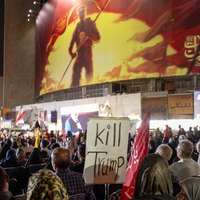
Iranian protesters display banners reading "don't stop speaking about Iran" and of former Crown Prince of Iran, Reza Pahlavi outside the venue of Iran-Egypt World Cup match in Seattle.

Iran’s exiled prince Reza Pahlavi said in an interview with Reuters that the US-led war against the Islamic Republic was a “necessary step” to prevent further bloodshed and give Iranians a better chance of ending clerical rule.

In the interview recorded in Paris on July 14, Pahlavi linked the military campaign to the January 8 and 9 protests, when demonstrators answered his call for nationwide action and were met with a brutal crackdown.

He said the scale of the violence showed that Iranians could not be expected to return safely to the streets while the forces responsible remained capable of crushing another uprising.

“We cannot expect people to be able to safely return to the streets to take on the final battle” without protection or the means to neutralize forces hostile to them, he said.

Pahlavi argued that US and Israeli strikes had weakened the Islamic Republic’s repressive apparatus and helped “equalize” the balance between the government and protesters.

“The campaign that started as a result of the massacre — that led to the intervention by the Israelis and the American forces to strike the regime — was an element that was perhaps a necessary step to avoid further bloodshed,” he said.

The protests began in late December after a sharp fall in the rial deepened economic and political discontent. As demonstrations spread, Pahlavi called on Iranians to take part in nationwide action on January 8 and 9 by gathering in the streets or chanting from their homes.

Millions joined the protests across Iran before security forces opened fire on demonstrators and authorities imposed sweeping internet restrictions.

Documents, medical records, field reports and testimony reviewed by Iran International indicate that at least 36,500 people were killed on January 8 and 9, making the crackdown one of the deadliest episodes of state violence against protesters in modern history.

Pahlavi said the killings demonstrated the limits of peaceful protest against a government willing to use overwhelming force against its own population.

“On January 8 and 9, people went to the street still peacefully, just chanting the slogan,” he said. “When that happens, you cannot expect that by the same method of nonviolence, you can achieve the same result with the way this regime is behaving.”

The United States and Israel launched their military campaign against Iran on February 28, striking Revolutionary Guards facilities, missile and drone units, military command centers and other state targets.

Pahlavi said the attacks had weakened the institutions responsible for suppressing dissent and could help prevent another massacre.

“When you have the mechanism of repression of the regime weakened as a result of those strikes, those are added help,” he said. “Those are the kind of outside interventions that may be required.”

He said the intervention could ultimately save lives that would otherwise be lost in another confrontation between protesters and the security forces.

“It’s really a matter of trying to protect more lives from being lost under this regime that is demonstrating that it has no limit in terms of how far it’s willing to go to kill its own citizens,” he said.

Pahlavi nevertheless stressed that foreign governments should not decide who would govern Iran after the Islamic Republic.

“It is not for a foreign government to decide who or what should be the alternative for Iran,” he said. “That’s up to the Iranian people.”

He said his campaign, which began after the 1979 revolution that overthrew his father, had always centered on Iranians’ right to determine their own political future.

“I’ve never asked for any kind of endorsement from any leader or governments,” he said.

‘A bridge to destination’

Pahlavi has presented himself as the leader of a temporary transition rather than a candidate seeking to predetermine whether Iran should become a monarchy or a republic.

“My position as a transitional leader is, I’m not the destination, I’m a bridge to the destination,” he said.

He said his role would be to act as a neutral arbiter and oversee a political process in which Iranians could debate and choose the country’s future system.

“I’m not taking sides, either for a monarchy or for a republic,” he said. “My job is to make sure that there’s a healthy debate and that in the end people decide what it is that they actually would prefer to have as the final form.”

Pahlavi said his coalition included former leftists, republicans and people once affiliated with groups that opposed his father’s government.

He said former members of the three major leftist groups Tudeh Party, the Fadaiyan-e-Khalq and the Mojahedin-e-Khalq (MEK) had joined his movement, presenting that as evidence that the opposition had become more unified.

“I don’t know how far more can you stretch the tent, including those people, to prove that in fact there is much more unity than ever, certainly inside Iran,” he said.

He added, however, that there were three groups with which he would not cooperate: supporters of the Islamic Republic, the MEK as an organization and separatists.

“There are certain lines that I’m not going to cross,” he said.

Pahlavi also rejected violence, intimidation or criminal conduct by people claiming to support him.

“I believe in pluralism. I believe in tolerance. I believe in civility, in debate, in argument, in comportment, respect, and no hostility of any kind,” he said.

He said anyone who violated those principles would not be considered a supporter and should face legal consequences if their conduct was criminal.

Pahlavi also acknowledged concerns over statements made by people associated with his political team, saying stricter internal protocols were being introduced.

He said those close to him would have to exercise greater caution because their remarks could be interpreted as representing his movement.

‘A democratic culture’

Turning to Iran’s political future, Pahlavi said most Iranians wanted secular democracy, the rule of law and protection of human rights, but warned that building a democratic political culture would take time.

“What I think will take some time, and I mean that in the most honest way possible, is to bring about a democratic culture,” he said.

Pahlavi also clarified earlier statements about contacts with members of Iran’s security forces.

He said individual members of the Basij, the Revolutionary Guards and the regular military had contacted him discreetly over the years to express opposition to the Islamic Republic.

He denied, however, that he had been in direct communication with the IRGC’s senior command.

“It’s not like, in fact, talking to the IRGC command. Not at all,” he said.

Pahlavi said he had advocated for the IRGC to be designated as a terrorist organization for at least a decade because of its role in repression at home and military operations abroad.

He described the Guards as the central institution keeping the Islamic Republic in power and said increasing pressure on it remained a key part of his political strategy.

Pahlavi is the eldest son of Mohammad Reza Shah, Iran’s last monarch, who was overthrown in the 1979 revolution that brought the Islamic Republic to power. The royal family left Iran shortly before the revolution, and Pahlavi has lived in exile since then.


Iranian women being shut out of engineering fields, official warns

Jul 20, 2026, 16:50 GMT+1
100%
A man and woman attend the International Conference on Artificial Intelligence and Software Engineering in Shiraz, Iran, on November 24, 2024.

Women dominate Iran’s universities but remain sharply underrepresented in engineering and other technical fields, Iran’s vice president for women’s affairs said on Monday, calling for a review of admissions and the social barriers shaping their choices.

Zahra Behrouz-Azar said women account for more than 64% of applicants seeking university admission and more than 52% of the country’s university students.

However, she said the overall figures conceal a pronounced gender divide between academic disciplines.

Speaking at the unveiling of Iran’s annual statistical report on women, she said the gap is quite wide in technical and engineering subjects, where approximately 573,000 men graduated, compared with about 180,000 women, during the latest year covered by the report.

The imbalance reflects a wider international pattern. Women account for around 35% of graduates in science, technology, engineering and mathematics worldwide, a proportion that UNESCO says has remained largely unchanged for a decade.

Behrouz Azar said, however, that Iran’s gender gap appeared more pronounced and required closer research into the cultural, social and institutional forces shaping students’ choices.

“Which beliefs and cultural and social factors cause girls to gravitate less toward fields such as electrical engineering, computer science and some other technical disciplines?” she asked.

Behrouz-Azar said the disparity was particularly striking because Iranian women had established a strong presence in content production, the digital economy and freelance work, but were less likely to enter programming, coding and specialist areas of artificial intelligence.

She warned against the assumption that some disciplines were inherently “male” or that women did not need to enter them. Her office had raised the matter with the science minister and requested a detailed review of university admission procedures and other factors contributing to the disparity, she said.

The vice president did not allege that formal admissions rules explicitly excluded women from those subjects. She instead called on academics and researchers to examine the “hidden layers” behind the statistics, including whether social attitudes, education and career expectations discourage girls from pursuing technical fields.

Behrouz-Azar also linked women’s representation in technology to the development of artificial intelligence, saying researchers in AI ethics had argued that greater participation by women could contribute to systems that placed more emphasis on ethics and care.

Iran’s expansion of women’s access to university has not produced comparable participation in the labor market. World Bank data put the female labor-force participation rate at about 14% in 2025, while an International Labor Organization assessment reported a large and persistent divide between women and men in access to paid work.

That reflects not only personal choice but also decades of bureaucratic and social barriers limiting women's employment.

  • Why so few Iranians have jobs despite low unemployment

    Why so few Iranians have jobs despite low unemployment

That disconnect means many highly educated Iranian women remain outside formal employment even as they make up a majority of the university population. International labor bodies have previously pointed to restrictions on women’s access to formal employment despite major advances in education.