• العربية
  • فارسی
Brand
  • Iran Insight
  • Politics
  • Economy
  • Analysis
  • Special Report
  • Opinion
  • Podcast
  • Iran Insight
  • Politics
  • Economy
  • Analysis
  • Special Report
  • Opinion
  • Podcast
  • Theme
  • Language
    • العربية
    • فارسی
  • Iran Insight
  • Politics
  • Economy
  • Analysis
  • Special Report
  • Opinion
  • Podcast
All rights reserved for Volant Media UK Limited
volant media logo

IRGC claims strikes on US naval fuel pier in Kuwait, combat aircraft site in Bahrain

Jul 18, 2026, 06:23 GMT+1

Iran’s Revolutionary Guards said they launched missile and drone attacks on a US naval fuel-support pier at Kuwait’s Al-Ahmadi port and a combat aircraft site at Bahrain’s Sheikh Isa Air Base, the IRGC-affiliated Tasnim News Agency reported.

In its 28th wartime statement, the IRGC also said it struck a Batelco facility in Bahrain, which it described as an enemy intelligence data center, and destroyed a US signals and communications center in Kuwait.

The force said the attacks were part of the 19th wave of its Nasr-2 operation and were carried out in response to US strikes the previous night.

Most Viewed

Why US strikes are moving deeper into southern Iran
1
PODCAST

Why US strikes are moving deeper into southern Iran

2
INSIGHT

Iran hardliners blamed as cost of US strikes mounts

3

UK outlaws support for IRGC under new national security powers

4

Tehran demands media limit strike damage coverage as US widens war

5

Tehran billboard hints Trump is the 'next one' after Graham's death

Banner
Banner
Banner

Spotlight

  • Iran hardliners blamed as cost of US strikes mounts
    INSIGHT

    Iran hardliners blamed as cost of US strikes mounts

  • Vance, Ghalibaf back diplomacy as US, Iran strikes continue
    INSIGHT

    Vance, Ghalibaf back diplomacy as US, Iran strikes continue

  • Leaked presidency report shows how Iran plans to manage record public anger
    INSIGHT

    Leaked presidency report shows how Iran plans to manage record public anger

  • Wave of Iran plots drove UK action against IRGC, terror law tsar says
    EXCLUSIVE

    Wave of Iran plots drove UK action against IRGC, terror law tsar says

  • Two Iranians at the World Cup final – and neither represents the Islamic Republic

    Two Iranians at the World Cup final – and neither represents the Islamic Republic

•
•
•

More Stories

Iran claims strikes on US sites in Kuwait

Jul 18, 2026, 05:28 GMT+1

Iran’s Revolutionary Guards said they targeted US military installations in Kuwait, as the Kuwaiti army reported intercepting missiles and drones launched from Iran.

The IRGC warned that countries hosting American forces should expect “corresponding responses” if their territory is used for attacks on Iran, according to the Guards-affiliated Tasnim news agency.

Kuwait hosts several thousand US troops and serves as an important logistics hub for American military operations in the region.

There was no immediate confirmation from US Central Command of damage or casualties at American facilities in Kuwait.

Jordan air defenses intercept 10 Iranian missiles, no casualties or damages

Jul 18, 2026, 04:00 GMT+1

Jordan’s armed forces said on Friday that the interception of 10 Iranian missiles targeting the kingdom caused no injuries or material damage.

The military said engineering units begun work at sites where shrapnel fell to secure and handle the debris according to established technical and security procedures.

Why US strikes are moving deeper into southern Iran

Jul 18, 2026, 03:49 GMT+1
•
Negar Mojtahedi
100%
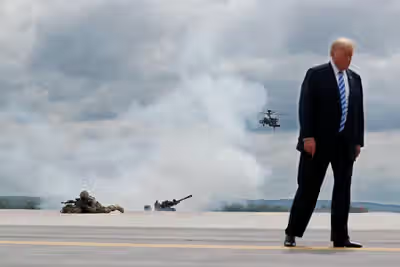
President Donald Trump observes a demonstration with U.S. Army 10th Mountain Division troops, an attack helicopter and artillery, as he visits Fort Drum, New York, in this 2018 file photo

The latest US strikes on southern Iran may offer the clearest indication yet of how Washington's campaign around the Strait of Hormuz is evolving from retaliation to the systematic degradation of Iran's military infrastructure.

American forces have been striking targets along Iran’s Persian Gulf coast for almost a week.

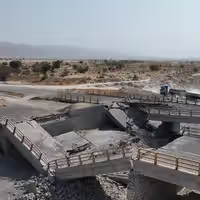
Iranian media reported that eight people were killed as bridges, communications infrastructure and a maritime surveillance tower were hit across Hormozgan and Sistan-Baluchistan provinces.

Rebeccah Heinrichs, a senior fellow at the Hudson Institute, says the concentration of attacks along Iran’s southern coastline—and increasingly farther inland—suggests the United States is moving beyond retaliation against individual strikes and targeting the infrastructure that allows Tehran to sustain and eventually rebuild the military capabilities underpinning its operations around the Strait of Hormuz.

“Up until very recently, the United States was primarily focused on doing retaliatory strikes exclusively along the coastline of Iran,” Heinrichs told Eye for Iran. . “

‘Protecting maritime traffic’

The attacks came after President Donald Trump warned that bridges and power infrastructure could become targets if Tehran refused to return to negotiations.

Iranian military officials, meanwhile, said the conflict would “spread to new areas” if US operations continued.

“I suspect that the United States has had these targets on their list,” she said. “President Trump has gone back to Admiral Cooper and said, ‘What else do we need to hit?’”

The likely focus, she added, was Iran’s ability to replenish the military capabilities it uses around the Strait of Hormuz.

Among the sites struck was a maritime surveillance tower in Chabahar. Iran described it as a facility monitoring commercial shipping, while US Central Command said it formed part of an IRGC network used to track vessels transiting the strait and coordinate attacks against them.

CENTCOM said destroying the tower would directly reduce the Revolutionary Guards’ ability to threaten maritime traffic.

The targeting of bridges in Hormozgan province also points to an expanding set of military objectives.

Heinrichs said Washington had sought to limit civilian harm, but argued that some dual-use infrastructure could become a legitimate military target if it substantially enabled IRGC operations.

“There are some targets that the United States could legitimately hit,” she said. “They may create some harm, of course, to the civilian population, but they also primarily enable and facilitate the IRGC to repress their people and to continue their war effort.”

A limited ground role?

The widening campaign has also fuelled speculation about whether Washington could eventually deploy ground forces inside Iran.

Heinrichs dismissed the prospect of a large-scale invasion, saying any deployment would more likely involve special operations forces tasked with securing or removing nuclear material rather than occupying territory.

“If President Trump were to go with any contingency that would entail some element of US ground forces, it would almost certainly be because the United States wants to remove any nuclear material that is still inside Iran,” she said.

For now, however, Heinrichs believes the campaign remains centred on the Strait of Hormuz.

The initial phase significantly weakened Iran’s military leadership and its capacity to project power beyond its borders, she said. Washington has now moved into what she described as “the battle over the Strait of Hormuz.”

Taken together, the latest strikes point to a campaign that is evolving beyond retaliation. Rather than simply responding to Iranian attacks, Washington appears increasingly focused on preventing Tehran from regenerating the military infrastructure underpinning its operations around the Strait of Hormuz.

Iran’s cruise missile use raises risks for Persian Gulf shipping - WSJ

Jul 18, 2026, 03:33 GMT+1

Iran’s reported shift toward using cruise missiles against commercial vessels has made the Persian Gulf conflict deadlier for civilian shipping, The Wall Street Journal reported on Friday.

The newspaper said at least three seafarers were killed and more than a dozen injured over the past week, bringing the total number of commercial sailors killed since the war began to at least 17, according to the International Maritime Organization. It also reported that Strait of Hormuz traffic fell to eight transits on Thursday, down from about 30 a day the previous week.

Air defenses intercepting Iranian missile, drone attacks to Kuwait

Jul 18, 2026, 03:03 GMT+1

Kuwait’s military said on Friday its air defenses were responding to hostile missile and drone attacks following what it described as Iranian aggression.