Shin Bet probes who tipped off Channel 12 before Israel’s opening Iran strikes
Israel’s Shin Bet chief has asked for permission to question journalists as investigators try to identify who allegedly tipped off Channel 12 about the timing of the opening US-Israeli strikes on Iran, Haaretz reported.
David Zini asked Attorney General Gali Baharav-Miara to authorize the questioning, arguing it may be the only way to find the source because around 4,500 people had access to the operational plans before the February 28 attacks.
“When there are 4,500 people who share the secret and there is no indication whatsoever that any of them leaked anything, the only way is to take testimony from the journalists,” a security source told Haaretz.
Channel 12 reported Saturday that Prime Minister Benjamin Netanyahu had instructed Zini to investigate the alleged leak, days after the Shin Bet denied it had opened the inquiry under political pressure.
Iran's state railway operator said passenger services from Bandar Abbas had been rerouted after a strike damaged railway infrastructure in Hormozgan province.
Passengers would be taken by bus from Bandar Abbas station to Fin before continuing their journeys by train, the operator said.
Iranian media said a railway junction about 10 km (6 miles) west of Bandar Abbas was struck overnight, injuring two people and damaging the station. The junction connects passenger and freight lines serving Bandar Abbas and Shahid Rajaee port.
Tehran Mayor Alireza Zakani said those responsible for the killing of Iran's Supreme Leader Ali Khamenei would face retaliation and that US President Donald Trump "will not be safe anywhere in the world."
In an interview published by the Didban Iran news website on Friday, Zakani said retaliation against those he described as responsible for Khamenei's killing "will be carried out."
"From now on, Trump will not be safe anywhere in the world," Zakani said.
Zakani also said Muslims and others around the world wanted those responsible to be punished and described retaliation as inevitable.
Iran's Energy Ministry urged people on Friday to reduce electricity consumption to help maintain power supplies in the country's south after attacks damaged electricity infrastructure in and around Bandar Abbas.
The ministry asked households to switch off air conditioners for one hour during peak demand to help ease pressure on the national grid as southern provinces cope with extreme heat and damage to power facilities.
It said electricity had been restored to some affected areas and power supplies there had stabilised, but called on the public to continue conserving electricity to support reliable service across southern Iran.
A senior Iranian official said on Friday that any location used to launch attacks against Iran would become a legitimate target for retaliation, warning that if Iranian infrastructure were attacked, "no infrastructure" would remain elsewhere in the region.
Mohammad Reza Bahonar, a member of Iran's Expediency Council, also said decisions over the Strait of Hormuz rested with Iran and Oman, adding that countries from outside the region could not decide its future. Referring to outside involvement, he said anyone seeking to do so would have their "hand cut off."
Bahonar also addressed debate within Iran over diplomacy, saying some opponents of negotiations believed Iran should continue fighting until either it was destroyed or its enemies were defeated. But he said, "We cannot fight the world only with missiles," adding that Iran also had to confront what he called "the arrogant world" through "logic and negotiations."
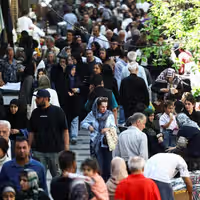
An image published on social media shows Iranian applicants outside the Australian embassy in Tehran.
Australia declined to provide a timeline for resolving delayed skilled visa applications from Iranian nationals and did not directly answer whether Iranian applicants face additional security or identity checks compared with other nationalities.
“All visa applicants, regardless of nationality, must meet the eligibility requirements set out in Australia’s migration legislation before a visa can be granted,” a Department of Home Affairs spokesperson told Iran International on Friday.
The processing times, the spokesperson said, depend on factors including application complexity, completeness, demand, ministerial priorities and migration planning levels.
“Processing times can also be affected by application processing requirements, including verification of applicant information ... and the time taken to receive clearances from external agencies, particularly for health, character and national security assessments,” the spokesperson said.
The department did not directly address the question on whether Iranian citizens undergo broader or different security screening than applicants from other countries.
The response came after images emerged of protests by Iranian applicants outside the Australian embassy in Tehran, alongside letters, official correspondence with the Department of Home Affairs, documents related to pending cases and messages from applicants inside and outside Australia.
Image published on social media shows Iranian applicants outside the Australian embassy in Tehran.
Documents and correspondence show some applications have remained unresolved for more than two years, and in some cases more than 30 months, despite applicants completing key requirements including skills assessments, medical examinations and biometric checks.
Protests and travel restrictions
The department also did not provide a specific explanation for delays affecting Iranian skilled visa applicants who were already inside Australia when they lodged their applications.
Officials said some applicants have faced conflict-related obstacles inside Iran, including internet disruptions that hinder access to biometric appointments, medical examinations and documents such as police certificates and passports. The extensions, the department said, may be granted in such cases but applicants must still satisfy all legal visa requirements.
In recent months, groups of Iranian applicants have staged two protests outside the Australian embassy in Tehran, calling for greater transparency over prolonged processing delays and requesting decisions on their applications.
The department also referred to temporary travel restrictions affecting holders of Australian Visitor visas linked to Iranian passports. It said the Arrival Control Determination, introduced on March 26, 2026, remains in force for six months and prevents affected visa holders outside Australia from entering the country.
Any extension beyond the initial six-month period, according to the department, would require a new legal determination and a finding that continuing the restrictions serves Australia’s national interest. The government has said the measure is intended to provide time to assess conditions in Iran and associated migration risks, leaving the future of both the travel restrictions and many pending visa applications uncert