• العربية
  • فارسی
Brand
  • Iran Insight
  • Politics
  • Economy
  • Analysis
  • Special Report
  • Opinion
  • Podcast
  • Iran Insight
  • Politics
  • Economy
  • Analysis
  • Special Report
  • Opinion
  • Podcast
  • Theme
  • Language
    • العربية
    • فارسی
  • Iran Insight
  • Politics
  • Economy
  • Analysis
  • Special Report
  • Opinion
  • Podcast
All rights reserved for Volant Media UK Limited
volant media logo

IRGC says it hit Thai-flagged ship in Strait of Hormuz

Jul 17, 2026, 19:33 GMT+1

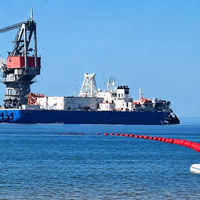
Iran says the Revolutionary Guard's navy targeted a Thai-flagged ship in the Strait of Hormuz on Friday after the vessel "ignored warnings and attempted to transit without obtaining permission."

A video published by IRGC-affiliated media appeared to show damage to the vessel.


Most Viewed

Petition tells Iran hardliners: Fight the US war yourselves
1

Petition tells Iran hardliners: Fight the US war yourselves

2
INSIGHT

Leaked presidency report shows how Iran plans to manage record public anger

3
INSIGHT

Iran hardliners blamed as cost of US strikes mounts

4

Tehran billboard hints Trump is the 'next one' after Graham's death

5
VOICES FROM IRAN

Inflation leaves Iranian pensioners unable to cover basic costs

Banner
Banner
Banner

Spotlight

  • Iran hardliners blamed as cost of US strikes mounts
    INSIGHT

    Iran hardliners blamed as cost of US strikes mounts

  • Vance, Ghalibaf back diplomacy as US, Iran strikes continue
    INSIGHT

    Vance, Ghalibaf back diplomacy as US, Iran strikes continue

  • Leaked presidency report shows how Iran plans to manage record public anger
    INSIGHT

    Leaked presidency report shows how Iran plans to manage record public anger

  • Wave of Iran plots drove UK action against IRGC, terror law tsar says
    EXCLUSIVE

    Wave of Iran plots drove UK action against IRGC, terror law tsar says

  • Two Iranians at the World Cup final – and neither represents the Islamic Republic

    Two Iranians at the World Cup final – and neither represents the Islamic Republic

•
•
•

More Stories

US backs Iraq pipeline plans to bypass Hormuz

Jul 17, 2026, 19:24 GMT+1
100%
An Islamic Revolutionary Guard Corps speedboat patrols near a commercial tanker in the Strait of Hormuz in this file photo.

US-backed plans to revive an oil pipeline linking Iraq and Syria have gained new urgency as Iran's closure of the Strait of Hormuz and attacks on shipping disrupt regional exports and drive oil prices higher.

The US State Department on Wednesday welcomed Iraq's and Syria's decision to prioritize reconstruction of the Iraq-Syria crude oil pipeline, describing it as a strategically important regional infrastructure project and backing a US-led international consortium to carry out the technical and financial work.

The department said the rehabilitated pipeline would initially be capable of transporting 2 million barrels of crude per day from Iraq to Mediterranean export markets, calling the announcement "an important milestone" for the region and for relations between Baghdad and Damascus.

The renewed push comes during the US-Iran war, which has sharply reduced traffic through the Strait of Hormuz, a waterway that carried about one-fifth of global oil supplies before the conflict.

US ambassador to Turkey and special envoy for Syria and Iraq Tom Barrack said Iraqi Prime Minister Ali al-Zaidi's plans to develop alternative export corridors were aligned with broader regional efforts involving Syria, Jordan, Turkey, Lebanon and Egypt.

He said the projects could make Hormuz "an afterthought" for Iraq within two years.

Chevron is in advanced discussions with Los Angeles-based TI Capital and Qatar's UCC Holding to form a consortium for a pipeline network linking southern Iraqi oilfields to the Mediterranean through Syria, the Financial Times reported.

The proposed system would include one line running north from southern Iraq toward Kirkuk and another extending west to the Syrian port of Baniyas.

In parallel, Iraq's cabinet has approved preliminary studies of routes from Basra through Haditha to either Baniyas or Turkey's Mediterranean export terminal at Ceyhan. The approvals do not create binding financial or contractual obligations for Iraq's Oil Ministry.

US Representative Joe Wilson, a Republican from South Carolina, praised Barrack's efforts, saying pipelines through Syria and Turkey could help replace export capacity threatened by Iran's actions around Hormuz.

He estimated the broader network could eventually transport 2.5 million barrels per day to the Mediterranean or Turkey and reduce Baghdad's dependence on Tehran.

Oil prices have climbed during the renewed fighting, with Brent crude settling at $88 a barrel on Friday, its highest level in a month.

The proposed routes remain subject to feasibility studies and would face significant financing, construction and security challenges before becoming operational.

Iran MP calls US bridge strikes possible prelude to ground assault on islands

Jul 17, 2026, 17:29 GMT+1

An Iranian lawmaker said the US strikes that hit several bridges in southern Iran on Thursday may have been a prelude to a ground assault on Iran’s Persian Gulf islands, the IRGC-affiliated Fars news agency reported Friday.

Amirhossein Sabeti said the strikes were intended to destroy transport infrastructure and facilitate “the occupation of some Iranian islands and key sites by separatist groups or airborne forces," while disrupting Iranian military movements.

He also warned that any US ground attack on Iran would likely result in heavy casualties for American forces.

US says IRGC used Chabahar surveillance tower to target vessels in Hormuz

Jul 17, 2026, 17:15 GMT+1

The Chabahar surveillance tower which was destroyed in a US airstrike on Thursday was “part of a maritime surveillance network along Iran’s Gulf of Oman coastline used for decades by the Islamic Revolutionary Guard Corps (IRGC) to track and target commercial vessels transiting the Strait of Hormuz,” US Central Command said in a post on X.

“The destruction of the tower directly degrades IRGC’s ability to coordinate attacks on innocent civilian crew members. Furthermore, the strike protects freedom of navigation in regional waters for all vessels, except for ships attempting to violate the ongoing US naval blockade against Iran.”

US sends more refueling planes to Israel as it weighs wider Iran war - Axios

Jul 17, 2026, 17:09 GMT+1

The Trump administration has told Israel it will send dozens more aerial refueling planes ahead of a possible major expansion of military operations against Iran, Axios reported, citing three US and Israeli officials.

President Donald Trump is considering an offensive significantly broader than the current US strikes around the Strait of Hormuz after reviewing several new military plans at a White House Situation Room meeting on Tuesday, the report said.

Options under discussion include attacks on Iranian power plants and other infrastructure, further strikes on nuclear facilities aimed at burying Iran’s enriched uranium more deeply, and an attack on the underground Pickaxe Mountain site, which is suspected of being developed as a nuclear-related facility.

Trump has not made a final decision, Axios said. However, US and Israeli officials told the outlet that he could order an escalation within days.

The reported objective would be to inflict enough damage to pressure the Islamic Republic into reopening the Strait of Hormuz and accepting Trump’s nuclear demands.

The United States plans to send several dozen additional refueling aircraft to Israel in the coming days, restoring the fleet to roughly the level deployed at the start of the war, Axios reported, citing Israeli officials.

The US military reportedly prefers to operate the planes from Ben Gurion Airport because other regional bases are considered more vulnerable to Iranian attacks.

Iran hardliners blamed as cost of US strikes mounts

Jul 17, 2026, 16:04 GMT+1
•
Behrouz Turani
100%
An image released by Iranian media showing a bridge in the Persian Gulf port city of Bandar Khamir, destroyed by US strikes, July 17, 2026

Moderate voices in Iran are sharpening their criticism of hardline calls for continued confrontation with the United States, arguing that diplomacy has become a patriotic necessity as renewed war exacts mounting economic and human costs.

The debate has intensified since Iran targeted a vessel near the Strait of Hormuz last week, prompting a renewed US military campaign that has included days of strikes on ports, bridges, airports and military facilities across Iran’s southern provinces.

Even as US Vice President JD Vance and Iranian Parliament Speaker and chief negotiator Mohammad-Bagher Ghalibaf have continued to defend diplomacy backed by military preparedness, the fighting has persisted and the prospect of a wider conflict has grown.

The criticism has been directed in part at ultrahardline figures such as Qom Seminary Chancellor Alireza Arafi, who has called for further war against the United States and an end to negotiations.

Two recent commentaries—one by former lawmaker and former National Security Committee chairman Heshmatollah Falahatpisheh, the other by political analyst Abdolrahman Fathollahi—reflect the growing push to hold hardliners accountable for the costs of confrontation.

While one focuses on political responsibility for failed diplomacy, the other highlights the burden borne by communities on Iran’s southern frontier.

‘Defeating diplomacy’

Writing in the moderate daily Toseh Irani, Falahatpisheh accused hardline factions of using what he called a distorted interpretation of religion to obstruct diplomatic opportunities.

“I believe part of these two major wars against Iran was the result of this very definition of religious beliefs by extremists, who are now turning to distorting religion to defeat diplomacy,” he wrote.

He argued that the same factions had repeatedly promised better outcomes while blocking agreements that could have reduced tensions.

“They are the exact same people who blocked two good agreements during the major periods of 2021 and 2022, claiming they would forge a better deal,” he wrote. “But in practice, not only was no agreement achieved, but two major wars were imposed on Iran.”

Falahatpisheh called for the prosecution of those he said had turned diplomatic opportunities into military conflict.

‘Patriotism from a safe distance’

A second commentary, published Thursday in Shargh, shifted the focus from political responsibility to the human cost of confrontation.

Under the title The Country’s Future and the Triangle of Extremism, Costs, and Responsibility, Fathollahi warned about the toll of intensifying US airstrikes on Iran’s southern coastal provinces.

He pointed to public campaigns calling for outspoken opponents of negotiations to be sent to the front lines, accusing them of practising what he described as “patriotism from a safe distance.”

“One certainly cannot beat the drums of war from the safe margins of the capital behind podiums, while dumping the costs of those decisions onto the people living in the front lines,” Fathollahi wrote, highlighting the plight of communities bearing the brunt of the fighting over the Strait of Hormuz.

The comments come after a week of US strikes on infrastructure across Iran’s Persian Gulf provinces, where dozens have been killed or injured and many more affected by transport disruption, electricity blackouts and water shortages during the height of summer.

For Fathollahi, the question is no longer simply one of military strategy but whether Iran’s leaders are willing to change course before the costs grow even higher.

“Rethinking certain political approaches and utilizing all expert and diplomatic capacities is not a choice,” he concluded, “but a necessity to safeguard national interests and reduce the costs imposed on society.”