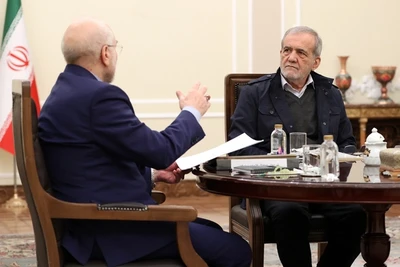
The document, titled "What Iran Wants" and obtained by IranWire, was written by Ali Rabiei, a former intelligence ministry official and government spokesman who now advises President Masoud Pezeshkian on social affairs. It is built on a survey conducted in April and May by the ARA research center and was circulated among senior officials in June.
Its timing matters. The survey was taken in the aftermath of the January protests, in which security forces killed tens of thousands of demonstrators within days, and during a war with the United States that has already claimed the life of Supreme Leader Ali Khamenei. Through all of it, state television has filled its evenings with images of packed squares and chants of revenge.
The report is the government's private mirror, and it shows something else entirely. Given four options for the country's future, only nine percent of respondents chose keeping things as they are; the rest split between reform, deep reform, and changing the system outright.
The document discloses no methodology, and official polling in Iran is conducted among respondents who have every reason to fear giving an honest answer to a state questionnaire.
Sociologist Saeed Paivandi, who reviewed the full report for IranWire, called its findings broadly plausible despite those gaps. In practice, that means each figure below is best read as a floor, not a ceiling. Whatever the government's own instrument records, the reality is unlikely to be milder.
The angriest country ever measured
The report's starkest finding is a number without precedent. Gallup's global emotions index has never recorded a national anger rate above 47 percent, a figure that belonged to Chad. Rabiei's survey puts Iran at 63.6 percent, up twelve points since December, the month before the massacre.
The document itself acknowledges the record, placing Iran above every country Gallup has measured for both anger and grief.
Iran had appeared in those global rankings before, alongside war-scarred states like Iraq and Afghanistan. It has now left them behind.
No war, no surrender
On the confrontation with Washington, the surveyed public fits neither of the stories told about it: the nation baying for battle that state television broadcasts, or the one ready to capitulate that some in Washington count on.
Asked the best course in the current crisis, 44.3 percent chose preserving the ceasefire and continuing negotiations, roughly double the share that favored ending the talks and preparing for war.
Barely one in ten would accept all American conditions, and about two-thirds oppose a complete shutdown of uranium enrichment.
Yet this is not trust in the men at the table. Fewer than a third of respondents expressed high confidence in Iran's new negotiating team, and nearly half the country reports serious fear of another round of war.
What emerges is a population that rejects both another war and a capitulation, and trusts neither the diplomats nor the generals conducting either.
A society in freefall, and the myth of the rallying nation
The emotional data reads like a casualty report. Half the country reports hopelessness, up eight points since December.
Nearly 48 percent report sadness and depression, 45 percent chronic fear and anxiety. Despair runs highest among the young and the educated, the very people a state would need to rebuild anything.
The same pages quietly dismantle the leadership's central wartime claim: that the nation has closed ranks behind it.
By the government's own count, 47 percent of Iranians never attended a single one of the nightly wartime rallies that state television presents as proof of unity. In Tehran, 61 percent stayed away.
Rabiei concedes that a much-promoted volunteer registration drive for national defense underperformed, and attributes the reluctance to people's fear of being judged.
It is an official admission that even gestures of patriotism have become politically fraught. The report's own data explains why: Iranians overwhelmingly separate defending their country, which a majority say they would do if attacked again, from defending the Islamic Republic.
Proud, secular, and packing
The most quietly radical section concerns who Iranians say they are. National pride is rising. More than 85 percent express pride in being Iranian, and the share who identify first as "Iranian" rather than "Iranian Muslim" has grown since the war, most sharply among the young.
Religious observance, the Islamic Republic's ideological foundation, is collapsing under the same roof.
In 1975, four years before the revolution, 79 percent of Iranians said they fasted through Ramadan. By 2023 it was 42 percent. This year it is roughly 30.
And the pride does not translate into staying. A third of Iranians say they would emigrate if they could, including nearly half of everyone under thirty and half of the university-educated. People are not leaving Iran, the report effectively concludes; they are leaving its future.
A manual for management
What makes the document remarkable is less its data than its purpose. Rabiei's recommendations to the leadership contain no political change at all.
Officials should do a better job convincing people that sanctions, not mismanagement, caused their misery; state television should show a more inclusive face; the ration cards should continue. This, even as the report's own respondents name official incompetence, ahead of sanctions, as the main cause of their problems.
One recommendation stands out: state bodies should avoid policies that put them in confrontation with society.
That instruction has a visible form on Iran's streets, where enforcement of the small rules of daily life has gone relatively quiet. Many Iranians read the leniency less as tolerance than as triage, a state conserving its strength for a collision it can see coming.
Independent surveys suggest the private picture is, if anything, generous. The Netherlands-based GAMAAN institute, polling Iranians beyond the reach of official questionnaires, has found large majorities opposed to the Islamic Republic's continuation altogether.
Rabiei reaches for an older vocabulary to describe what his numbers show: a society trapped in the present, unable to desire its past or picture its future. The term he borrows, "presentism," was coined by an Iranian scholar to describe the national mood in 1975.
Four years later, that society produced a revolution.