US launches new wave of strikes on Iran - CENTCOM
The United States began a new wave of strikes against Iran at 2 p.m. ET (1800 GMT) on Thursday to “further degrade Iranian military capabilities,” US Central Command said.
The United States began a new wave of strikes against Iran at 2 p.m. ET (1800 GMT) on Thursday to “further degrade Iranian military capabilities,” US Central Command said.







The Hamshahri newspaper reported on Thursday that falling birth rates, coupled with soaring daycare costs, have reduced demand for kindergartens and preschool centers across the country.
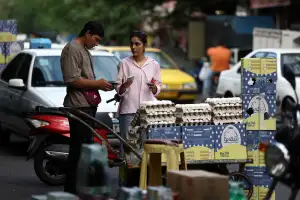
Monthly daycare fees vary widely across Tehran, according to the report. In middle-income neighborhoods, tuition ranges from 50 million ($25) to 80 million rials (over $40), while families in wealthier districts pay between 250 million (around $130) and 300 million rials ($160).
The average monthly income in Iran is estimated at $150–$200, depending on fluctuations in the open-market exchange rate. By comparison, the minimum monthly cost of basic living expenses, including food and housing, is estimated at $385–$400, leaving many households unable to meet essential needs.
Daycare operators in affluent areas attributed the higher fees to rising rents and staff wages, saying the increased costs have discouraged many parents from enrolling their children.
More than 60% of kindergarten operating costs are spent on personnel under Iran's labor law, Hamidreza Sheikholeslam, head of the National Organization for Early Childhood Education, said in June.
Sheikholeslam said staffing costs, the number of teachers and children, operating hours, rent, facilities and equipment, and other operating expenses all influence tuition fees.
Many families, the report said, have responded to rising childcare costs and broader financial pressures by turning to lower-cost alternatives, most commonly asking grandparents to care for young children.
Experts warn of social consequences
Sociologists quoted by Hamshahri said removing daycare from household spending is not only an economic decision but could become a broader social challenge.
They argued that young children benefit from interacting with their peers in educational settings and warned that replacing daycare with care by relatives could undermine their social development.
The concerns follow earlier reports highlighting the growing burden on extended families. In May, the Shargh newspaper reported that prolonged preschool closures following the recent war left many working parents scrambling for childcare, with some relying on grandparents and relatives.
Another report published by Haft-e Sobh daily in February warned that rising daycare costs had effectively turned many grandparents into full-time caregivers, raising concerns about the physical and psychological burden on older adults as well as differences in parenting approaches across generations.
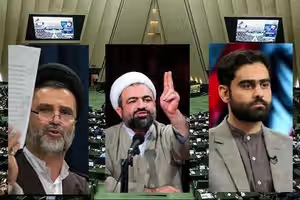
The petition, hosted on the Iranian platform Karzar, calls on prominent Paydari figures, including lawmakers Hamid Rasaei and Amirhossein Sabeti, to travel to the southern cities of Sirik and Bandar Abbas, where residents have faced repeated attacks during the conflict.
Its authors said such a visit would help the politicians "better understand the realities on the ground" and avoid decisions that could endanger civilians.
Challenge to hardline rhetoric
The petition says residents of southern Iran have lived under "direct and around-the-clock threats" while military personnel and civilians alike face fears of further attacks and damage to critical infrastructure.
It argues that politicians who have called for a wartime posture should experience those conditions themselves, saying a field visit could lead to "more realistic decision-making" and greater solidarity with local communities.
The Paydari Front is one of Iran's most hardline political factions and has been among the strongest opponents of negotiations with the United States. Its lawmakers have repeatedly criticized President Masoud Pezeshkian, Parliament Speaker Mohammad Bagher Ghalibaf and Foreign Minister Abbas Araghchi over diplomacy with Washington.
Earlier this week, parliament removed two of the bloc's most outspoken critics of negotiations from senior positions on the National Security and Foreign Policy Committee, reflecting growing tensions within Iran's conservative establishment over the handling of the conflict.
Southern anger
The petition has coincided with growing criticism on Persian-language social media over the burden borne by southern Iran, where much of the fighting has been concentrated.
In a video posted on Instagram, a comedian and influencer from southern Iran accused officials of downplaying attacks on the region. He said that when Tehran and other parts of the country came under attack, authorities described them as missile and drone strikes, but now that the south was bearing the brunt of the fighting, incoming rockets were being referred to simply as "projectiles."
"They've sanitized the language," he said. "It's as if a four- or five-year-old neighbor's child has thrown a stone at someone." He added: "You may not have the courage to call it what it is, but at least have some humanity. Don't treat southerners differently from everyone else."
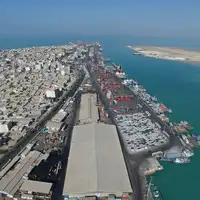
Journalist Azadeh Mokhtari wrote on X that southern Iran was "the beating heart of Iran's economy," saying its ports were vital to imports, cargo handling and supplying much of the country.
Another X user argued that the Islamic Republic had turned large parts of the southern coastline into military zones and missile sites while residents continued to struggle with poverty despite the region's strategic importance and natural wealth.
A third wrote that Iranians should not pretend there was no war simply because the attacks were concentrated in the south. "Southern Iran is an inseparable part of this country," the post said. "Its pain is the pain of all Iran."
Unity message meets political divisions
The petition emerged as Iran's Press Supervisory Board instructed media outlets not to highlight political or factional disputes, urging them instead to avoid content it said could harm national cohesion or amplify social divisions.
The guidance told outlets to avoid "highlighting political and factional differences," "reproducing internal disputes" and publishing material that could undermine public unity.
Iran ranks among the world's lowest countries for press freedom, according to Reporters Without Borders, which says state repression continues to weigh heavily on independent journalism.
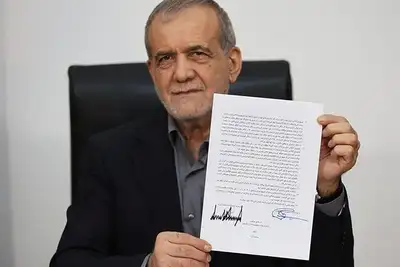
The document, titled "What Iran Wants" and obtained by IranWire, was written by Ali Rabiei, a former intelligence ministry official and government spokesman who now advises President Masoud Pezeshkian on social affairs. It is built on a survey conducted in April and May by the ARA research center and was circulated among senior officials in June.
Its timing matters. The survey was taken in the aftermath of the January protests, in which security forces killed tens of thousands of demonstrators within days, and during a war with the United States that has already claimed the life of Supreme Leader Ali Khamenei. Through all of it, state television has filled its evenings with images of packed squares and chants of revenge.
The report is the government's private mirror, and it shows something else entirely. Given four options for the country's future, only nine percent of respondents chose keeping things as they are; the rest split between reform, deep reform, and changing the system outright.
The document discloses no methodology, and official polling in Iran is conducted among respondents who have every reason to fear giving an honest answer to a state questionnaire.
Sociologist Saeed Paivandi, who reviewed the full report for IranWire, called its findings broadly plausible despite those gaps. In practice, that means each figure below is best read as a floor, not a ceiling. Whatever the government's own instrument records, the reality is unlikely to be milder.
The angriest country ever measured
The report's starkest finding is a number without precedent. Gallup's global emotions index has never recorded a national anger rate above 47 percent, a figure that belonged to Chad. Rabiei's survey puts Iran at 63.6 percent, up twelve points since December, the month before the massacre.
The document itself acknowledges the record, placing Iran above every country Gallup has measured for both anger and grief.
Iran had appeared in those global rankings before, alongside war-scarred states like Iraq and Afghanistan. It has now left them behind.
No war, no surrender
On the confrontation with Washington, the surveyed public fits neither of the stories told about it: the nation baying for battle that state television broadcasts, or the one ready to capitulate that some in Washington count on.
Asked the best course in the current crisis, 44.3 percent chose preserving the ceasefire and continuing negotiations, roughly double the share that favored ending the talks and preparing for war.
Barely one in ten would accept all American conditions, and about two-thirds oppose a complete shutdown of uranium enrichment.
Yet this is not trust in the men at the table. Fewer than a third of respondents expressed high confidence in Iran's new negotiating team, and nearly half the country reports serious fear of another round of war.
What emerges is a population that rejects both another war and a capitulation, and trusts neither the diplomats nor the generals conducting either.
A society in freefall, and the myth of the rallying nation
The emotional data reads like a casualty report. Half the country reports hopelessness, up eight points since December.
Nearly 48 percent report sadness and depression, 45 percent chronic fear and anxiety. Despair runs highest among the young and the educated, the very people a state would need to rebuild anything.
The same pages quietly dismantle the leadership's central wartime claim: that the nation has closed ranks behind it.
By the government's own count, 47 percent of Iranians never attended a single one of the nightly wartime rallies that state television presents as proof of unity. In Tehran, 61 percent stayed away.
Rabiei concedes that a much-promoted volunteer registration drive for national defense underperformed, and attributes the reluctance to people's fear of being judged.
It is an official admission that even gestures of patriotism have become politically fraught. The report's own data explains why: Iranians overwhelmingly separate defending their country, which a majority say they would do if attacked again, from defending the Islamic Republic.
Proud, secular, and packing
The most quietly radical section concerns who Iranians say they are. National pride is rising. More than 85 percent express pride in being Iranian, and the share who identify first as "Iranian" rather than "Iranian Muslim" has grown since the war, most sharply among the young.
Religious observance, the Islamic Republic's ideological foundation, is collapsing under the same roof.
In 1975, four years before the revolution, 79 percent of Iranians said they fasted through Ramadan. By 2023 it was 42 percent. This year it is roughly 30.
And the pride does not translate into staying. A third of Iranians say they would emigrate if they could, including nearly half of everyone under thirty and half of the university-educated. People are not leaving Iran, the report effectively concludes; they are leaving its future.
A manual for management
What makes the document remarkable is less its data than its purpose. Rabiei's recommendations to the leadership contain no political change at all.
Officials should do a better job convincing people that sanctions, not mismanagement, caused their misery; state television should show a more inclusive face; the ration cards should continue. This, even as the report's own respondents name official incompetence, ahead of sanctions, as the main cause of their problems.
One recommendation stands out: state bodies should avoid policies that put them in confrontation with society.
That instruction has a visible form on Iran's streets, where enforcement of the small rules of daily life has gone relatively quiet. Many Iranians read the leniency less as tolerance than as triage, a state conserving its strength for a collision it can see coming.
Independent surveys suggest the private picture is, if anything, generous. The Netherlands-based GAMAAN institute, polling Iranians beyond the reach of official questionnaires, has found large majorities opposed to the Islamic Republic's continuation altogether.
Rabiei reaches for an older vocabulary to describe what his numbers show: a society trapped in the present, unable to desire its past or picture its future. The term he borrows, "presentism," was coined by an Iranian scholar to describe the national mood in 1975.
Four years later, that society produced a revolution.
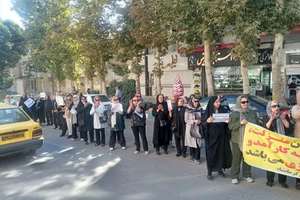
“The pension is only enough to cover the equivalent of 13 days of basic work,” one woman receiving her late husband's pension told Iran International, describing monthly payments as far below the cost of supporting her family.
Other retirees also told Iran International that decades of contributions to the social security system have left them with pensions insufficient to meet basic expenses.
Several said that after 35 years of paying into the system, they now receive around 220 million rials ($117) a month, an amount they say does not even cover rent in many parts of the country.
The average monthly income in Iran is approximately $150 to $200, depending on fluctuations in the open market currency rate. This level of income falls far short of the cost of living, which requires around $385 to $400 per month to afford basic necessities like food and housing.
“Last year my husband's pension was 90 million rials ($48). This year it has increased by about 22% to 110 million rials ($58),” another woman supporting her two children told Iran International.
Many said they have turned to driving for ride-hailing services or other informal work after retirement to supplement their income.
Official data show year-on-year inflation for food and beverages has remained above 130% in recent months, placing further pressure on households already struggling with rising living costs.
Pension system under growing strain
The financial hardship described by pensioners reflects broader strains on Iran's retirement system, which has faced mounting funding shortages and growing concern over the sustainability of pension funds.
Mostafa Salari, head of the Social Security Organization, said on July 13 that the organization faces an 820 trillion rials ($436 million) funding gap to pay pension arrears for the first two months of the Iranian year and is also struggling to finance July payments.
The government has also moved to raise the retirement age as it seeks to ease pressure on the pension system, a step that has drawn criticism from labor advocates.
Economists have for years warned that demographic pressures, underfunding and broader economic problems have left Iran's pension funds increasingly vulnerable.
In 2022, Sajjad Padam, then director-general for social insurance at the Ministry of Labour and Social Welfare, warned that even selling three million barrels of oil a day without sanctions would not be enough to resolve Iran's pension crisis, underscoring the depth of the structural challenges facing the country's retirement system.