• العربية
  • فارسی
Brand
  • Iran Insight
  • Politics
  • Economy
  • Analysis
  • Special Report
  • Opinion
  • Podcast
  • Iran Insight
  • Politics
  • Economy
  • Analysis
  • Special Report
  • Opinion
  • Podcast
  • Theme
  • Language
    • العربية
    • فارسی
  • Iran Insight
  • Politics
  • Economy
  • Analysis
  • Special Report
  • Opinion
  • Podcast
All rights reserved for Volant Media UK Limited
volant media logo

Kuwait says it intercepted 4 missiles and 21 drones

Jul 15, 2026, 20:07 GMT+1Updated: 23:12 GMT+1

Kuwait’s armed forces said Wednesday they detected and intercepted four cruise missiles and 21 hostile drones in the country’s airspace from dawn, while several vital facilities were struck and sustained material damage.

“The Iranian aggression targeted a number of vital facilities in the country,” the country’s Defense Ministry spokesperson said, adding that no casualties were reported.

Most Viewed

Iran hardliners cry foul as Ghalibaf camp gains ground
1
INSIGHT

Iran hardliners cry foul as Ghalibaf camp gains ground

2

Petition tells Iran hardliners: Fight the US war yourselves

3
INSIGHT

Leaked presidency report shows how Iran plans to manage record public anger

4
VOICES FROM IRAN

Inflation leaves Iranian pensioners unable to cover basic costs

5

Tehran billboard hints Trump is the 'next one' after Graham's death

Banner
Banner
Banner

Spotlight

  • Iran hardliners blamed as cost of US strikes mounts
    INSIGHT

    Iran hardliners blamed as cost of US strikes mounts

  • Vance, Ghalibaf back diplomacy as US, Iran strikes continue
    INSIGHT

    Vance, Ghalibaf back diplomacy as US, Iran strikes continue

  • Leaked presidency report shows how Iran plans to manage record public anger
    INSIGHT

    Leaked presidency report shows how Iran plans to manage record public anger

  • Wave of Iran plots drove UK action against IRGC, terror law tsar says
    EXCLUSIVE

    Wave of Iran plots drove UK action against IRGC, terror law tsar says

  • Two Iranians at the World Cup final – and neither represents the Islamic Republic

    Two Iranians at the World Cup final – and neither represents the Islamic Republic

•
•
•

More Stories

Vance rejects claims of foreign influence over Iran policy

Jul 15, 2026, 19:43 GMT+1

US Vice President JD Vance rejected accusations that Qatar, other foreign governments or conservative commentator Tucker Carlson had influenced his approach to Iran.

“People said I’m influenced by Qatar, foreign governments, I take my marching orders from Tucker Carlson. There’s so much bullshit out there,” Vance said in an interview with Joe Rogan.

Vance said he was seeking to carry out President Donald Trump’s objective of reaching a settlement that would prevent Iran from obtaining a nuclear weapon and ensure the free flow of oil and gas.

Iran executes 2022 protester, Aref Khoshkar- HRANA

Jul 15, 2026, 19:06 GMT+1
100%

Iranian authorities executed Aref Khoshkar, a detainee from the 2022 Woman, Life, Freedom protests, at dawn Wednesday in Ghezel Hesar Prison in Karaj, the Human Rights Activists News Agency reported.

Khoshkar had been sentenced to death on charges including moharebeh, or “enmity against God,” over allegations that he carried and used a weapon and killed a Basij member.

A source close to his family told HRANA that prison authorities informed them of the execution at around 8 a.m. and initially refused to hand over his body, transferring it instead to the Behesht Zahra morgue in Tehran.

IRGC claims to have downed US drone over Bandar Abbas

Jul 15, 2026, 18:53 GMT+1
100%

Iran's IRGC says it has shot down a US "Lucas" drone over the southern port city of Bandar Abbas.

The semi-official Fars News Agency published images it said showed the wreckage of the drone.

The United States has not commented, and the Iranian claim could not be independently verified.

Ghalibaf says Iran must fight while pursuing diplomacy

Jul 15, 2026, 18:42 GMT+1

Iranian Parliament Speaker Mohammad Bagher Ghalibaf said Wednesday that Tehran did not seek war but must remain prepared to fight to the end while also using diplomacy and negotiations to secure its national interests.

“We have never welcomed war and do not, but we must always be ready to fight and stand to the end to safeguard our national security and interests,” Ghalibaf said in a statement.

He said Iran was in what he described as an “essential and existential war” with the United States, accusing Washington of seeking both to topple the Islamic Republic and fragment Iran.

Ghalibaf said Iran’s approach to war or negotiations should be realistic, long-term and based on national security and interests, adding that Tehran had no choice but to rely on its own strength.

He said Iran had no reason to abide by the memorandum of understanding if it did not benefit from it, and added that the armed forces had complete freedom of action to confront what he called the enemy’s aggression.

Ghalibaf said Iran’s national security depended on maintaining what he called the “Iranian arrangements” in the Strait of Hormuz.

He added that negotiations at this stage did not amount to compromise but were, alongside war, part of a strategy of resistance and protecting national interests.

“Separating and choosing either negotiation or war as the only solution is a strategic error,” Ghalibaf said, adding that the “enemy’s” strategy had not changed.

As Tehran debates, Iran's south lives the war

Jul 15, 2026, 17:30 GMT+1
•
Behrouz Turani
100%
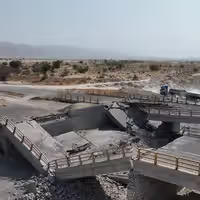
A screen-grab from a video published by citizen journalist Vahid Online, purporting to show the aftermath of a US strike on Iran's southeastern port city of Chabahar, July 15, 2026

A week of heavy fighting has left parts of Iran’s southern coast looking unmistakably like a war zone. Yet in Tehran, many still struggle to believe the country is at war.

Watching explosions on television and social media from hundreds of kilometers away, many see the confrontation with the United States as another familiar cycle of pressure that may yet give way to negotiations.

Fatemeh Rajabi, the news anchor who first reported the U.S. strikes on ports and military sites in southern Iran on the YouTube program Hasht-e Shab, says many in the capital find it difficult to grasp that a war is unfolding along the northern shores of the Persian Gulf — the region they casually refer to as “down under.”

Reporter Ali Pakzad, who visited the area during the strikes, says missiles hit targets from Abadan near the Iraqi border to Chabahar and Saravan near Pakistan.

He described damaged fishing vessels, battered ports and communities whose livelihoods have been shattered by attacks documented in the program’s footage.

That contrast lies at the heart of an investigative report by journalist Mira Ghorbanifar in Toseh Irani, titled The South in the Fire of War and Ashes of Ceasefire.

Ghorbanifar writes that explosions now puncture the dawn along Iran’s southern coast. Smoke rises from damaged docks, charred dhows lie abandoned, and fish markets once full of noise now speak only of “a war for which no one has yet chosen a definite name.”

While officials speak of “understandings,” “ceasefires” and “crisis management,” she argues, people in Iran’s south are grappling with damaged infrastructure and disrupted shipping, trying to adapt to what increasingly resembles a war of attrition.

She also asks whether the so-called Islamabad Understanding still exists. Is the fighting along Iran’s southern coast part of the same hundred-day conflict, or the start of a new phase of controlled escalation? And can both sides return to negotiations before crossing a point of no return?

The concerns extend well beyond independent journalists.

Government-aligned newspapers have increasingly questioned whether Iran can sustain a prolonged confrontation while struggling to protect civilians and critical infrastructure.

Moderate daily Sharq describes the country’s predicament as “structural and accumulated,” arguing that damaged infrastructure, naval disruption and collapsing logistics have left even minor shocks capable of triggering major crises.

Centrist Etemad warns that public trust has eroded while the state remains unprepared for cascading emergencies.

Economic newspapers have echoed those warnings.

Jahan Sanat argues that Iran’s deterrence is steadily weakening under sustained pressure, while Donya-ye Eghtesad says military decisions are increasingly driven by political necessity rather than strategic advantage, leaving the country more vulnerable in a prolonged conflict.

Washington-based analysts Mohammad Ghaedi and Farzin Nadimi have voiced similar concerns in interviews with Persian-language media abroad.

Ghaedi argues that Iran’s governing system “has repeatedly refused to learn from past mistakes,” pointing to what he sees as a widening disconnect between insulated decision-makers and citizens bearing the costs of conflict.

Nadimi says Iran is confronting the United States at “a moment of maximum structural fragility,” with deterrence eroding and escalation driven more by political necessity than strategic advantage.

“Iran is not in a position to manage a prolonged conflict,” he warns, adding that every new attack “burns away another part of Iran’s deterrent capability.”

Even hardline media have shown hints of concern. Resalat recently urged Iran to “rebuild its defensive capacity” after recent military losses — a rare acknowledgement from a conservative newspaper that the country’s deterrence has been weakened.

For now, the divide remains striking. In Tehran, politicians and commentators continue to debate negotiations, ceasefires and diplomatic understandings.

Along the southern coast, many residents have already stopped asking what to call the conflict. They are simply living through it.