In a message issued after the burial of former supreme leader, Mojtaba Khamenei described retaliation for his father’s death in a February 28 airstrike as “a national demand”, adding that it “will most certainly be carried out.”
Judiciary chief Gholamhossein Mohseni-Ejei, recently reappointed by Khamenei for another five-year term, immediately welcomed the declaration that revenge for his slain father was inevitable.
“We will pursue and punish the murderers of the martyred Imam,” he wrote on X.
Former IRGC commander Mohsen Rezaei, now a military adviser to the supreme leader, said US president Donal Trump and Israeli Prime Minister Benjamin Netanyahu had crossed the Islamic Republic’s “red lines” and “must be met with decisive and proportionate punishment.”
“Revenge is part of the path of the Revolution,” he added.
The declaration revived a contradiction at the heart of Iranian policy: whether Tehran can negotiate with Washington while presenting revenge against its president as a national or religious obligation.
Hours before Khamenei’s message, Trump said 1,000 US missiles were “locked and loaded” and aimed at Iran, with thousands more ready to follow if the Iranian government acted on threats to kill him.
The message also intensified pressure on officials viewed as favouring engagement with Washington.
Some hardline commentators portrayed it as drawing a clear line between the supreme leader and supporters of negotiations, while others complained that senior officials and institutions had been slow to endorse it publicly.
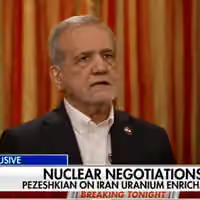
President Masoud Pezeshkian had earlier affirmed Iran’s right to avenge what he called the “historic crime,” while Parliament Speaker and chief negotiator Mohammad-Bagher Ghalibaf said those responsible would face justice.
Neither had publicly commented on Khamenei’s latest message at the time of writing.
Former nuclear negotiator Saeed Jalili said avenging Khamenei would be “a defence of every nation’s sovereignty” and “the greatest service to international law.”
Hardline political activist Ahmad Ghadiri argued that advocating Trump’s assassination fundamentally contradicts negotiations with Washington.
Amir Chizari, a political activist close to Ghalibaf, disagreed. He maintained that the obligation to seek revenge, which he said Khamenei had imposed on all Muslims, “does not contradict the negotiations that have taken place so far.”
Reformist journalist Ahmad Zeidabadi questioned the logic of pursuing both tracks simultaneously.
“Those who say Iran should negotiate and reach an agreement with the United States while at the same time planning to cut off Trump’s head, or demanding his extradition to Iran to be killed, what framework of political or practical logic are they following?” he wrote.
Some hardline figures called for the rhetoric to be translated into action.
Political analyst Ehsan Salehi told Hamshahri’s online television channel that security agencies should establish dedicated units to carry out revenge operations.
“The word ‘revenge’ is neither ambiguous nor open to interpretation,” he said. “It has a clear meaning: punishing and eliminating the killers. It cannot be diluted into harmless slogans or symbolic projects.”
Salehi argued that a stronger response to the US killing of Qasem Soleimani in 2020 might have deterred subsequent attacks.
Cleric Mohammad Fayyazi said Khamenei’s declaration had effectively made revenge official policy and urged the government to endorse it formally, without what he called “pointless diplomatic considerations.”
The debate exposed broader disagreements over Iran’s priorities.
The news website Rouydad24 argued that while parts of the political and military establishment consider revenge the country’s foremost objective, others see the deteriorating economy and declining public trust as the more immediate threats.
It warned that becoming trapped in “a vicious cycle of emotional decisions” could bring tougher sanctions, greater economic hardship and deeper domestic discontent.
One reformist-leaning user argued that revenge also required the capacity to carry it out.
“A country that could not guarantee the security of its late leader, and cannot fully guarantee the security of its current leader, should first restore its own strength before thinking about revenge,” the user wrote. “Otherwise, the result will be no different from before.”
Religious scholar Saeed Sadoughi raised a more fundamental question.
“Suppose Trump and Netanyahu are gone and revenge is achieved. Will the country’s problems be solved?” he wrote. “Will issues such as high-level uranium enrichment and the Strait of Hormuz simply disappear? Will the country suddenly move towards development and prosperity?”