Iran state-linked media: missiles, drones launched against US targets


State-affiliated Iranian media claimed early Monday that Iran had launched a new wave of missile and drone attacks against US military bases and naval assets across the region.
Nour News, which is affiliated with Iran's Supreme National Security Council, reported that "extensive missile and drone attacks" against US bases and vessels had begun.
Sabereen News, a Telegram channel close to Iran-backed armed groups, separately claimed that several ballistic missiles had been launched from western and central Iran toward US military positions in the region.
The claims could not be independently verified, and there was no immediate comment from the US military.





Oil prices climbed sharply and Asian shares slipped on Monday as fighting intensified in the Persian Gulf and Iran claimed to have closed the Strait of Hormuz, renewing fears of supply disruptions and higher global inflation.
Brent crude rose 3.3% to $78.50 a barrel after falling as low as $70.14 in recent weeks, while US crude gained 3.4% to $73.83 a barrel.
The dollar strengthened alongside bond yields as investors increased bets that the Federal Reserve could raise interest rates.
US strikes appear to have expanded early Monday local time compared with previous days, based on reports emerging from Iranian media.
Eskan News' Telegram channel reported that the latest wave of attacks targeted a wider range of locations across southern and western Iran than previous strikes.
According to the report, the targeted areas include Qeshm, Sirik, Bandar Abbas, Jask, Bushehr, Khondab, Bandar Mahshahr, Behbahan, Andimeshk, Dezful, Ahvaz, Abadan and Khorramshahr.
The report could not be independently verified, and neither US nor Iranian authorities have immediately confirmed the full scope of the reported attacks.
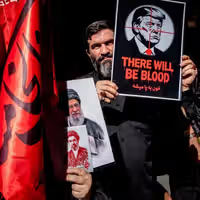
Supreme Leader Mojtaba Khamenei’s renewed call for revenge over his father’s killing has emboldened hardliners demanding concrete action, while raising questions over how such threats can be reconciled with Tehran’s stated openness to diplomacy.
In a message issued after the burial of former supreme leader, Mojtaba Khamenei described retaliation for his father’s death in a February 28 airstrike as “a national demand”, adding that it “will most certainly be carried out.”
Judiciary chief Gholamhossein Mohseni-Ejei, recently reappointed by Khamenei for another five-year term, immediately welcomed the declaration that revenge for his slain father was inevitable.
“We will pursue and punish the murderers of the martyred Imam,” he wrote on X.
Read the full article here.
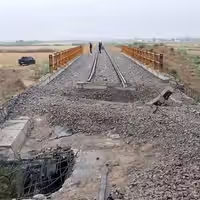
Iran's Foreign Ministry has accused the United States of flagrantly violating both the recent ceasefire agreement and the UN Charter, saying Washington's attacks over the past 24 hours targeted Iran's transportation infrastructure, commercial shipping, cargo vessels and aviation facilities.
The ministry also accused the US of interfering with Iran's arrangements for the Strait of Hormuz, saying the actions had undermined security and disrupted international commercial shipping.
"Only 25 days have passed since the ceasefire agreement ending the war, yet the US government has violated nearly all aspects of that agreement," the ministry said, describing the attacks as among "the gravest war crimes."
Tehran also said the US had used the territory and facilities of some regional states to launch attacks on Iran, warning neighboring countries against allowing their territory to be used for military operations.
While insisting Iran does not seek war, the ministry said the origin of any attack on Iranian territory would be considered a legitimate target for retaliatory strikes.
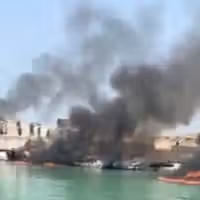
IRGC forces fired at commercial shipping transiting the Strait of Hormuz within the past hour, according to CNN, citing US military officials.
US aircraft subsequently shot down an Iranian cruise missile and a one-way attack drone, the report said.
The reported engagement came as US forces carried out another round of strikes against Iran aimed at degrading Tehran's ability to threaten commercial shipping in the strategic waterway.