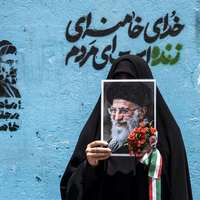
The debate comes as Ali Khamenei was buried in Mashhad after a week of funeral ceremonies, marking the symbolic beginning of a new political era for the Islamic Republic.
One headline on a leading Tehran news site captured the anxiety: “People will have to pay the price of uncalculated slogans.”
Other outlets warned of “the very high possibility of a full-fledged war,” soaring exchange rates and gold prices, and a country trapped in “a war between wars.”
Coverage on pro-reform Fararu and other outlets reflected growing concern over security and the economy, as Iranians rushed to convert savings into gold and dollars in a volatile market reacting to every comment from Tehran or Washington.
‘Incation worse than compromise’
Economist Mehdi Pazouki warned in an interview with Fararu that continued uncertainty would deepen the damage to Iran’s economy and people’s livelihoods.
“Every single day earlier that the agreement is signed is in the country’s interest,” he said, urging Tehran to finalize an agreement with Washington and pursue deeper reforms.
“The cost of inaction is far greater than the cost of compromise,” he added.
Despite renewed military escalation, Reuters cited a US official on Thursday as saying Washington remained committed to finding a resolution with Iran and that technical talks were continuing.
The pro-Pezeshkian daily Etemad voiced concern over the growing pressure on Iran’s state institutions.
While acknowledging what it called “the necessity of a calculated defense to deter unilateral American bullying,” the paper warned that a wider regional war could overwhelm civilian systems.
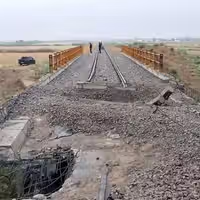
It pointed to casualties reported by the Health Ministry—at least 14 killed and 78 wounded—and damage to transport corridors in Khuzestan and Golestan provinces.
Etemad urged the Supreme National Security Council to ensure that any military response does not close backchannel or third-party diplomatic efforts, arguing that preventing a broader crisis must remain the government’s priority.
Sharq warned that US strikes on bridges and the Tehran-Mashhad railway marked a shift toward what it described as efforts to isolate Iran’s domestic markets.
Sharq said Iran’s ability to withstand pressure depends not only on military power but also economic durability, urging the government to use global concerns over energy instability to push for mediation.
‘Sacrilegious and criminal’
Hardline outlets presented the same developments as evidence that Iran should abandon restraint and expand its response.
Conservative factions framed the latest strikes as an opportunity to enforce Iranian control over the Strait of Hormuz.
Kayhan, whose chief is customarily appointed by the Supreme Leader, described the targeting of the Tehran-Mashhad railway corridor ahead of the late Supreme Leader’s burial as a “sacrilegious and criminal act of desperation.”
It argued that Supreme Leader, Mojtaba Khamenei now had a mandate for defiance, warning that any attack on Iran’s infrastructure would render “the entire maritime transit apparatus of the Persian Gulf completely non-operational.”
In a commentary headlined “Shattering the Logistics of Aggression,” the municipal daily Hamshahri praised Iranian strikes on US targets, including Patriot missile infrastructure in Kuwait and fuel depots in Bahrain.
Hamshahri argued that by expanding attacks to include host nations, Tehran was weakening what it described as the American security umbrella in the region.
The paper warned that disruption of Iran’s transport networks would be answered with paralysis of the regional energy supply chain.