• العربية
  • فارسی
Brand
  • Iran Insight
  • Politics
  • Economy
  • Analysis
  • Special Report
  • Opinion
  • Podcast
  • Iran Insight
  • Politics
  • Economy
  • Analysis
  • Special Report
  • Opinion
  • Podcast
  • Theme
  • Language
    • العربية
    • فارسی
  • Iran Insight
  • Politics
  • Economy
  • Analysis
  • Special Report
  • Opinion
  • Podcast
All rights reserved for Volant Media UK Limited
volant media logo

Netanyahu, Trump discuss US moves in Persian Gulf

Jul 9, 2026, 21:44 GMT+1

Israeli Prime Minister Benjamin Netanyahu and US President Donald Trump spoke Thursday and agreed to continue coordination between their countries in various sectors, Netanyahu’s office said.

The office said Trump updated Netanyahu on US moves in the Persian Gulf.

Netanyahu raised what his office called the severity of statements by Turkish President Recep Tayyip Erdogan and his officials against Israel’s existence, as well as the need for security zones along Israel’s borders.

Most Viewed

Iran faces region’s harshest mix of wartime contraction and inflation
1

Iran faces region’s harshest mix of wartime contraction and inflation

2

Khamenei doubles down on revenge after Trump vows to decimate Iran if targeted

3
INSIGHT

Iran’s economic pain deepens as factions trade blame

4
PODCAST

Is the Iran-US MoU dead – or are we asking the wrong question?

5
INSIGHT

For many Iranians, paychecks now barely cover food

Banner
Banner
Banner

Spotlight

  • Iran faces region’s harshest mix of wartime contraction and inflation

    Iran faces region’s harshest mix of wartime contraction and inflation

  • Is the Iran-US MoU dead – or are we asking the wrong question?
    PODCAST

    Is the Iran-US MoU dead – or are we asking the wrong question?

  • For many Iranians, paychecks now barely cover food
    INSIGHT

    For many Iranians, paychecks now barely cover food

  • Iran’s economic pain deepens as factions trade blame
    INSIGHT

    Iran’s economic pain deepens as factions trade blame

  • A remote bridge shows how US-Iran war is expanding
    ANALYSIS

    A remote bridge shows how US-Iran war is expanding

•
•
•

More Stories

US strikes, Hormuz clashes push Iran deal to brink

Jul 9, 2026, 21:43 GMT+1
•
Maryam Sinaiee
100%
A US fighter jet on board a US warship in this CENTCOM handout

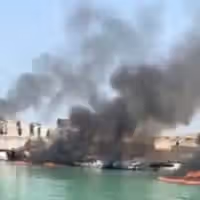
The fragile memorandum between Tehran and Washington is facing its biggest test yet after two days of US strikes on targets along Iran’s southern coast and Iranian attacks on commercial shipping near the Strait of Hormuz raised fears of a return to full-scale war.

Iranian officials have threatened severe retaliation, while analysts warn that disputes over sanctions, maritime routes and the future of the agreement could push both sides into another major confrontation.

Mohsen Jalilvand, a professor of international relations, said the continued US military presence in the region and Tehran's insistence on controlling shipping through the Strait of Hormuz have significantly increased the risk of war.

"When both sides continue to stand by their positions, and there are no signs of retreat, it is only natural that the likelihood of a broader confrontation increases," he told the news website Fararu.

"Overall, I see the outlook moving less toward an agreement and more toward escalating tensions and a greater possibility of a major conflict."

‘Abandon MoU’

Senior officials and hardline media reacted angrily after the latest US attacks, which the Iranian Health Ministry said killed 14 people and injured 78 others. Several senior figures demanded tougher retaliation or called for formally abandoning the memorandum with Washington.

Parliament Speaker and Iran's chief negotiator Mohammad-Bagher Ghalibaf wrote on X that "America still has not learned that bullying and breaking its commitments no longer come without a cost."

"Let me be clear: if you strike, you will be struck. Stop struggling in vain—you will only sink deeper. The Strait of Hormuz will be reopened only under Iranian arrangements, not American threats."

Alaeddin Boroujerdi, a member of parliament's National Security and Foreign Policy Committee, told state broadcaster IRIB that Iran's response would be "more severe" and warned that continued confrontation would ultimately harm the United States.

The hardline Kayhan newspaper argued that repeated US attacks, the revocation of Iran's oil export waiver and what it described as violations of the agreed shipping arrangements in Hormuz had rendered the agreement meaningless.

"When Iran's armed forces tighten their grip on the world's energy artery in the Strait of Hormuz and play the Bab al-Mandab card, the West's economic lifeline will be cut, and Trump will beg for a ceasefire more desperately than ever," the newspaper wrote.

Kayhan urged the Foreign Ministry to formally declare the memorandum void so the armed forces could "settle Trump's account once and for all."

Tensions with Oman

The latest escalation followed Iranian attacks on vessels using a route south of the Strait of Hormuz, on the Omani side, while under US naval escort rather than the shipping corridor designated by Tehran.

Deputy Foreign Minister Kazem Gharibabadi accused Washington of pressuring Oman to open an alternative southern shipping lane despite what he said was an agreement that Iran would regulate maritime traffic during the memorandum's 60-day implementation period.

"From our perspective, America's insistence on creating a parallel route disrupted implementation of the memorandum," Gharibabadi said. “The Revolutionary Guards' response was entirely lawful and legitimate."

Iran's Khatam al-Anbiya Central Headquarters warned that any party providing military support for US attacks on Iran would constitute a legitimate target.

“The only safe shipping route through the Strait of Hormuz is the one designated by the Islamic Republic," the statement said.

Oman, however, told the International Maritime Organization on Thursday that it opposed the imposition of transit charges on ships using the strait and reiterated that "the right of transit passage through straits used for international navigation is guaranteed under international law."

Gharibabadi said Iranian officials had informed Omani and Qatari authorities—and indirectly Washington—that the southern route was "completely illegal," violated Clause 5 of the memorandum and "must be closed."

Public exhaustion

Although Tehran and most major Iranian cities have not been targeted since the ceasefire, apart from areas along the southern coastline, the renewed fighting has had an immediate economic impact.

The Iranian rial weakened sharply on Thursday, with the US dollar rising from about 1.6 million rials to more than 1.8 million rials. According to the Central Bank of Iran's latest figures, point-to-point inflation has reached nearly 83 percent.

Despite growing fears of renewed conflict, many Iranians appear more subdued than during previous crises after experiencing two wars within a year. Online discussions suggest widespread exhaustion and emotional numbness rather than panic.

"Is it just my algorithm, or does nobody actually care that the war has started again?" one X user wrote.

Another user, Sina, wrote: "Do we really have to hear fighter jets and explosions over Tehran before we believe the war has resumed?"

A third user commented: "Iranian cities were bombed last night. That means we're officially at war. But our minds are so exhausted, and we've suffered so much, that we're collectively choosing denial."

A reader commenting on Khabar Online wrote: "I just came to say we're exhausted. By God, we're exhausted. How much more tension and pressure can we take? Are you really going to bring another war down on our heads?”


Tehran plays ‘responsible’ role in Hormuz security, Iran tells NATO

Jul 9, 2026, 21:21 GMT+1

Iran’s embassy in Turkey rejected NATO claims about freedom of navigation in the Strait of Hormuz and Tehran’s nuclear program as “baseless, politically motivated and unacceptable,” Iran’s state-run IRNA news agency reported Thursday.

The embassy said Tehran had played a “responsible” role in preserving maritime security in the Persian Gulf and the Strait of Hormuz, and accused the United States and other “extra-regional actors” of being the main source of insecurity in the region.

It also said Iran’s nuclear program was entirely peaceful.

Iran says military site hit in Bushehr, air defenses repelled US drones

Jul 9, 2026, 20:32 GMT+1

A senior official in Iran’s southern Bushehr province said explosions heard in the city on Thursday were caused by air defense fire against US drones, while a military site on the outskirts of Bushehr was also struck by what he called a “US-Israeli” projectile.

He added that no casualties had been reported so far from the strike on the military site.

The deputy governor for political and security affairs said the “timely response” of air defenses prevented enemy drones from carrying out an attack.

Exiled prince urges world not to let Iran talks erase January protest killings

Jul 9, 2026, 18:22 GMT+1

Exiled Iranian prince Reza Pahlavi on Thursday marked six months since the January 8–9 protests, urging the international community not to let negotiations with Tehran overshadow the killing of tens of thousands of demonstrators.

He also argued that a free Iran would end the nuclear threat and secure lasting peace in the region.

101-year-old cleric missed Khamenei funeral prayer

Jul 9, 2026, 18:19 GMT+1
100%

Ayatollah Hossein Nouri Hamedani’s office said the 101-year-old Shiite cleric was unable to attend the funeral prayer for slain Supreme Leader Ali Khamenei, despite earlier reports that he would lead the prayer.

The office said his attendance had been considered, but health concerns, the long distance and lack of necessary travel arrangements made it impossible for him to attend.

Iranian state television had earlier said the funeral procession would conclude in Mashhad with a funeral prayer led by Nouri Hamedani, a senior Shiite marja known for his hardline views and close alignment with the Islamic Republic’s political establishment.

The office said it had informed organizers days before the ceremony that Nouri Hamedani could not attend, but reports of his presence continued to circulate in some media until the final hours, causing confusion.

The funeral ceremonies have also drawn attention to the continued absence of Mojtaba Khamenei, who was named successor to his father but has not appeared in public since his appointment, with no audio message from him released.