The latest US strikes hit southern Iran on Thursday, with a provincial official saying an attack on a pier in Sirik killed three people and wounded 15 others. Iranian media also reported explosions near Bandar Abbas, while a Bushehr official said projectiles struck areas around the province's nuclear power plant.
The attacks followed a broader US campaign against Iranian military infrastructure along the country's southern coast.
US Central Command said it struck around 90 military targets, including coastal surveillance systems, air defenses, anti-ship missile positions, drone and missile storage sites, logistics infrastructure and dozens of Islamic Revolutionary Guards Corps naval vessels, saying the operation was intended to reduce Iran's ability to threaten shipping in the Strait of Hormuz.
Iran responded by announcing missile and drone attacks on what it called US military facilities in Bahrain, Kuwait and Qatar, saying it targeted air defense systems, fuel storage sites and other military infrastructure in retaliation for the US strikes.
Bahrain and Kuwait said their air defenses intercepted incoming missiles and drones, while Jordan activated nationwide air raid sirens after missiles and drones entered its airspace.
The US Embassy in Amman urged Americans to seek shelter indoors, and Qatar condemned Iranian attacks on Bahrain, Jordan and Kuwait while urging all sides to return to diplomacy.
Strait of Hormuz
The confrontation increasingly centered on the Strait of Hormuz, one of the world's most important energy corridors.
Bloomberg reported commercial traffic through the waterway had slowed to a near standstill, while CBS News, citing vessel-tracking data, said only three fuel tankers were observed transiting the strait on Thursday.
The IRGC Navy said shipping had recovered to about half of pre-war levels under routes designated by Iran but warned any US attempt to control maritime traffic would receive a "crushing response."
Oil prices climbed to their highest levels in about three weeks as traders weighed the risks to global energy supplies.
Diplomacy falters
President Donald Trump said the United States had struck Iran "much harder" after attacks on commercial ships and warned further Iranian action would trigger an even stronger response.
He also questioned whether Tehran could be trusted to uphold any future agreement despite saying Iran had again sought negotiations.
Axios reported the White House was preparing for the possibility of a military exchange lasting days or even weeks depending on Iran's next moves in the Strait of Hormuz.
Iran accused Washington of violating the memorandum of understanding reached after April's ceasefire and appealed to the UN Security Council, arguing the latest strikes breached both the agreement and the UN Charter.
Qatar urged both Washington and Tehran to honor the memorandum and return to dialogue, while Iraq said it was seeking to promote rapprochement between the two countries.
Funeral ceremonies continue
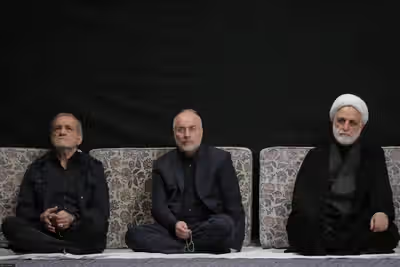
Military operations unfolded alongside the final stage of funeral ceremonies for former Supreme Leader Ali Khamenei.
After processions in Tehran, Qom, Najaf and Karbala, Khamenei's coffin was flown from Iraq to Mashhad for burial. Iranian authorities presented the ceremonies as a demonstration of regional solidarity, while IRGC-affiliated media published photographs it said showed Quds Force commander Esmail Qaani attending the funeral.
The past day's events showed how the confrontation has shifted beyond Iran's nuclear program, with the Strait of Hormuz emerging as the military and economic center of the conflict.