Political prisoners face disease in southwestern Iran prison


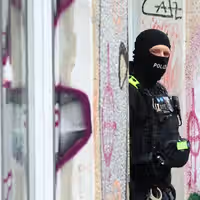
Repeated water cuts, muddy water and sewage overflow at Sheiban Prison in the southwestern Iranian city of Ahvaz have led to the spread of eye and kidney diseases among political prisoners, sources told Iran International.
Political prisoners held at the facility are facing a severe shortage of sanitary facilities and poor detention conditions, the sources said. In one ward, only one shower and one toilet are available to prisoners, forcing them to wait for hours to use them.
The sources said political prisoners are being held in the same ward as detainees accused of charges including membership in ISIS.
Political prisoner Hojat Al-Mohammad, who is held in the ward, is suffering from serious health problems including kidney disease and severe damage to his teeth but has so far been denied proper medical care, the sources said.




The United States and Iran expanded their military confrontation over the past 24 hours with fresh strikes, missile and drone attacks across the Persian Gulf and growing disruption to shipping through the Strait of Hormuz despite diplomatic efforts to preserve a ceasefire.
The latest US strikes hit southern Iran on Thursday, with a provincial official saying an attack on a pier in Sirik killed three people and wounded 15 others. Iranian media also reported explosions near Bandar Abbas, while a Bushehr official said projectiles struck areas around the province's nuclear power plant.
The attacks followed a broader US campaign against Iranian military infrastructure along the country's southern coast.
US Central Command said it struck around 90 military targets, including coastal surveillance systems, air defenses, anti-ship missile positions, drone and missile storage sites, logistics infrastructure and dozens of Islamic Revolutionary Guards Corps naval vessels, saying the operation was intended to reduce Iran's ability to threaten shipping in the Strait of Hormuz.
Iran responded by announcing missile and drone attacks on what it called US military facilities in Bahrain, Kuwait and Qatar, saying it targeted air defense systems, fuel storage sites and other military infrastructure in retaliation for the US strikes.
Bahrain and Kuwait said their air defenses intercepted incoming missiles and drones, while Jordan activated nationwide air raid sirens after missiles and drones entered its airspace.
The US Embassy in Amman urged Americans to seek shelter indoors, and Qatar condemned Iranian attacks on Bahrain, Jordan and Kuwait while urging all sides to return to diplomacy.
Strait of Hormuz
The confrontation increasingly centered on the Strait of Hormuz, one of the world's most important energy corridors.
Bloomberg reported commercial traffic through the waterway had slowed to a near standstill, while CBS News, citing vessel-tracking data, said only three fuel tankers were observed transiting the strait on Thursday.
The IRGC Navy said shipping had recovered to about half of pre-war levels under routes designated by Iran but warned any US attempt to control maritime traffic would receive a "crushing response."
Oil prices climbed to their highest levels in about three weeks as traders weighed the risks to global energy supplies.
Diplomacy falters
President Donald Trump said the United States had struck Iran "much harder" after attacks on commercial ships and warned further Iranian action would trigger an even stronger response.
He also questioned whether Tehran could be trusted to uphold any future agreement despite saying Iran had again sought negotiations.
Axios reported the White House was preparing for the possibility of a military exchange lasting days or even weeks depending on Iran's next moves in the Strait of Hormuz.
Iran accused Washington of violating the memorandum of understanding reached after April's ceasefire and appealed to the UN Security Council, arguing the latest strikes breached both the agreement and the UN Charter.
Qatar urged both Washington and Tehran to honor the memorandum and return to dialogue, while Iraq said it was seeking to promote rapprochement between the two countries.
Funeral ceremonies continue
Military operations unfolded alongside the final stage of funeral ceremonies for former Supreme Leader Ali Khamenei.
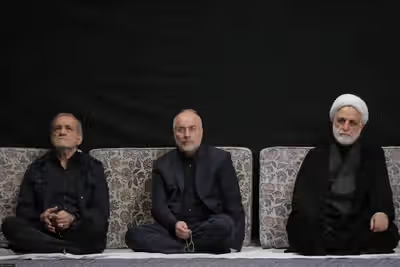
After processions in Tehran, Qom, Najaf and Karbala, Khamenei's coffin was flown from Iraq to Mashhad for burial. Iranian authorities presented the ceremonies as a demonstration of regional solidarity, while IRGC-affiliated media published photographs it said showed Quds Force commander Esmail Qaani attending the funeral.
The past day's events showed how the confrontation has shifted beyond Iran's nuclear program, with the Strait of Hormuz emerging as the military and economic center of the conflict.
Only three fuel tankers were seen transiting the Strait of Hormuz on Thursday as US-Iran hostilities intensified, CBS News reported, citing vessel-tracking data from MarineTraffic.
CBS said two of the vessels were under US sanctions over alleged links to Iranian fuel shipments, while a third tanker was not sanctioned but had shown what it described as suspicious movements consistent with ship-to-ship fuel transfers.
The report said the two outbound tankers were using the northern shipping lane designated by Iran, while it was possible other vessels were using the southern route near Oman's coast with their tracking transponders switched off. Iran has attacked three vessels using that route this week.
The naval arm of Iran's Islamic Revolutionary Guard Corps said on Thursday that "foreigners have no place in this land and the Strait of Hormuz," warning that any US “intervention” in shipping routes would disrupt the gradual reopening of the waterway.
In a statement, the IRGC Navy said it had restored traffic through the Strait to about 50% of pre-war levels and was increasing capacity for vessels that obtained permission to use routes designated by Iran.
It said any attempt by the US military to determine shipping routes would bring "a crushing response" and jeopardize the interests of countries using the Strait.
President Donald Trump’s tougher rhetoric toward Iran and renewed US strikes have stirred mixed reactions among Iranians, from hopes for political change to fears of another long and unresolved conflict after months of living between war and peace.
The responses shared with Iran International and posted on X and Instagram pointed less to enthusiasm for military escalation than to exhaustion after nearly four months of conflict. Many described life in a state of “neither war nor peace,” where even short-term decisions have been put on hold.
They spoke of worsening economic pressure, constant anxiety and tighter security conditions, as the United States and Iran traded a fresh round of attacks on Wednesday and Thursday, throwing their fragile agreement to end the war into deeper doubt.
The US military said it struck about 90 targets across Iran after Trump said the interim deal with Tehran is over for him, citing Iranian attacks on shipping in the Strait of Hormuz.
Iran responded with strikes on US-linked targets in Qatar, Bahrain and Kuwait, as both sides accused each other of violating the interim agreement.
The Pentagon said it targeted Iranian military sites involved in attacks on commercial shipping.
Iran’s foreign ministry said the US strikes hit civilian infrastructure, including two railway bridges on the route to Mashhad, where authorities planned to bury former Supreme Leader Ali Khamenei on Thursday. Fars said one was the Aq Taqeh Khan railway bridge in Golestan province, part of a northern route to China and Russia that became more important after the US blockade of Iran’s Persian Gulf ports.
Many messages sent to Iran International linked the timing of the strikes to Khamenei’s funeral, saying they disrupted what the Islamic Republic had tried to stage as a show of unity and political continuity.
“I hope this time the war makes a difference and this cancer is removed from the root. We’re all suffering,” one citizen wrote.
Others saw Trump’s tougher language as a sign that diplomacy with Tehran had reached a dead end.
“Should we tell Trump, ‘We told you so,’ or is it still too early?” one message read.
Another wrote: “Mr. Trump seems to have only just realized what kind of creature he is dealing with.”
Several urged Trump not to return to negotiations.
“Mr. Trump, Mr. Netanyahu and NATO leaders, have you realized yet that negotiating with the Islamic Republic is a waste of time?” one message said.
Another person in Tehran wrote: “Mr. Trump, you say bad days are coming for Iran. Come here for one day. If you find even one good day under the Islamic Republic, you’ll see the hell they have created for the people.”
Hope tempered by fear
Despite welcoming Trump's apparent shift away from diplomacy, several said they feared another drawn-out conflict that would deepen economic hardship without bringing meaningful political change.
"Mr. Trump, please stop. We don't know whether to worry about war, inflation, the dollar or our future," one citizen wrote.
Another said: "I'm only worried that war starts again but nothing changes. If war is inevitable, I hope it benefits the people of Iran."
Some openly encouraged stronger military action.
"President Trump, please finish the job quickly. People, don't lose hope. Our day of freedom is near," one message read.
Another added: "I'm a Trump supporter. I like him. He's a superpower that nobody can challenge. But sometimes he goes off script. Please, President Trump, finish the job this time. It's hard living in your own country with a group of criminals."
Others remained skeptical, saying Trump's previous preference for negotiations made them doubt whether the latest strikes would ultimately produce lasting change.
'Mohammad Something' becomes an instant meme
Trump's remarks on Wednesday also generated a wave of satire after he seemingly referred to chief negotiator Mohammad-Bagher Ghalibaf as "Mohammad something" while describing US surveillance of Iran's nuclear facilities.
The phrase quickly became one of the most widely shared jokes among Persian-language users on X, spawning countless memes aimed at senior Iranian officials.
X user Amin Parvin wrote: "We are living in a state of no war, no peace, no ceasefire and Mohammad Something."
Another user wrote: "Mohammad Something, Mojtaba (Khamenei) Nothing. You've become the laughing stock of the world."
Many directed the joke at Ghalibaf’s page after Trump appeared unable to recall his name.
"Mohammad Something, write your will. Trump didn't even bother learning your surname," one post said.
Another wrote: "Mohammad Something, it looks like this time it's your turn."
Reading Trump's strategy
Beyond the humor, users also debated whether Trump's harsher rhetoric signaled the abandonment of diplomacy or a negotiating tactic designed to force Iranian concessions.
"Trump is playing cat and mouse with them. He doesn't want a full-scale war yet. He's waiting for their response before deciding what to do next," one X user wrote.
Another posted: "I'm genuinely happy Trump is finally seeing their true nature."
Others argued Trump still preferred a negotiated settlement but believed military pressure had become his principal leverage.
"Trump loves being able to say he defeated them without war, so he's trying to disarm them through negotiations," one user wrote. "But their file is closed. Trump himself has said they'll lose their uranium either through negotiations or through war."
The Islamic Republic sought to turn Ali Khamenei’s funeral ceremonies in Iraq into a regional show of loyalty, using processions in Najaf and Karbala to suggest that his authority reached beyond Iran even as Tehran’s allied network faces growing pressure.
After funeral processions in Tehran and Qom, the coffins of Khamenei and several members of his family, who were killed in the February 28 US-Israeli attack, were taken on Tuesday to Najaf, home to the shrine of Imam Ali, one of the holiest sites in Shiite Islam.
They were transferred on Wednesday to Karbala, home to the shrine of Imam Hussein. Both cities carry deep religious symbolism for Shiites, especially in narratives of martyrdom, sacrifice and political defiance.