Exiled prince urges Dutch lawmakers to back Iran democracy movement
Iran's exiled prince Reza Pahlavi, in an address to the Dutch parliament’s Foreign Affairs Committee on Monday, called for supporting the Iranian people’s struggle for democracy, describing it as an investment in the security of the Netherlands and the stability of Europe.
Pahlavi said a democratic Iran would end support for terrorism, stop supplying equipment to Russia’s war machine, help stabilize the region and become a partner for Europe in trade and investment.
“The Islamic Republic is no longer merely a challenge in the Middle East; it has become a threat to Europe and the world,” Pahlavi said, according to a copy of his speech published by his press office.
“Supporting the people of Iran is not merely a humanitarian gesture toward a distant country; it is an investment in the security of the Netherlands, the stability of Europe and a Middle East that exports trade, cooperation and prosperity instead of terrorism, instability and waves of refugees,” he said.
Iranian Parliament Speaker Mohammad Bagher Ghalibaf said those responsible for the killing of Ali Khamenei would be punished, adding that the “final step of revenge” would be realized through the “liberation of Jerusalem.”
In a message marking Khamenei’s funeral procession in Tehran, Ghalibaf said Iranians had spent the past four months chanting “Death to America” and “Death to Israel” and demanding revenge against what he called “the killers of our martyred imam.”
“The aggressors against Islamic Iran and the killers of the martyrs of this land, especially the leader of the ummah, will pay for their actions,” he said.
Ghalibaf, who leads Iran's negotiations with the United States, said the struggle would continue through both military and diplomatic means, describing negotiations as part of Iran’s broader “civilizational” confrontation with what he called domineering powers.
British nationals Craig and Lindsay Foreman remain on hunger strike in Tehran’s Evin prison and have been denied adequate medical care, essential medicine and family phone calls, US-based rights group HRANA reported on Monday.
The report said Lindsay Foreman had not received a medical checkup for about 10 days and was suffering from dizziness, body tremors, severe weakness and more than 14 kg of weight loss. Craig Foreman had lost about 16 kilograms, it added.
HRANA cited an informed source as saying the couple had recently been allowed phone contact with their lawyer but remained barred from speaking to their family, children and each other.
The source said pressure on the couple intensified after interviews with BBC World in which they discussed executions in Iran.
Craig and Lindsay Foreman were sentenced to 10 years in prison in February on espionage charges, which they deny.
The couple were first detained in the southeastern city of Kerman, where they spent 30 days in solitary confinement before being transferred to Tehran, the family has said, adding that, they had entered Iran with valid visas, a licensed guide and a cleared itinerary.
Almost a third of vessels crossing the Strait of Hormuz in recent days used a route along Oman’s coast, CNN reported, citing maritime tracking agency MarineTraffic.
One hundred and eight vessels crossed the strait from Friday through Sunday, the report said. Of those, 30 vessels, including crude and LPG tankers, followed the Omani route.
Vessel traffic through the channel, which carries about one-fifth of global oil and liquefied gas supplies, was highest on Friday, with 43 crossings. Saturday and Sunday saw 34 and 31 crossings respectively.
Washington is “close to maybe making a deal” with Iran, US President Donald Trump said on Monday, but warned the United States would “finish the job” if no agreement is reached, adding that it could destroy Iran’s bridges and power plants within hours.
“We’re either going to make a deal or we’re going to finish the job,” Trump said. “And it won’t be tough to finish the job.”
Trump said he would rather reach an agreement because he did not want to affect Iran’s population.
“I’d rather make a deal because I don’t want to affect 91 million people,” he said. “We can knock down their bridges in one hour. We can knock out their energy supply.”
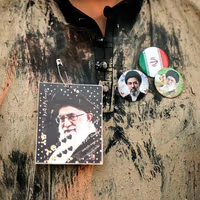
Supreme Leader Ali Khamenei's funeral procession in Tehran on July 5, 2026.
The Islamic Republic's state funeral for Ali Khamenei has drawn criticism over its attendance, the extensive public resources devoted to the event and what many Iranians described as an unsuccessful attempt to project political strength, following the burial ceremony.
Images and videos from Tehran's prayer ground complex prompted widespread discussion among Iranians, with many saying attendance fell short despite an extensive state mobilization effort.
Messages sent to Iran International argued authorities relied on government employees, security forces, organized transportation, free meals and public holidays to maximize turnout, yet still failed to fill the designated venue.
For many, the relatively sparse gathering represented more than a logistical disappointment. They viewed it as evidence of a widening gap between the establishment and society, arguing the Islamic Republic could no longer convincingly stage large public displays of popular support.
Several citizens contrasted the official portrayal of the funeral as a demonstration of national unity with what they described as a subdued public response after nearly five decades of clerical rule.
Symbolism meets economic hardship
Many reactions focused on the economic contrast between the scale of the ceremony and the financial pressures facing ordinary Iranians.
Iranians questioned the use of public resources for an elaborate state funeral at a time when inflation, declining purchasing power and rising living costs continue to dominate daily life.
Several described households that have reduced or eliminated meat and other protein from their diets, arguing that spending on ceremonial events appeared disconnected from the country's economic realities.
Others said successive crises – including war, sanctions, regional isolation and economic decline – had not altered what they viewed as the system's priority of funding state institutions and political messaging ahead of public welfare.
Contradictory political messaging
Another frequently discussed issue involved videos circulating on social media showing participants symbolically pelting an image of US President Donald Trump with stones during the funeral events.
Supreme Leader Ali Khamenei's funeral procession in Tehran on July 5, 2026.
Some citizens highlighted what they saw as a contradiction between anti-US demonstrations and expectations that Iranian and US officials could resume negotiations in the near future.
They argued that confrontational domestic messaging has repeatedly existed alongside diplomatic engagement, reflecting what they described as two parallel tracks in the Islamic Republic's foreign policy.
Questions over the cost
No official estimate has been released for the total cost of the funeral and burial ceremonies.
Nevertheless, many messages attempted to estimate the overall expenditure by citing security deployments, temporary infrastructure, transportation, accommodation, food distribution, ceremonial preparations and construction work carried out along the procession route.
Some suggested the total bill could approach $800 million, although no official evidence has been presented to support that figure.
The estimate prompted comparisons with recent funerals for other world leaders.
Several people pointed to the funeral of Elizabeth II in 2022, which the British government estimated cost around £162 million – roughly $200 million at contemporary exchange rates. The event included days of public lying-in-state, thousands of police and military personnel, extensive international participation and worldwide television coverage.
Others referred to the funerals of Omani Sultan Qaboos bin Said and Kuwaiti Emir Sabah Al-Ahmad Al-Jaber Al-Sabah, both of which followed Islamic tradition with relatively swift burial ceremonies. Although no comprehensive official costs were released, participants noted those events appeared considerably more modest despite taking place in wealthy Persian Gulf monarchies.
Debate over public priorities
Many also drew comparisons with the Islamic Republic's longstanding criticism of the lavish celebrations marking the 2,500th anniversary of the Persian Emire under the Pahlavi dynasty.
They questioned why authorities that had long condemned those celebrations as wasteful were now directing substantial public funds toward a funeral ceremony during a period of economic hardship.
Supreme Leader Ali Khamenei's funeral procession in Tehran on July 5, 2026.
Several messages further said that the system has never devoted comparable financial and organizational resources to national celebrations such as Nowruz, Yalda Night or Chaharshanbe Suri, despite their broad cultural significance.
For many, the debate surrounding the funeral extended beyond attendance or cost. They said the ceremony reflected broader concerns about state priorities, economic management and political legitimacy.
Rather than reinforcing the image of a confident political system, citizens argued the funeral underscored the difficulties facing a regime confronting deep economic challenges and declining public trust, even as it sought to present the burial of its longtime leader as a demonstration of continuity and authority.