Trump says US will ‘finish the job’ if no deal reached with Iran
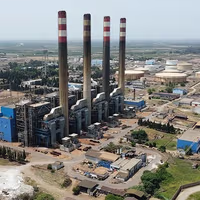
Washington is “close to maybe making a deal” with Iran, US President Donald Trump said on Monday, but warned the United States would “finish the job” if no agreement is reached, adding that it could destroy Iran’s bridges and power plants within hours.
“We’re either going to make a deal or we’re going to finish the job,” Trump said. “And it won’t be tough to finish the job.”
Trump said he would rather reach an agreement because he did not want to affect Iran’s population.
“I’d rather make a deal because I don’t want to affect 91 million people,” he said. “We can knock down their bridges in one hour. We can knock out their energy supply.”
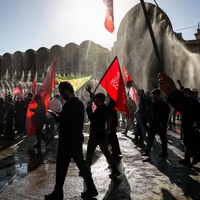
Supreme Leader Ali Khamenei's funeral procession in Tehran on July 5, 2026.
The Islamic Republic's state funeral for Ali Khamenei has drawn criticism over its attendance, the extensive public resources devoted to the event and what many Iranians described as an unsuccessful attempt to project political strength, following the burial ceremony.
Images and videos from Tehran's prayer ground complex prompted widespread discussion among Iranians, with many saying attendance fell short despite an extensive state mobilization effort.
Messages sent to Iran International argued authorities relied on government employees, security forces, organized transportation, free meals and public holidays to maximize turnout, yet still failed to fill the designated venue.
For many, the relatively sparse gathering represented more than a logistical disappointment. They viewed it as evidence of a widening gap between the establishment and society, arguing the Islamic Republic could no longer convincingly stage large public displays of popular support.
Several citizens contrasted the official portrayal of the funeral as a demonstration of national unity with what they described as a subdued public response after nearly five decades of clerical rule.
Symbolism meets economic hardship
Many reactions focused on the economic contrast between the scale of the ceremony and the financial pressures facing ordinary Iranians.
Iranians questioned the use of public resources for an elaborate state funeral at a time when inflation, declining purchasing power and rising living costs continue to dominate daily life.
Several described households that have reduced or eliminated meat and other protein from their diets, arguing that spending on ceremonial events appeared disconnected from the country's economic realities.
Others said successive crises – including war, sanctions, regional isolation and economic decline – had not altered what they viewed as the system's priority of funding state institutions and political messaging ahead of public welfare.
Contradictory political messaging
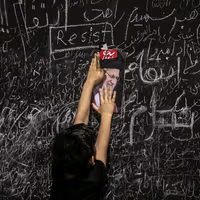
Another frequently discussed issue involved videos circulating on social media showing participants symbolically pelting an image of US President Donald Trump with stones during the funeral events.
Supreme Leader Ali Khamenei's funeral procession in Tehran on July 5, 2026.
Some citizens highlighted what they saw as a contradiction between anti-US demonstrations and expectations that Iranian and US officials could resume negotiations in the near future.
They argued that confrontational domestic messaging has repeatedly existed alongside diplomatic engagement, reflecting what they described as two parallel tracks in the Islamic Republic's foreign policy.
Questions over the cost
No official estimate has been released for the total cost of the funeral and burial ceremonies.
Nevertheless, many messages attempted to estimate the overall expenditure by citing security deployments, temporary infrastructure, transportation, accommodation, food distribution, ceremonial preparations and construction work carried out along the procession route.
Some suggested the total bill could approach $800 million, although no official evidence has been presented to support that figure.
The estimate prompted comparisons with recent funerals for other world leaders.
Several people pointed to the funeral of Elizabeth II in 2022, which the British government estimated cost around £162 million – roughly $200 million at contemporary exchange rates. The event included days of public lying-in-state, thousands of police and military personnel, extensive international participation and worldwide television coverage.
Others referred to the funerals of Omani Sultan Qaboos bin Said and Kuwaiti Emir Sabah Al-Ahmad Al-Jaber Al-Sabah, both of which followed Islamic tradition with relatively swift burial ceremonies. Although no comprehensive official costs were released, participants noted those events appeared considerably more modest despite taking place in wealthy Persian Gulf monarchies.
Debate over public priorities
Many also drew comparisons with the Islamic Republic's longstanding criticism of the lavish celebrations marking the 2,500th anniversary of the Persian Emire under the Pahlavi dynasty.
They questioned why authorities that had long condemned those celebrations as wasteful were now directing substantial public funds toward a funeral ceremony during a period of economic hardship.
Supreme Leader Ali Khamenei's funeral procession in Tehran on July 5, 2026.
Several messages further said that the system has never devoted comparable financial and organizational resources to national celebrations such as Nowruz, Yalda Night or Chaharshanbe Suri, despite their broad cultural significance.
For many, the debate surrounding the funeral extended beyond attendance or cost. They said the ceremony reflected broader concerns about state priorities, economic management and political legitimacy.
Rather than reinforcing the image of a confident political system, citizens argued the funeral underscored the difficulties facing a regime confronting deep economic challenges and declining public trust, even as it sought to present the burial of its longtime leader as a demonstration of continuity and authority.
Gholamhossein Mohseni Ejei was recently reappointed as judiciary chief for another five-year term, reinforcing the Islamic Republic’s security-focused judicial system and offering an early indication of how Supreme Leader Mojtaba Khamenei intends to manage power.
The appointment, issued under Article 157 of Iran’s constitution, leaves one of the Islamic Republic’s longest-serving judicial and intelligence figures at the head of an institution that has played a central role in prosecuting dissent, overseeing political cases and implementing the state’s domestic security policies.
Mohseni Ejei, 69, has spent more than four decades moving between the Revolutionary Courts, the Intelligence Ministry and the judiciary, making him one of the few senior officials with experience across all three pillars of Iran’s security establishment.
Gholamhossein Mohseni Ejei was recently reappointed as judiciary chief for another five-year term, reinforcing the Islamic Republic’s security-focused judicial system and offering an early indication of how Supreme Leader Mojtaba Khamenei intends to manage power.
The appointment, issued under Article 157 of Iran’s constitution, leaves one of the Islamic Republic’s longest-serving judicial and intelligence figures at the head of an institution that has played a central role in prosecuting dissent, overseeing political cases and implementing the state’s domestic security policies.
Mohseni Ejei, 69, has spent more than four decades moving between the Revolutionary Courts, the Intelligence Ministry and the judiciary, making him one of the few senior officials with experience across all three pillars of Iran’s security establishment.
Unlike many first-generation clerics who rose through purely religious institutions, Mohseni Ejei also earned a master's degree in private international law. That legal education, however, has done little to shape his public image, which has instead been defined by security cases, political prosecutions and harsh judicial policies.
His rise began during the 1980s, when he served as an investigator in the case against Mehdi Hashemi, the brother-in-law of the late Grand Ayatollah Hossein Ali Montazeri. The prosecution helped weaken Montazeri's political standing before he was removed as the designated successor to the Islamic Republic's founder, Ruhollah Khomeini.
That early role established Mohseni Ejei as an official closely associated with politically sensitive investigations, forced confessions and cases that blurred the boundary between judicial procedure and national security.
Security insider
Official biographies highlight his studies at the Haqqani Seminary and his involvement in prominent corruption prosecutions during the 1990s, including cases involving businessman Fazel Khodadad and former Tehran mayor Gholamhossein Karbaschi.
His career expanded further when he became intelligence minister under President Mahmoud Ahmadinejad before being dismissed in 2009. He was subsequently appointed prosecutor general, later became first deputy judiciary chief and assumed the judiciary's top post in 2021.
The combination of intelligence, prosecutorial and judicial experience has made Mohseni Ejei one of the Islamic Republic's most trusted officials for handling politically sensitive files involving opposition figures, corruption allegations and national security matters.
Supporters portray him as an experienced administrator familiar with every layer of Iran's judicial system. Critics argue his career reflects the increasing integration of intelligence agencies and the courts, turning judicial institutions into instruments for enforcing political control.
Mohseni Ejei has also maintained an unusually low public profile outside official duties. Unlike many senior Iranian politicians, he rarely projects a personal image or family life through the media, appearing primarily in court proceedings, official meetings and state broadcasts.
'The man who bites'
Among many Iranians, Mohseni Ejei's public reputation extends beyond his judicial decisions.
One of the most enduring stories surrounding him dates to 2004, when journalist Isa Saharkhiz accused Mohseni Ejei of throwing a cube-sugar bowl and biting his shoulder during a dispute at a meeting of Iran's Press Supervisory Board. The account became one of the defining anecdotes associated with his public image.
His international profile, however, has been shaped more by human rights concerns than by personal controversies.
The United States Department of the Treasury sanctioned Mohseni Ejei in September 2010 over his role in serious human rights abuses following Iran's disputed 2009 presidential election. The sanctions placed him alongside other senior Iranian security officials accused of involvement in post-election repression.
The European Union also imposed human rights sanctions on him, citing his role in unfair trials and severe prison and death sentences against political activists and protesters.
Judiciary under scrutiny
During his first term as judiciary chief, Mohseni Ejei said wants to promote themes including judicial reform, anti-corruption efforts and reducing court delays.
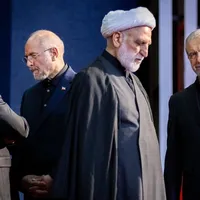
Judiciary Chief Gholamhossein Mohseni Ejei, recently appointed to a new five-year term, attends a ceremony alongside President Masoud Pezeshkian (left) and Parliament Speaker Mohammad Bagher Ghalibaf (center).
Human rights organizations, however, have argued the judiciary became more deeply involved in suppressing political opposition, particularly following the 2022 Woman, Life, Freedom protests triggered by the death of Mahsa Amini in morality police custody.
Mohseni Ejei publicly defended death sentences imposed on some protesters after those demonstrations.
Amnesty International said in September 2025 that Iran had executed more than 1,000 people that year, describing it as the highest annual total recorded by the organization in at least 15 years. The group said authorities had increasingly relied on capital punishment following the Woman, Life, Freedom protests.
The Iran Human Rights annual report recorded at least 1,639 executions during 2025, saying more than 93% were never officially announced and that Revolutionary Courts handed down 852 execution sentences during the year.
Following the recent conflict involving Israel and the United States, rights groups have also accused Iranian authorities of accelerating political prosecutions under wartime conditions.
Amnesty International said in May 2026 that Iranian authorities had intensified mass arrests, expedited trials and politically motivated executions, documenting at least 42 executions on political charges since late February after proceedings it described as unfair.
Mohseni Ejei's reappointment follows days of speculation that Iran's new leadership might replace him to demonstrate a change of direction. Instead, retaining him suggests continuity rather than restructuring at the judiciary.
The decision shows that, at least in the early phase of Mojtaba Khamenei's leadership, judicial authority will remain closely aligned with Iran's security institutions, reinforcing a model in which the courts continue to play a central role in maintaining political control rather than signaling a broader opening of the country's legal system.
Iranian President Masoud Pezeshkian will travel to Iraq to attend funeral ceremonies for former Supreme Leader Ali Khamenei in Najaf and Karbala, the semi-official ISNA news agency reported on Monday.
It also denied earlier reports that Mostafa Khamenei, Khamenei’s eldest son, and Parliament Speaker Mohammad Bagher Ghalibaf would also attend the ceremonies in Iraq.
Mehr News had earlier reported that Khamenei’s body would arrive in Najaf accompanied by Pezeshkian, Ghalibaf and Khamenei’s eldest son.
The Joint Maritime Information Center said on Monday that the southern route through the Strait of Hormuz remained available to commercial shipping, while the maritime security threat level in the area remained “substantial.”
The advisory said mariners should expect VHF hailing from naval forces and be aware of the mine danger area in the traditional traffic separation scheme.
It said vessels could transit the southern route day or night with AIS switched on, radars operating, running lights on and normal VHF use.
JMIC encouraged vessels to communicate with US Navy maritime coordination authorities for information on safe transit routes.