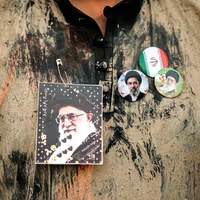
Iran's costly farewell for supreme leader draws backlash
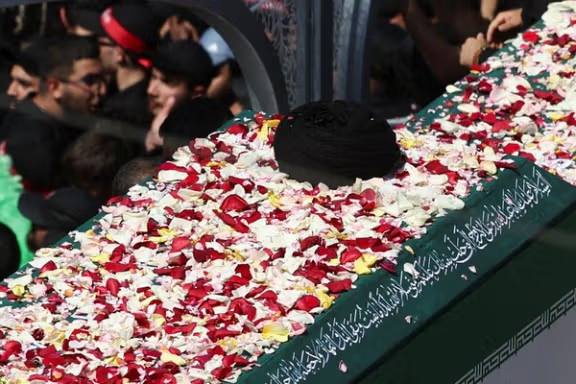

The Islamic Republic's state funeral for Ali Khamenei has drawn criticism over its attendance, the extensive public resources devoted to the event and what many Iranians described as an unsuccessful attempt to project political strength, following the burial ceremony.
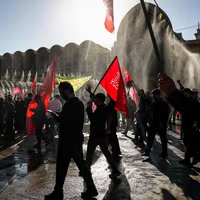
Images and videos from Tehran's prayer ground complex prompted widespread discussion among Iranians, with many saying attendance fell short despite an extensive state mobilization effort.
Messages sent to Iran International argued authorities relied on government employees, security forces, organized transportation, free meals and public holidays to maximize turnout, yet still failed to fill the designated venue.
For many, the relatively sparse gathering represented more than a logistical disappointment.
Read the full article here.



The Islamic Republic's state funeral for Ali Khamenei has drawn criticism over its attendance, the extensive public resources devoted to the event and what many Iranians described as an unsuccessful attempt to project political strength, following the burial ceremony.
Images and videos from Tehran's prayer ground complex prompted widespread discussion among Iranians, with many saying attendance fell short despite an extensive state mobilization effort.
Messages sent to Iran International argued authorities relied on government employees, security forces, organized transportation, free meals and public holidays to maximize turnout, yet still failed to fill the designated venue.
For many, the relatively sparse gathering represented more than a logistical disappointment. They viewed it as evidence of a widening gap between the establishment and society, arguing the Islamic Republic could no longer convincingly stage large public displays of popular support.
Several citizens contrasted the official portrayal of the funeral as a demonstration of national unity with what they described as a subdued public response after nearly five decades of clerical rule.
Symbolism meets economic hardship
Many reactions focused on the economic contrast between the scale of the ceremony and the financial pressures facing ordinary Iranians.
Iranians questioned the use of public resources for an elaborate state funeral at a time when inflation, declining purchasing power and rising living costs continue to dominate daily life.
Several described households that have reduced or eliminated meat and other protein from their diets, arguing that spending on ceremonial events appeared disconnected from the country's economic realities.
Others said successive crises – including war, sanctions, regional isolation and economic decline – had not altered what they viewed as the system's priority of funding state institutions and political messaging ahead of public welfare.
Contradictory political messaging
Another frequently discussed issue involved videos circulating on social media showing participants symbolically pelting an image of US President Donald Trump with stones during the funeral events.
Some citizens highlighted what they saw as a contradiction between anti-US demonstrations and expectations that Iranian and US officials could resume negotiations in the near future.
They argued that confrontational domestic messaging has repeatedly existed alongside diplomatic engagement, reflecting what they described as two parallel tracks in the Islamic Republic's foreign policy.
Questions over the cost
No official estimate has been released for the total cost of the funeral and burial ceremonies.
Nevertheless, many messages attempted to estimate the overall expenditure by citing security deployments, temporary infrastructure, transportation, accommodation, food distribution, ceremonial preparations and construction work carried out along the procession route.
Some suggested the total bill could approach $800 million, although no official evidence has been presented to support that figure.
The estimate prompted comparisons with recent funerals for other world leaders.
Several people pointed to the funeral of Elizabeth II in 2022, which the British government estimated cost around £162 million – roughly $200 million at contemporary exchange rates. The event included days of public lying-in-state, thousands of police and military personnel, extensive international participation and worldwide television coverage.
Others referred to the funerals of Omani Sultan Qaboos bin Said and Kuwaiti Emir Sabah Al-Ahmad Al-Jaber Al-Sabah, both of which followed Islamic tradition with relatively swift burial ceremonies. Although no comprehensive official costs were released, participants noted those events appeared considerably more modest despite taking place in wealthy Persian Gulf monarchies.
Debate over public priorities
Many also drew comparisons with the Islamic Republic's longstanding criticism of the lavish celebrations marking the 2,500th anniversary of the Persian Emire under the Pahlavi dynasty.
They questioned why authorities that had long condemned those celebrations as wasteful were now directing substantial public funds toward a funeral ceremony during a period of economic hardship.
Several messages further said that the system has never devoted comparable financial and organizational resources to national celebrations such as Nowruz, Yalda Night or Chaharshanbe Suri, despite their broad cultural significance.
For many, the debate surrounding the funeral extended beyond attendance or cost. They said the ceremony reflected broader concerns about state priorities, economic management and political legitimacy.
Rather than reinforcing the image of a confident political system, citizens argued the funeral underscored the difficulties facing a regime confronting deep economic challenges and declining public trust, even as it sought to present the burial of its longtime leader as a demonstration of continuity and authority.
Funeral spending for former Supreme Leader Ali Khamenei has fueled public anger, with messages to Iran International saying authorities are forcing businesses and state employees to fund ceremonies, provide services or attend events before his burial.
More than four months after Khamenei's death on February 28, authorities say he will be buried on July 9 following five days of ceremonies across Iran and Iraq. Officials have attributed the unusually long delay to wartime conditions and security concerns.
Messages sent to Iran International from people across the country describe what was a broad campaign to mobilize resources for the funeral, even as many Iranians struggle with inflation and declining living standards.
"We work at the terminal, and they told us we are not allowed to sell tickets for three days," one person wrote. "Every shop inside the terminal has also been ordered to close, and they are not even reducing our rent."
Businesses told to shoulder costs
Another message from Semnan said industrial companies had been instructed to finance roadside service stations for mourners.
"They forced companies in the industrial zone to set up booths and provide soup, tea, juice and dates at their own expense," the person wrote. "This is a government order for all organizations."
Another message said companies in Tehran had been compelled to contribute large sums for the funeral.
"The Islamic Republic and the Revolutionary Guards have forced all companies in Tehran to pay for booths and food for the funeral," the message said. "More than 1,000 billion rials (over $570,000) has been taken from automobile manufacturers, while workers are struggling to make ends meet."
People identifying themselves as employees of Iran's Civil Registration Organization also said staff had been offered incentives to attend the ceremonies.
"Today we were each given 20 kilograms of rice so we would participate in the ceremony," a citizen said. "But we are going to northern Iran instead (for fun)."
The reported pressure comes as the average monthly income is around $150, according to independent estimates, well below a poverty line estimated at roughly $350 for a family, leaving many households struggling to meet basic needs.
Economic hardship fuels backlash
Several also criticized the cost of the funeral during a period of economic hardship.
"People are being destroyed by poverty and inflation, while those in power are spending the nation's wealth on the funeral," one person wrote.
Another said bread prices had been raised before the ceremonies, but they are distributing free bread.
"They increased bread prices just before the funeral," the message read. "Now they want to hand out free bread along the procession routes so more people will attend."
A large number of messages urged people to wear bright-colored clothing instead of black during the official mourning period, saying they would mark the occasion by celebrating rather than mourning. Several also described Khamenei's burial as symbolizing the eventual end of the Islamic Republic.
Iran has announced funeral processions beginning in Tehran before continuing through Qom, Iraqi cities of Najaf and Karbala ahead of Khamenei's burial in Mashhad on July 9.
Images published by state media on Friday showed foreign delegations attending a ceremony in Tehran where the coffins of Khamenei and members of his family were on display.
Authorities have also announced heightened security measures, including temporary airspace restrictions over Tehran and Mashhad during the ceremonies.
Dozens of messages sent to Iran International say Iranian authorities and state-linked institutions are pressuring workers, businesses and charities to take part in funeral ceremonies for slain Supreme Leader Ali Khamenei.
The accounts describe a broad campaign of workplace directives, business closures and logistical mobilization in the days leading up to Khamenei’s funeral and burial.
The Islamic Republic's second Supreme Leader was killed on the morning of February 28, in the opening hours of the war with Israel and the United States.
More than four months after Khamenei's death, authorities say he will be buried on July 9 following five days of ceremonies across Iran and Iraq. Officials have attributed the unusually long delay to wartime conditions and security concerns, a sign of the political sensitivity and logistical difficulty surrounding the former leader’s burial.
Several messages said that businesses had been warned to close during the ceremonies or face penalties if they remained open.
"We received a text message from the real estate union saying we are not allowed to open our office during the funeral days and must attend the ceremonies," one Tehran resident wrote.
Another message from Tehran said members of the Basij visited shops and warned owners that businesses opening during the mourning period would be sealed.
"My parents are shopkeepers. Basij members told our shop and others nearby that if we open during the funeral days, the shop will be sealed," the citizen said.
Others described wider economic disruption linked to the ceremonies.
One Tehran gym owner wrote that officials had instructed fitness centers to close from Saturday through Wednesday.
Another message said Tehran's Grand Bazaar had been ordered shut until Thursday, adding that the prolonged closure would place further pressure on already struggling businesses.
Workers describe mandatory attendance
Several messages added that public-sector employees were ordered to attend official ceremonies.
One Tehran municipality employee said all leave had been canceled and staff across municipal bodies had been ordered to attend the ceremonies.
Another message referred to an audio recording attributed to the human resources director of Tehran Municipality's District 10, which instructed all employees, including parents with young children and workers with serious medical conditions, to attend.
The Hamshahri newspaper group, another citizen said, had instructed management to provide 200 employees for the ceremonies.
Workers at automaker Saipa also described disruptions, with one employee saying overtime had been canceled as company facilities were prepared to accommodate around 2,000 visitors from Iraq attending the funeral.
Charities, restaurants and residents pressured
Messages also pointed to pressure beyond government workplaces.
One message from Nahavand in Hamedan province said local officials summoned charities on Wednesday and demanded they contribute to the funeral, warning that their work could be disrupted if they refused.
Another said that police and Basij members visited restaurants in an industrial town near Tehran and warned owners they must prepare thousands of free meals for mourners or risk closure.
A Tehran resident also reported that text messages encouraged households to host visitors traveling to the capital for the ceremonies.
Extensive state mobilization
Official announcements indicate the authorities are preparing a large logistical operation for the funeral.
The Basij Organization for Guilds said 50 million loaves of bread were being prepared nationwide with the participation of bakers' unions, while 16 mobile bakeries would be deployed across Tehran and surrounding areas to prevent shortages.
Several messages criticized the scale of those preparations, contrasting them with economic hardship and reductions in public support.
"Free trains and hotels are available for their leader's burial, but student food subsidies have been cut," one student wrote.
Another message said bread was being transported from Kerman for the ceremonies, adding that transport resources would face additional pressure.
Iran has announced that funeral processions will begin in Tehran on July 4 before continuing through Qom, Najaf and Karbala ahead of Khamenei's burial in Mashhad on July 9. Authorities have also announced heightened security measures, including temporary airspace restrictions over Tehran and Mashhad during the ceremonies.
Rising drug prices and lagging insurance coverage are pushing diabetes medication further out of reach in Iran, documents obtained by Iran International show, with one patient’s NovoMix FlexPen insulin payment rising more than 24-fold in less than two months.
The patient paid 1,592,500 rials (about $0.91) for 15 insulin pens in early May. The same prescription, purchased from the same pharmacy in Tabriz on June 28, cost 39,092,500 rials (about $22.27), an increase of about 2,355%.
The sharp rise in the patient's bill far exceeded the increase in the price of the medicine itself. The total cost of the prescription rose from 96,862,500 rials (about $55.19) to 134,362,500 rials (about $76.56), an increase of 37,500,000 rials (about $21.37), or about 38.7%.
Rising drug prices and lagging insurance coverage are pushing diabetes medication further out of reach in Iran, documents obtained by Iran International show, with one patient’s NovoMix FlexPen insulin payment rising more than 24-fold in less than two months.
The patient paid 1,592,500 rials (about $0.91) for 15 insulin pens in early May. The same prescription, purchased from the same pharmacy in Tabriz on June 28, cost 39,092,500 rials (about $22.27), an increase of about 2,355%.
The sharp rise in the patient's bill far exceeded the increase in the price of the medicine itself. The total cost of the prescription rose from 96,862,500 rials (about $55.19) to 134,362,500 rials (about $76.56), an increase of 37,500,000 rials (about $21.37), or about 38.7%.
The receipts show the same billing categories, including the insurer's contribution, the patient's share, coverage for patients with special illnesses and pharmacy service fees. But while the drug's price increased, the Social Security Organization's reimbursement remained fixed at 96,000,000 rials (about $54.70), leaving the patient to pay the difference.
The newer receipt also included a new line item labeled "difference" worth 37,500,000 rials (about $21.37), transferring the additional cost directly to the patient. That line did not appear on the receipt issued in early May.
As a result, while the price of the drug itself increased by less than 40%, the patient's out-of-pocket payment rose more than 24-fold because the insurance reimbursement ceiling was not adjusted.
Drug prices continue to climb
Iran International reported in late April that insulin prices had already surged compared with levels before the Persian New Year (March 21), with some domestically produced brands rising by up to 212% and imported products by as much as 271%.
The latest receipts suggest prices have continued to rise since then, while also highlighting the growing burden on patients as insurance coverage has failed to keep pace with higher costs.
Industry blames production costs
Pharmaceutical industry representatives say the crisis has been driven by a combination of factors, including the removal of subsidized exchange rates, the depreciation of the rial, higher prices for raw materials and packaging, rising wages, increased financing costs and supply chain disruptions linked to the recent war.
They say manufacturers have also struggled with higher working capital requirements, while delayed price adjustments and insufficient government and banking support have compounded the problem.
Since January, following the government's exchange-rate unification policy, pharmaceutical raw materials that had previously been imported at a subsidized exchange rate have instead been purchased at rates more than five times higher.
Mohammad Abdehzadeh, head of the Health Economy Commission at the Tehran Chamber of Commerce, told Donya-ye Eqhtesad on Wednesday that most medicines had been removed from the subsidized currency system since March and were now being produced using the new exchange rate.
The newspaper said Iran's pharmaceutical sector was facing twin pressures: producers struggling with sharply higher manufacturing costs and liquidity shortages, and patients increasingly forced to bear a much larger share of medicine costs out of pocket.