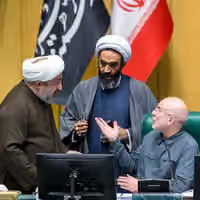
Sources inside Iran told Iran International that Khamenei does not intend to extend Eje'i’s term for another five years, breaking with a practice followed for nearly four decades in which judiciary chiefs have usually served two consecutive five-year terms.
The sources, who spoke on condition of anonymity, said the decision is not aimed at judicial reform but is part of a broader reshaping of power after the recent war.
They said the new supreme leader is seeking to replace key officials in major state institutions with figures more closely aligned with him.
Eje'i’s expected removal could mark one of the first major signs of Khamenei’s effort to rebuild control over the Islamic Republic’s judicial, security and political apparatus after the transfer of power.
Hardliners step up pressure on Eje'i
The decision comes amid growing criticism of Eje'i from hardline figures after the names of Supreme National Security Council members who voted in favor of a memorandum of understanding with the United States were disclosed.
Critics say Eje'i’s vote was at odds with Khamenei’s stated position, after the leader said in a letter that he had, in principle, held a different view on the memorandum of understanding.
Signs of dissatisfaction with Eje'i’s five-year record have also appeared in recent official and semi-official commentary close to the power structure.
In a message marking Judiciary Week, Khamenei did not clearly endorse Eje'i’s continuation in office. Instead, he addressed the judiciary as an institution and called for the “actualization” of demands previously made by former Supreme Leader Ali Khamenei.
The message repeated calls for the implementation of the judicial transformation document, fighting corruption inside the judiciary, reviving public rights, blocking the use of recommendations and lobbying, and improving communication with the public.
Eje'i seeks to defend his record
A day later, Eje'i published a letter to Khamenei in deferential language, defending the judiciary’s performance and pledging to continue the path of “judicial transformation.”
“I and all components of the judiciary consider ourselves obliged to carry out Your Excellency’s binding commands precisely, swiftly and without any reduction,” Eje'i wrote.
Media outlets and figures close to the establishment criticized Eje'i for not publishing such a letter before Khamenei’s message. Some also described the new leader’s renewed emphasis on his father’s demands as a negative assessment of Eje'i’s record, arguing that their repetition showed the judiciary had failed to deliver practical results under him.
Rival factions inside the establishment have also stepped up attacks on Eje'i, accusing him of distancing himself from the leadership’s demands.
Media close to Parliament Speaker Mohammad Bagher Ghalibaf and President Masoud Pezeshkian have described the attacks as part of an effort by the faction aligned with Saeed Jalili, a member of Iran’s Supreme National Security Council, and the Paydari Front to create divisions among senior officials and weaken the postwar political path.
Media close to the judiciary and Eje'i’s supporters have sought to portray his five-year record as successful, citing reduced imprisonment, electronic court proceedings, shorter trials, anti-corruption efforts and public outreach.
Rights groups point to record of repression
Human rights groups and activists say Eje'i is not a reformist figure but a long-standing part of the Islamic Republic’s repressive judicial and security apparatus.
They point to his record in the Special Clerical Court, the Ministry of Intelligence, and later as first deputy and head of the judiciary, saying his tenure has been marked by continued heavy sentences against protesters, political activists, journalists, prisoners of conscience and minorities.
Rights advocates say the judiciary under Eje'i has continued to act as the legal and executive arm of security institutions in political and security cases.
They also argue that replacing Eje'i alone would not bring meaningful change without structural reform, an end to security interference in judicial cases, guaranteed access to lawyers, a halt to forced confessions, the annulment of political verdicts and respect for fair trial standards.