• العربية
  • فارسی
Brand
  • Iran Insight
  • Politics
  • Economy
  • Analysis
  • Special Report
  • Opinion
  • Podcast
  • Iran Insight
  • Politics
  • Economy
  • Analysis
  • Special Report
  • Opinion
  • Podcast
  • Theme
  • Language
    • العربية
    • فارسی
  • Iran Insight
  • Politics
  • Economy
  • Analysis
  • Special Report
  • Opinion
  • Podcast
All rights reserved for Volant Media UK Limited
volant media logo

Canada sends mixed signals on Tehran embassy reopening

Jun 25, 2026, 22:00 GMT+1
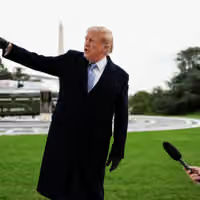
Canadian Prime Minister Mark Carney

A day after Canada’s Foreign Ministry told Iran International it was not considering reopening its embassy in Tehran, Prime Minister Mark Carney called for broader diplomatic engagement with Iran, saying embassies do not amount to endorsement.

Speaking to reporters in Ottawa after deadly earthquakes in Venezuela, Carney said diplomatic presence does not amount to political approval.

“Engagement is not endorsement,” he said, adding that embassies and consular services help governments respond faster in emergencies.

Carney said Canada had faced similar challenges during the war in Iran. “We’ve had to rely on allies and countries that also aren’t our natural allies to help us, particularly in Iran, to help get Canadians out."

“In my opinion, we must change the way we’re doing things,” Carney added, while cautioning that he was making a general point and that no decision had been made on restoring ties.

His remarks come despite earlier comments by Canada’s Foreign Ministry to Iran International that Ottawa’s policy toward Tehran had not changed.

The ministry said Canada maintains a Controlled Engagement Policy with Iran, limiting bilateral contacts to consular affairs, including issues related to the downing of Flight PS752, as well as human rights and nuclear non-proliferation.

“While we continually monitor opportunities in which diplomatic representation may be in the interests of Canadians, and noting that engagement is not endorsement, we are not currently considering re-opening an embassy in Iran,” the ministry told Iran International.

Canada closed its embassy in Tehran in 2012 and expelled Iranian diplomats from Ottawa after designating the Islamic Republic a state sponsor of terrorism. The absence of diplomatic ties has complicated consular support for Canadians in Iran, including members of Canada’s large Iranian diaspora.

Ottawa has since maintained what it calls a Controlled Engagement Policy with Tehran, limiting bilateral contacts to consular issues, the 2020 downing of Flight PS752, human rights and nuclear non-proliferation.

The absence of Iranian diplomatic representation in Canada has in turn forced more than 280,000 members of the country’s Iranian diaspora to handle consular affairs through the Islamic Republic’s Interests Section in Washington, DC.

Most Viewed

Don’t feed us, free us: Iranians hit back at Vance over 'hunger' remarks
1
VOICES FROM IRAN

Don’t feed us, free us: Iranians hit back at Vance over 'hunger' remarks

2
EXCLUSIVE

IRGC personnel sheltered in Shiraz lodging complex were target of deadly strike

3
INSIGHT

President's economic reality check fuels Iran's US deal debate

4

IAEA chief says inspectors will visit Iran enrichment sites under US-Iran MoU

5
EXCLUSIVE

Sources detail Ali Khamenei bunker with blast-resistant room

Banner
Banner
Banner

Spotlight

  • Sources detail Ali Khamenei bunker with blast-resistant room
    EXCLUSIVE

    Sources detail Ali Khamenei bunker with blast-resistant room

  • Unveiled in wartime, targeted in peacetime?
    INSIGHT

    Unveiled in wartime, targeted in peacetime?

  • US sanctions waiver could bring Iran's oil trade out of the shadows
    ANALYSIS

    US sanctions waiver could bring Iran's oil trade out of the shadows

  • Hardline revolt targets Ghalibaf over US agreement
    INSIGHT

    Hardline revolt targets Ghalibaf over US agreement

  • IRGC personnel sheltered in Shiraz lodging complex were target of deadly strike
    EXCLUSIVE

    IRGC personnel sheltered in Shiraz lodging complex were target of deadly strike

  • Don’t feed us, free us: Iranians hit back at Vance over 'hunger' remarks
    VOICES FROM IRAN

    Don’t feed us, free us: Iranians hit back at Vance over 'hunger' remarks

  • Opium for survival: Inside a shift in Iran’s Zagros villages
    EXCLUSIVE

    Opium for survival: Inside a shift in Iran’s Zagros villages

•
•
•

More Stories

Hardline revolt targets Ghalibaf over US agreement

Jun 25, 2026, 02:46 GMT+1
•
Behrouz Turani
Hardline revolt targets Ghalibaf over US agreement
100%
Iran's parliament speaker and lead negotiator Mohamed Bagher Ghalibaf arrives in Zurich, Switzerland for talks with the United State, June 20, 2026

Resistance to Mohammad Bagher Ghalibaf's leadership, both as parliament speaker and chief negotiator, appears to be growing, though it remains confined to a small but vocal group of ultraconservative lawmakers.

Over recent days, at least four MPs—Hamid Rasai, Amir Hossein Sabeti, Abolfazl Aboutorabi and Kamran Ghazanfari—have publicly challenged Ghalibaf, accusing him of violating Supreme Leader Mojtaba Khamenei's red lines and keeping parliament closed to shield the government and negotiators from criticism.

Despite the attacks, Ghalibaf's position appears secure. A recent internal vote showed his supporters retain a comfortable majority, with fewer than 30 of the Majles' 290 members opposing his speakership.

All four leading critics belong to the ultraconservative Paydari (Steadfastness) Party, which has consistently opposed negotiations with the United States.

Even so, Ghazanfari has threatened that if parliament does not reopen before June 28, he and like-minded MPs will stage a sit-in outside the Majles. He argues the closure was never authorized by the Supreme National Security Council (SNSC), as Ghalibaf has maintained, and claims one man has effectively been making decisions on behalf of all 290 lawmakers.

Parliament was originally closed after the outbreak of the 40-day war with Israel and the United States because of security concerns.

Ghazanfari's assertion that "all MPs" want parliament reopened is not borne out by events. Over the past four months, only Rasai has publicly demanded its reopening. Ghazanfari nevertheless accuses Ghalibaf of unlawfully keeping the Majles shut because he fears lawmakers would oppose negotiations with Washington.

Ghalibaf has rejected the allegation, saying parliament remains operational and that sessions are being held online because of continuing security risks. He has also called on the Judiciary to investigate the claims against him.

According to ILNA, Ghazanfari has further accused Ghalibaf of violating the constitution and falsely claiming the SNSC ordered parliament's closure.

He also alleges Ghalibaf refused to show MPs the purported SNSC authorization and ignored what he described as a request from Mojtaba Khamenei to reopen parliament.

Hardline MP Abolfazl Aboutorabi told the Didban Iran website that Ghalibaf was preventing parliament from legislating on Iran's sovereignty over the Strait of Hormuz. He accused the speaker of "playing with words" by presenting the accord with the United States as an MoU rather than a binding agreement.

Aboutorabi said several MPs were preparing a legal complaint against Ghalibaf, arguing that any memorandum or agreement should require parliamentary approval.

Asked whether MPs planned to impeach President Masoud Pezeshkian over the MoU, he replied that impeachment was not currently under consideration, adding: "Maybe God helps and makes him a martyr."

The remark is among the most serious death-tinged comments directed at the president since a prominent eulogist earlier suggested Pezeshkian could be beheaded before later insisting the remark had been intended as an "internal discussion."

Aboutorabi also accused Ghalibaf of violating Khamenei's red lines on the Strait of Hormuz and nuclear negotiations.

Similar allegations have been made by other Paydari figures, including Mahmoud Nabavian and Amir Hossein Sabeti, who argue the agreement with Washington is being pursued against the Supreme Leader's wishes.

For now, however, there is little indication the campaign is gaining traction beyond a small faction. Ghalibaf's support within parliament remains strong, while his longstanding ties to the Revolutionary Guards and Khamenei's inner circle leave him well placed to withstand attacks from rivals with far less institutional backing.

US opens door to Iranian oil in historic sanctions rollback

Jun 23, 2026, 01:35 GMT+1
US opens door to Iranian oil in historic sanctions rollback
100%
An engineer watches over a part of Fajr-e Jam refinery in Iran's southern province of Bushehr, February 2026

The United States on Monday announced a sweeping sanctions waiver for Iran's energy sector, authorizing the sale of Iranian oil, allowing payments to Tehran in US dollars and opening the door for Iranian oil and petroleum products to be imported into the United States.

The move marks one of the most dramatic shifts in US policy toward Iran since the 1979 Islamic Revolution and follows the recently signed US-Iran Memorandum of Understanding.

Treasury Secretary Scott Bessent presented the measure as part of the administration's effort to implement the agreement while negotiations continue toward a broader settlement.

Under the waiver issued by the Treasury Department, Iran will be allowed to produce, sell and transport crude oil, petroleum products and petrochemicals through August 21 while negotiations continue.

The authorization also permits payments in US dollars and allows Iranian oil and petroleum products to be imported into the United States. It effectively suspends key restrictions on Iran's energy sector that had been in place for years under both primary and secondary sanctions.

The Treasury Department said the waiver covers shipping, insurance, vessel management, registration and other services necessary to facilitate oil trade, while suspending restrictions under a range of sanctions authorities that have constrained Iran's energy exports for decades.

For years, Iran has built an extensive sanctions-evasion network to keep its oil flowing to international markets. The system relies on a large "shadow fleet" of tankers, ship-to-ship transfers, intermediaries and opaque financial arrangements designed to conceal the origin and destination of Iranian crude.

Oil exports remain the backbone of Iran's economy and a critical source of government revenue. By allowing Iranian crude and petroleum products to be sold more openly and through conventional financial channels, the waiver provides one of the strongest economic incentives yet for Tehran to convert the current understanding into a permanent deal.

Iranian officials portrayed the move as evidence that negotiations were delivering tangible economic benefits.

Parliament Speaker and chief negotiator Mohammad Bagher Ghalibaf said Iran had also secured an agreement on the release of frozen assets.

"In Switzerland we agreed on the release of $12 billion in frozen assets," Ghalibaf said in remarks carried by state media.

He also argued that the negotiations had helped reduce violence in Lebanon, one of the most contentious issues during the talks.

"Since we entered the Swiss negotiations, we have seen that the enemy's fire against Lebanon has stopped and a large part of the people have returned to their homes," he said.

Ghalibaf said Iran would continue pursuing its objectives in Lebanon through the diplomatic process.

"With the decision made in Switzerland, we will achieve the territorial integrity and national sovereignty of Lebanon in these talks, and we will not abandon it until we achieve a result."

His remarks are likely to fuel criticism from opponents of the agreement, who argue Washington has granted sweeping economic concessions before securing major commitments from Tehran on its nuclear program or regional activities.

Critics have pointed in particular to the scale of the sanctions relief and the release of frozen assets, arguing that the administration is moving ahead with incentives while many of the most difficult issues remain unresolved.

Supporters of the agreement, meanwhile, argue that the measures are intended to build momentum for negotiations, secure nuclear inspections and reduce the risk of renewed conflict in the region.

Will the Islamic Republic trade with the 'Great Satan'?

Jun 22, 2026, 21:58 GMT+1
•
Negar Mojtahedi
Will the Islamic Republic trade with the 'Great Satan'?
100%
People walk next to an anti-US mural on a street as protests erupt over the collapse of the currency's value in Tehran, Iran, January 2, 2026.

Nearly half a century after Iran's revolutionary government severed ties with Washington, took US diplomats hostage and turned "Death to America" into one of its defining slogans, a new US proposal could see frozen Iranian assets used to purchase American goods.

The proposal points to one of the more striking ironies of the emerging US-Iran agreement: using Iranian assets to buy American products from a country the Islamic Republic has long cast as the "Great Satan" and a threat to the revolution.

Speaking in Switzerland on Monday, US Vice President JD Vance said Washington could agree to unfreeze Iranian assets for purchases of American products such as soybeans, corn and wheat.

"If Iranian assets are ever unfrozen, they're going to go to make American farmers richer and to feed the Iranian people," Vance said, adding that the United States and Qatar would oversee the process.

The proposal marks one of the clearest signs yet that the Trump administration may be shifting from its longstanding "maximum pressure" approach toward a strategy centered on incentives and compliance.

It has also revived questions about whether limited economic engagement could eventually evolve into something that once seemed unimaginable: renewed trade between Iran and the United States.

Vance said the proposal was developed by Jared Kushner, President Donald Trump's son-in-law and one of the lead US negotiators, together with Qatari officials.

Close allies turn sworn adversaries

Before the 1979 revolution, Iran was one of Washington's closest allies in the Middle East and an important market for American goods and services.

"There was no embargo, no sanctions and no limitation," said Mohamad Machine-Chian, economist and journalist at Iran International. "Iranian industrial infrastructure is American to begin with," Machine-Chian said.

The revolution transformed that relationship. The hostage crisis, sanctions and decades of political hostility largely froze direct commerce between the two countries.

At the same time, the Islamic Republic built much of its identity around opposition to the United States. Iranian leaders frequently portrayed American economic and cultural influence as a threat to the revolution, while late Supreme Leader Ali Khamenei repeatedly warned against what he described as Western "cultural aggression."

A market that never disappeared

Yet American products never entirely disappeared from Iran.

Machine-Chian said some US goods continued reaching the country through intermediaries, often passing through several countries and layers of traders before reaching Iranian consumers.

The arrangement was costly and inefficient, but demand remained. And it led to a contradiction that persists today. While many Iranians continued to seek out American products, the country’s rulers repeatedly warned against them.

The Islamic Republic has long viewed unrestricted American economic and cultural influence with suspicion, arguing that it could undermine the values the revolution sought to promote. Khamenei often described such influence as a form of "cultural aggression."

"There is a great deal of potential between Iran and the US," Machine-Chian said. "Iran remains the last untapped developing market in the world … Iranian people love American products and would love a good deal to be able to buy and sell, trade with America."

Still, he cautioned against assuming the latest proposal signals a broader economic opening.

"The result will be decided by compliance, the negotiations and the political aspect of it all," he said. "I wouldn't hold my breath."

Will American goods reach ordinary Iranians?

Supporters of the proposal argue that using frozen assets to purchase food and agricultural products could help ease economic pressure on ordinary Iranians without handing Tehran unrestricted cash.

Mahdi Ghodsi, Economist and Leader of the International Economics Group at the Vienna Institute for International Economic Studies (wiiw) and Senior Fellow at the Centre for Middle East and Global Order (CMEG), said the arrangement could help stabilize prices and reduce pressure on Iran's currency reserves.

"It means there is a lower pressure on currency reserves," Ghodsi said. "There could be some stabilization in the currency market of Iran."

He argued that preventing further economic deterioration is important not only for Iran's economy but for ordinary households already struggling with soaring costs.

But Ghodsi also warned about oversight.

"The regime is corrupt. The regime is a kleptocracy," he said. "We cannot be sure that they don't benefit from such behavior to fill their pockets."

Critics, however, argue that the success of any such arrangement would depend on how strictly it is monitored.

Max Meizlish, a sanctions expert at the Foundation for Defense of Democracies and former US Treasury official, warned that humanitarian trade does not automatically guarantee humanitarian outcomes.

He said Washington would need safeguards to ensure goods purchased with frozen Iranian assets actually reach ordinary people and are not diverted through networks linked to the Islamic Revolutionary Guard Corps.

"The question is whether they might be providing an indirect form of support to the IRGC," Meizlish said.

Without a transparent mechanism, he warned, American goods intended for civilians could end up strengthening the very actors Washington says it wants to constrain.

Meizlish also questioned the administration's broader shift in approach.

Just days before the latest proposal, US officials were still describing Iranian oil revenues as a major source of funding for Tehran's armed forces, regional partners and proxies.

"Iran's oil and petroleum exports are a primary source of revenue for its armed forces, terrorist partners and proxies," the State Department wrote in a report sent to Congress on June 16.

For critics, the contrast is striking: a government that only days ago warned that Iranian revenues fund armed groups is now considering a framework that could unlock billions of dollars in Iranian assets under a US-approved arrangement.

Whether the proposal becomes a meaningful opening or remains a narrowly defined humanitarian mechanism remains unclear. Whatever its economic impact, however, the symbolism is difficult to miss.

A state founded on opposition to the United States may soon use billions of dollars in frozen assets to purchase American goods, while a US administration once committed to maximum pressure is increasingly betting on incentives instead.

Lebanon 'deconfliction cell' emerges after intense Switzerland talks

Jun 22, 2026, 04:52 GMT+1
Lebanon 'deconfliction cell' emerges after intense Switzerland talks
100%
A child stands next to the rubble of a building damaged in an Israeli strike in Qennarit, southern Lebanon, June 20, 2026.

US-Iran talks in Switzerland produced a roadmap toward a final agreement within 60 days, but only after negotiators spent much of the first day grappling with the issue that nearly derailed the process: Lebanon.

A joint statement issued by mediators Qatar and Pakistan after nearly 18 hours of talks said the parties had agreed to establish a High Level Committee to oversee negotiations, launch technical working groups and begin work toward a final deal.

But one of the most notable provisions was the creation of a deconfliction cell involving the United States, Iran and Lebanon, facilitated by the two mediators, to ensure adherence to the cessation of military operations in Lebanon under the memorandum of understanding signed last week.

The prominence of the Lebanon mechanism in both the joint statement and subsequent comments by Iranian officials underscored how central the issue had become to the talks.

Vice President JD Vance met Iranian officials on Sunday at the Swiss resort of Buergenstock in the first round of negotiations aimed at implementing the memorandum between Tehran and Washington.

The talks quickly ran into difficulties.

Iranian media reported that Tehran refused to return to four-way talks after a break, citing public threats from President Donald Trump and arguing that substantive negotiations could not proceed while fighting continued in Lebanon.

US officials disputed that account.

"The Iranians never left and are still here meeting and negotiating deep into the night," a US diplomat involved in the talks said, adding that discussions covered Lebanon, the Strait of Hormuz, nuclear issues and implementation of the memorandum.

Iran argues that Washington has failed to uphold its commitment to help secure a halt to hostilities in Lebanon and has repeatedly linked progress in negotiations to developments on the Lebanese front.

The issue resurfaced throughout the talks and appears to have become one of the central subjects of mediation by Qatar and Pakistan.

Foreign Minister Abbas Araghchi highlighted the new Lebanon mechanism after the talks concluded, calling it the "first real test" of the understandings reached in Switzerland.

According to the joint statement, chief negotiators will report regularly to the High Level Committee and lead working groups focused on nuclear issues, sanctions, and a monitoring and dispute-resolution mechanism designed to ensure implementation of the memorandum.

The committee has also approved a roadmap toward reaching a final agreement within 60 days and authorized the immediate start of further technical negotiations.

In addition, the parties agreed to establish a communication channel aimed at preventing incidents and misunderstandings and ensuring the safe passage of commercial vessels through the Strait of Hormuz.

Despite public disagreements and repeated threats from Trump that the United States could resume military action if Iran failed to restrain its regional allies, both sides emerged from the talks with new negotiating structures and a timetable for future discussions.

For now, however, the success of the diplomatic process may depend less on nuclear issues than on whether the newly created Lebanon deconfliction mechanism can prevent another flare-up from derailing negotiations altogether.

Iran's postwar rallies become flashpoint in diplomacy debate

Jun 22, 2026, 03:27 GMT+1
•
Maryam Sinaiee
Iran's postwar rallies become flashpoint in diplomacy debate
100%
A participant records a nightly state-sponsored rally in Tehran as supporters wave Iranian and Hezbollah flags, June 9, 2026

Iranian hardliners have sharply criticized a government-linked report that warned prolonged nightly pro-state gatherings could obstruct diplomacy, exposing a growing dispute over the role of street mobilization in postwar Iran.

The controversy highlights tensions within Iran's political establishment over whether the rallies represent a source of national unity or an increasingly disruptive force in debates over diplomacy and relations with the United States.

The backlash was triggered by a document published by the presidential Strategic Affairs Office (SAO) following a conference titled "The Street Movement for Protecting Iran: Nature, Opportunities and Ways to Enhance It."

The report examined the nightly gatherings that have spread across Iranian cities since the war and argued that their continued presence could complicate decision-making and undermine diplomatic efforts.

Many of the nightly gatherings—known in Iran's political discourse simply as "the street"—began as public mourning ceremonies for Khamenei before evolving into organized political events.

It warned that the "continuation of gatherings would constitute a serious obstacle to adopting strategic and expedient decisions at sensitive moments." Left unchecked, the report said, the gatherings could "lead to obstruction in the path of diplomacy."

The report drew an immediate backlash from hardline media and politicians.

The website Jahan News criticized what it described as the report's "inappropriate and offensive" language, particularly its characterization of the gatherings as "emotional" rituals.

"This terminology is used despite the fact that the Supreme Leader repeatedly praised the nightly gatherings and even explicitly stated that people's chants in public squares influence the course of negotiations."

Initially encouraged by senior officials as demonstrations of national solidarity during wartime, the rallies attracted large crowds. Witnesses say attendance has since declined as the rhetoric has become more radical, with many gatherings now drawing between 100 and 200 participants.

Ali Khezriyan, a member of parliament's National Security and Foreign Policy Committee, criticized the Strategic Affairs Office for portraying the gatherings as an obstacle to diplomacy.

"While we speak about the role of the people, the SAO has described the people's gatherings as causing obstruction in diplomacy, whereas the Supreme Leader considers the people to be overseers," he told IRGC-linked Fars News.

"These same people brought themselves and their loved ones into the streets under enemy bombardment," he added.

The SAO report appeared to recommend gradually winding down the gatherings after the first ten days of Muharram or following the funeral of former Supreme Leader Ali Khamenei, scheduled for July 4-5.

Hardline political groups have increasingly used the events as platforms for speeches and mobilization. Speakers have addressed contentious issues including ceasefire terms and negotiations with the United States.

Some have targeted prominent political figures, particularly Parliament Speaker Mohammad Bagher Ghalibaf, who heads Iran's negotiating team, with crowds encouraged to chant slogans against him.

Fars News Agency, which is linked to the Revolutionary Guards (IRGC), published a photograph of a participant holding a banner that read: "Instead of deciding how to empty the streets, the government should think about the emptying of people's dinner tables."

One commenter wrote: "We did not gather on the orders of officials so that we would leave the streets based on their decisions."

Another wrote: "Why do you think you have the right to talk about these gatherings? People did not come into the streets with your permission for you to disperse them. Keep your mouth shut before we open ours."