• العربية
  • فارسی
Brand
  • Iran Insight
  • Politics
  • Economy
  • Analysis
  • Special Report
  • Opinion
  • Podcast
  • Iran Insight
  • Politics
  • Economy
  • Analysis
  • Special Report
  • Opinion
  • Podcast
  • Theme
  • Language
    • العربية
    • فارسی
  • Iran Insight
  • Politics
  • Economy
  • Analysis
  • Special Report
  • Opinion
  • Podcast
All rights reserved for Volant Media UK Limited
volant media logo
EXCLUSIVE

Sources detail Ali Khamenei bunker with blast-resistant room

Jun 25, 2026, 10:26 GMT+1

An underground complex built by the Islamic Revolutionary Guards Corps (IRGC) to protect former Supreme Leader Ali Khamenei included a blast-resistant room and escape tunnels beneath central Tehran, according to information received by Iran International.

Iran International obtained architectural plans for the facility from an informed source, and a security source confirmed the documents’ authenticity.

The plans show that the IRGC spent about a decade building the underground compound, known as Habib Ebrahimi, next to Khamenei’s official residence.

The complex, named after Khamenei's former driver Habib Ebrahimi, who died before construction began, was built between 2009 and the late 2010s, according to the information.

Continue reading

Most Viewed

Don’t feed us, free us: Iranians hit back at Vance over 'hunger' remarks
1
VOICES FROM IRAN

Don’t feed us, free us: Iranians hit back at Vance over 'hunger' remarks

2
EXCLUSIVE

IRGC personnel sheltered in Shiraz lodging complex were target of deadly strike

3
EXCLUSIVE

Opium for survival: Inside a shift in Iran’s Zagros villages

4

IAEA chief says inspectors will visit Iran enrichment sites under US-Iran MoU

5
INSIGHT

President's economic reality check fuels Iran's US deal debate

Banner
Banner
Banner

Spotlight

  • Sources detail Ali Khamenei bunker with blast-resistant room
    EXCLUSIVE

    Sources detail Ali Khamenei bunker with blast-resistant room

  • Unveiled in wartime, targeted in peacetime?
    INSIGHT

    Unveiled in wartime, targeted in peacetime?

  • US sanctions waiver could bring Iran's oil trade out of the shadows
    ANALYSIS

    US sanctions waiver could bring Iran's oil trade out of the shadows

  • Hardline revolt targets Ghalibaf over US agreement
    INSIGHT

    Hardline revolt targets Ghalibaf over US agreement

  • IRGC personnel sheltered in Shiraz lodging complex were target of deadly strike
    EXCLUSIVE

    IRGC personnel sheltered in Shiraz lodging complex were target of deadly strike

  • Don’t feed us, free us: Iranians hit back at Vance over 'hunger' remarks
    VOICES FROM IRAN

    Don’t feed us, free us: Iranians hit back at Vance over 'hunger' remarks

  • Opium for survival: Inside a shift in Iran’s Zagros villages
    EXCLUSIVE

    Opium for survival: Inside a shift in Iran’s Zagros villages

•
•
•

More Stories

Sources detail Ali Khamenei bunker with blast-resistant room

Jun 25, 2026, 10:15 GMT+1
•
Mojtaba Pourmohsen
Sources detail Ali Khamenei bunker with blast-resistant room
100%
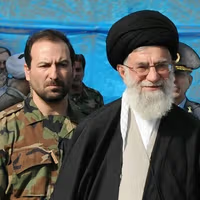
حسن اکبری و علی خامنه‌ای

An underground complex built by the Islamic Revolutionary Guards Corps (IRGC) to protect former Supreme Leader Ali Khamenei included a blast-resistant room and escape tunnels beneath central Tehran, according to information received by Iran International.

Iran International obtained architectural plans for the facility from an informed source, and a security source confirmed the documents’ authenticity.

The plans show that the IRGC spent about a decade building the underground compound, known as Habib Ebrahimi, next to Khamenei’s official residence.

The complex, named after Khamenei's former driver Habib Ebrahimi, who died before construction began, was built between 2009 and the late 2010s, according to the information.

Underground network

According to the plans, the main vehicle entrance allowed cars to descend about 30 meters underground into the complex.

Architectural plans obtained by Iran International show the layout of the IRGC-built underground bunker beneath the former supreme leader's compound in Tehran.
100%
Architectural plans obtained by Iran International show the layout of the IRGC-built underground bunker beneath the former supreme leader's compound in Tehran.

A 27-meter tunnel linked the bunker to multiple escape routes, including exits toward streets around. Another tunnel reportedly connected the facility to a parking garage near the Enghelab square in central Tehran.

Iran International reviewed construction images showing one tunnel exit during excavation, as well as separate images depicting a five-level underground office complex for senior officials attached to the Office of the Supreme Leader.

Sources familiar with the project, who spoke on condition of anonymity, said the site was concealed beneath what appeared to be a sports center. Below ground, the facility included a three-level parking garage, target ranges and two shelters located approximately 30 and 35 meters beneath the surface.

Plans show one of those shelters contained a blast-resistant room intended to protect Khamenei during missile attacks.

Construction and oversight

The documents showed construction began in 2009 with Khamenei's approval and was financed by the IRGC's Khatam al-Anbiya Construction Headquarters.

The project was overseen by the IRGC's engineering division, then headed by Brigadier General Ali Masjedian, while execution was assigned to the Shahid Rajaei Institute, a subsidiary of Khatam al-Anbiya.

The institute was headed by Brigadier General Hossein Akbari. His brother, Brigadier General Hassan Akbari, supervised construction while serving both as one of Khamenei's closest bodyguards and as an official in the IRGC unit responsible for protecting the Supreme Leader.

Brigadier General Hossein Akbari, the former head of the IRGC's Shahid Rajaei Institute, which oversaw construction of the underground bunker complex for Ali Khamenei.
100%
Brigadier General Hossein Akbari, the former head of the IRGC's Shahid Rajaei Institute, which oversaw construction of the underground bunker complex for Ali Khamenei.

The IRGC-linked Fars News Agency previously reported that Hassan Akbari was accidentally killed on April 29, 2016, after a weapon malfunction during a training mission.

A security source, however, told Iran International that his death was tied to an internal power struggle inside the Office of the Supreme Leader.

Contradictory public statements

The Habib Ebrahimi complex was among the Israeli military’s targets during a March 2026 strike on the Supreme Leader’s compound.

Satellite imagery reviewed by Iran International, however, did not show clear evidence that the underground facility had been destroyed.

Satellite image highlighting the underground bunker complex beneath the former supreme leader's compound in central Tehran.
100%
Satellite image highlighting the underground bunker complex beneath the former supreme leader's compound in central Tehran.

The discovery contrasts with public remarks by former Iranian officials. Former Interior Minister Mostafa Pourmohammadi had said Khamenei had no underground shelter, while Ezzatollah Zarghami, a former broadcasting chief and tourism minister, said Khamenei had opposed building one for himself.

Khamenei was killed in a targeted Israeli strike on his residence on February 28, 2026, during a meeting of Iran's Defense Council. The Financial Times later reported that Israel had used hacked traffic cameras and telecommunications infrastructure around the area to identify the gathering before the attack.

IRGC personnel sheltered in Shiraz lodging complex were target of deadly strike

Jun 24, 2026, 21:14 GMT+1
•
Shahed Alavi
IRGC personnel sheltered in Shiraz lodging complex were target of deadly strike
100%

IRGC personnel sheltering in a civilian lodging complex in Shiraz were the likely target of a strike that also killed nine civilians at a neighboring emergency center in the early days of the 2026 war, an Iran International investigation found.

The March 5 strike hit several buildings inside the Zibashahr emergency lodging complex, where members of the Islamic Revolutionary Guard Corps and affiliated forces had taken shelter during the war, according to images from the site, open-source data, Iranian media reports, witness accounts and an expert assessment reviewed by Iran International.

The evidence suggests the strike was not a simple miss aimed at a nearby IRGC facility, but an attack on the lodging complex itself.

The site sat inside a civilian area, beside a local ambulance station that is part of Iran’s 115 emergency medical service, as well as service buildings and residential homes.

No party has claimed responsibility for the strike.

Fars provincial authorities later said 20 people had been killed and 30 wounded. At an official memorial ceremony in Zibashahr, however, only 16 names and photographs were released: seven IRGC and Basij members and nine civilians.

The civilians included two emergency technicians, a health worker, municipal employees and contractors, and a local shopkeeper.

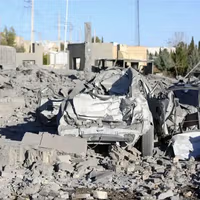
The strike destroyed the ambulance station, a neighboring building and a larger structure to the east that formed part of the municipal emergency lodging complex. Nearby residential buildings were also damaged.

Aftermath of the March 2026 strike on the Zibashahr complex in Shiraz
100%
Aftermath of the March 2026 strike on the Zibashahr complex in Shiraz

Why the lodging complex was hit

The large destroyed building inside the Zibashahr complex was not an empty passenger facility or an unidentified structure.

The Student News Agency, linked to the Student Basij, published a video report from the site after the attack and said missiles had hit “dormitory and administrative buildings” in the complex. It also reported that military personnel had been killed and wounded.

The agency said the personnel were there for “training courses for border protection.”

But public mapping services, including Google Maps and the Iranian app Neshan, identify the site as an emergency lodging complex, not a military training facility.

The entrance of the Zibashahr complex
100%
The entrance of the Zibashahr complex

Verified images and videos from the area also show the lodging complex sign at the entrance. Iran International found no publicly available evidence that the site had previously functioned as a military training center.

Less than 200 meters away, across the highway, sits a large IRGC Ground Forces training and military complex. Open-source mapping also links the area to the IRGC’s 19th Fajr Division and an IRGC Aerospace Force unit in Shiraz. One officer killed in the Zibashahr strike was linked to the 19th Fajr Division.

Yet post-strike imagery showed no sign that the nearby IRGC complex itself had been destroyed.

That pattern is central to the investigation. If the intended target had been the formal IRGC facility, a miss of about 200 meters across the highway would have to explain several impacts on separate buildings inside the civilian lodging complex.

Wes Bryant, a former head of a US Air Force special targeting team and former Pentagon civilian-casualty assessment official, reviewed visual evidence from the site.

He assessed that the strike involved about 1,350 kilograms of munitions, including a weapon comparable to a 900-kilogram bomb against the larger eastern building and smaller munitions, comparable to 220-kilogram bombs, against two western structures, including the ambulance station.

With modern precision-guided munitions, Bryant said, a 200-meter error across a highway would be highly unlikely, particularly in several separate impacts.

His assessment supports the conclusion drawn from the other evidence: the lodging complex itself, or specific buildings inside it, was the likely target.

Aftermath of the March 2026 strike on the Zibashahr complex in Shiraz
100%
Aftermath of the March 2026 strike on the Zibashahr complex in Shiraz

A target among civilians

The evidence reviewed by Iran International points to a strike on a civilian lodging complex after IRGC personnel moved into it during the war.

That may explain why the Zibashahr complex, rather than the nearby formal IRGC facility, was hit. But the same evidence also shows that the targeted buildings stood inside a civilian setting, beside an ambulance station and near residential homes.

That leaves responsibility on the Iranian side.

By moving or allowing military personnel to shelter in a civilian lodging complex, next to an emergency medical site and homes, Iranian authorities placed civilians and medical workers in the path of a foreseeable strike.

It is not necessary to prove that civilians were intentionally used as shields to establish the consequence: the risk of war was shifted from a military facility into a place used by civilians.

That responsibility does not remove the attacker’s obligations.

Even if the presence of IRGC personnel made part of the lodging complex a military target, it did not automatically strip the neighboring ambulance station, surrounding buildings or nearby homes of protection.

A medical site loses its special protection only if it is itself used for acts harmful to the enemy; Iran International found no evidence in the material reviewed that the ambulance station was used in that way.

The strike therefore leaves two central facts in tension.

IRGC personnel appear to have taken shelter among civilians, turning part of the complex into a target. But the attack also destroyed an ambulance station and killed civilians in an area whose medical and residential character was visible in public maps and imagery.

In Zibashahr, the war moved from a military complex into a lodging site, an ambulance station and people’s homes.

Opium for survival: Inside a shift in Iran’s Zagros villages

Jun 23, 2026, 22:00 GMT+1
•
Saman Rahmatian
Opium for survival: Inside a shift in Iran’s Zagros villages
100%

Opium poppy cultivation in some villages of the Zagros mountains in western Iran has evolved from a hidden, scattered practice into an essential part of the rural subsistence economy, an Iran International investigation found.

On the rugged slopes of the Zagros, amid rocky plots and felled oak trees, opium poppy is no longer merely an illegal crop. It has become a sign of the economic deadlock facing villages where wheat, chickpeas and lentils no longer cover the costs of farming and daily life.

A few kilometers from the road, deep in the Zagros mountains, a small plot of land emerges from among cut-down oaks. Access to it is difficult, and it is barely visible from the village. Its owner prefers to watch over it from a distance.

He told Iran International that if authorities find the plot, it would be difficult for them to prove who owns the land.

Opium poppy plants have grown quietly in the Zagros, a crop now seen more often than before in some villages across the region.

Lancing season on the Zagros slopes

It is now the season for lancing poppy capsules in the Zagros range. Before the sun grows harsh over the plains, farmers make cuts in the poppy bulbs.

Hours later, a white sap seeps from the wounds, a substance that turns into opium once dried.

Farmers say poppy is usually planted in the region in two seasons. Some fields are cultivated in the first month of autumn, around September and October, and others in the second month of winter, around January and February. Harvesting continues from mid- to late-spring, roughly from April to late May.

'Poppy is our only hope'

Iran International’s investigations show that poppy cultivation in the Zagros has been expanding for more than 10 years.

Most poppy growers prefer to plant the crop on mountain slopes and in hard-to-reach areas, where the risk of detection is lower.

One farmer said poppy is suited to the region’s climate and can be grown even on rain-fed and rocky land.

“Planting in the heart of the mountain is hard, but we have no other choice,” he said. “Poppy is our only hope.”

Wheat no longer covers the costs

For years, wheat, chickpeas and lentils formed the backbone of village economies in the Zagros. But farmers tell Iran International rising production costs, consecutive droughts, declining land productivity and delays in government payments have changed the farming equation.

“Wheat no longer covers the cost of the land,” one farmer said. “Costs have risen so much that in the end, nothing is left for us — and that is if the government pays for the wheat on time.”

Academic research and international studies in poppy-producing regions confirm that drought, falling agricultural income and the lack of alternative economic options are among the main factors pushing farmers toward poppy cultivation.

The United Nations Development Program has also stressed that combating poppy cultivation will be difficult without creating sustainable economic alternatives.

The opium economy: A more profitable crop

The value of the opium market has risen in recent years. Some Iranian media outlets reported in April that the retail price of each gram of opium was about 250,000 tomans, roughly $1.6.

According to data from the United Nations Office on Drugs and Crime, poppy fields in climates similar to Iran’s typically produce between 20 and 30 kilograms of pure opium per hectare. In some regions, the figure exceeds 50 kilograms.

A comparison between income from poppy and wheat, one of the main agricultural products of western Iran, helps explain why some farmers have turned to the crop.

With wheat priced at about 49,500 tomans per kilogram and average production of 3.5 tons per hectare, the value of wheat from 1 hectare is estimated at around 173 million tomans (almost $1,081).

By contrast, a hectare of poppy producing 20 to 30 kilograms of opium could generate an estimated 5 billion to 7.5 billion tomans, or roughly $31,000 to $47,000, based on the reported retail price.

In higher-yield areas, where output can exceed 50 kilograms per hectare, the value could rise to about 12.5 billion tomans, or roughly $78,000. That means the estimated value of opium from 1 hectare could be about 29 to 72 times higher than wheat grown on the same area.

Cultivated area grows more than threefold

Signs of the spread of poppy cultivation can even be seen in remarks by some officials.

According to Mohammad Jamalian, a member of parliament’s Health and Medical Commission, the area under poppy cultivation in Iran has reached about 32,000 hectares — a figure he said is more than 3 times higher than in previous years.

Accurately estimating the total area under cultivation is difficult, because many poppy fields are set up in remote lands and places outside public view.

However, a review of reports published in recent years shows that the names of Zagros provinces appear more often than other regions in news about the discovery and destruction of poppy fields. These are provinces that are simultaneously grappling with drought, unemployment and livelihood crises.

Afghanistan’s shadow over the regional market

The story of poppy does not end in the Zagros fields. Hundreds of kilometers away, in Afghanistan, an unprecedented decline in poppy cultivation following the Taliban’s return to power has altered the dynamics of the market across the region.

Iran’s Drug Control Headquarters has said the sharp fall in poppy cultivation in Afghanistan has led to a noticeable decline in the entry and seizures of opium in Iran, and has even created problems in supplying raw materials for some medicines.

The recent war has added to these pressures and worsened Iran’s medicine supply crisis, with health officials reporting shortages of nearly 1,000 types of medication across the country.

Meanwhile, Iran remains one of the world’s largest opium consumer markets.

According to Health Ministry officials, in addition to the hidden number of drug users, about 3 million people in Iran are officially registered as addicts, and opium remains their main drug of use.

Western Iran is also located near one of the region’s key routes for the trafficking of opiates, a route that passes through Iraq and the Kurdistan Region and continues toward Turkey and Europe.

Although there is no evidence that the crop produced by poppy farmers in the Zagros is exported, the existence of a consumer market and the region’s sensitive geography are among the factors that could create fertile ground for the phenomenon to expand.

The blade drawn today across poppy capsules on the slopes of the Zagros reveals the trace of a crisis that began with drought and rising costs — and has now changed the path of livelihood in some of Iran’s villages.


Iran media told to frame Hormuz closure as support for diplomacy

Jun 20, 2026, 17:07 GMT+1
Iran media told to frame Hormuz closure as support for diplomacy
100%

Iranian media have been instructed to avoid portraying the renewed closure of the Strait of Hormuz and Iran’s participation in US talks as a divide between the armed forces and negotiators, according to a Supreme National Security Council directive seen by Iran International.

The directive, addressed to media managers and editors, said the renewed closure of Hormuz came in response to what it called continued ceasefire violations and Israeli actions in southern Lebanon, while Iran’s negotiating team was heading to Switzerland.

It said the Islamic Republic was pursuing a “single strategy” that combines deterrence and military leverage with diplomacy to force the other side to implement its commitments and protect Iran’s national interests.

The directive urged media outlets to frame military actions not as a replacement for diplomacy but as its support, and to avoid presenting negotiations as a sign of retreat.

It also called on outlets to emphasize the “synergy” between military power and diplomacy in securing national interests.

Israel to help oust Iran regime, Bennett tells Iranians frustrated by US deal

Jun 16, 2026, 19:13 GMT+1
Israel to help oust Iran regime, Bennett tells Iranians frustrated by US deal
100%
File photo shows a billboard in Jerusalem that reads "the end of Ayatollah's regime in Iran"

Former Israeli prime minister Naftali Bennett says he has drawn up a detailed plan to help Iranians topple the Islamic Republic, addressing growing frustration among dissidents that an emerging US-Iran deal could save and embolden Tehran’s hardline rulers.

“We’re going to do everything in our power to ultimately topple this horrible regime,” Bennett told Iran International correspondent Babak Eshaghi. “And I want to tell the Iranian people, the wonderful Iranian nation: Don’t lose your hope.”

“This terrible, disconnected, corrupt and evil regime will fall. You will be free,” he said.

Bennett, who is positioning himself as one of Prime Minister Benjamin Netanyahu’s main challengers, said outside powers must be ready to help Iranians the next time they rise up against the Islamic Republic.

“What we’re going to do is ensure that next time the people of Iran rise up, we provide them the tools to win, communication and other tools,” he said. “This rotten regime will fall at some point.”

“Our job is to accelerate that,” Bennett added.

His comments come as many Iranians opposed to the Islamic Republic have voiced frustration over the expected signing of a US-Iran memorandum on Friday, fearing that Washington and Tehran are moving toward an agreement that would preserve the ruling system after months of war, repression, blackouts and sanctions.

After the January crackdown, in which security forces killed thousands of protesters and detained tens of thousands, both Donald Trump and Netanyahu promised to support Iranians seeking to bring down the regime.

But the emerging deal has deepened concern among many anti-government Iranians that ordinary people paid the heaviest price while Tehran’s more hardline leadership survived and may now gain breathing space through diplomacy.

Bennett sought to answer that concern by saying he had prepared “an elaborate and detailed plan” aimed at bringing down the Islamic Republic.

“I’ve put together an elaborate and detailed plan whose goal is to ultimately topple this Ayatollah regime,” he said.

He said the plan would rely on “many tools, not only war,” including “economic tools, diplomatic tools, covert, overt operations,” as well as efforts to empower the Iranian people.

Bennett also warned that the expected US-Iran memorandum should not lead to an easing of pressure on Tehran unless any final agreement fully dismantles Iran’s nuclear and missile programs and regional proxies.

“It’s a temporary agreement. It’s far from over,” he said.

“We have to ensure that the final agreement is a good one,” Bennett added. “That totally dismantles the Iranian nuclear program, the ballistic missile program, the regional terror program.”

“That’ll be the ultimate test,” he said. “We can’t let up on the sanctions and on all the pressure on this horrible regime until that’s achieved.”

His remarks come amid unease in Israel over the emerging agreement. Channel 12 reported that Israeli officials asked Washington to see the draft memorandum, but the United States refused to share the text before the signing ceremony.

The reported refusal has fueled concern in Israel that the deal could fall short of Netanyahu’s stated demands, including the dismantling of Iran’s nuclear capabilities, curbs on its missile program and limits on Tehran’s regional network.

Message to Iranian people and leaders

Bennett compared the Islamic Republic to the Soviet Union in its final years, saying authoritarian systems can collapse faster than expected.

“This regime will fall,” he said. “It’s a corrupt, disconnected and incompetent regime, very similar to the Soviet Union regime of the 1980s.”

“If you had asked me in 1985, will the regime fall? Who knows? But just four years later, it fell,” Bennett added.

“My message to the Iranian people is: Raise your heads. Be proud. Be strong. We are looking after you.”

He also issued a direct warning to Iran’s rulers.

“I would tell those leaders, those ayatollahs: Your time is running out. We are after you. We know exactly who you are. And you will not remain in power for long,” Bennett said.

“It might take a bit of time,” he added. “But your time is over.”