Pezeshkian says Iran-US talks depend on full commitment to obligations
Iranian President Masoud Pezeshkian said on Tuesday that the effectiveness of talks depended on full commitment to agreed obligations and their precise implementation.
Progress would be measured by practical adherence to accepted responsibilities, Pezeshkian said in a post on X.
“Statements outside the agreed text do not help advance the negotiations,” he said.
A conservative Iranian activist accused hardline lawmakers of pushing to reopen parliament to inflame tensions and use its platform for factional purposes following the MOU between Tehran and Washington.
Mohammad Mohajeri said members of the hardline Paydari Front wanted to use parliament’s podium for their own political interests, citing recent remarks by lawmaker Mahmoud Nabavian, who has criticized Iran’s negotiating team.
A conservative Iranian activist accused hardline lawmakers of pushing to reopen parliament to inflame tensions and use its platform for factional purposes following the MOU between Tehran and Washington.
Mohammad Mohajeri said members of the hardline Paydari Front wanted to use parliament’s podium for their own political interests, citing recent remarks by lawmaker Mahmoud Nabavian, who has criticized Iran’s negotiating team.
Mohajeri likened the hardliners to Colonel Vladimir Liakhov, a Tsarist Russian military officer who bombarded and shut down Iran’s parliament in 1908, saying they also “want to bombard parliament.”
He also criticized the current parliament, calling it “one of the most ineffective parliaments in terms of a positive record.”
“It has done nothing useful and has only pursued noise and controversy,” he said.
He made the comments after MP Kamran Ghazanfari announced plans for a protest outside parliament, saying a group of lawmakers will stage a sit-in if the legislature remained closed.
The head of parliament’s Health and Treatment Committee previously criticized the continued closure of parliament, saying lawmakers had been sidelined amid the Islamic Republic’s talks with the US.
“They closed parliament so they could sign whatever they wanted,” Hosseinali Shahriari said.
Shipowners are facing confusion over the safest route out of the Persian Gulf as Iran, the United States and western insurers issue conflicting guidance on travel through the Strait of Hormuz, the Financial Times reported on Tuesday.
Shipping traffic through the strait has increased, but Iran has warned that vessels could face penalties or be forced to turn back if they do not seek advance permission from Tehran and sail close to the Iranian coast, the report said.
At the same time, the United States and some western insurers are advising ships to use a route protected by US air cover on the Omani side of the strait, the report said, citing three shipping executives.
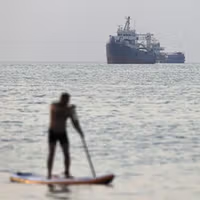
Ships are seen near the Strait of Hormuz in a handout image released by Iranian state media on June 21, 2026.
Shipowners are facing confusion over the safest route out of the Persian Gulf as Iran, the United States and western insurers issue conflicting guidance on travel through the Strait of Hormuz, the Financial Times reported on Tuesday.
Shipping traffic through the strait has increased, but Iran has warned that vessels could face penalties or be forced to turn back if they do not seek advance permission from Tehran and sail close to the Iranian coast, the report said.
At the same time, the United States and some western insurers are advising ships to use a route protected by US air cover on the Omani side of the strait, the report said, citing three shipping executives.
The conflicting guidance has left shipowners unsure whether to risk possible Iranian interference or ignore advice from insurers and US authorities, it added.
“Shipowners and operators find themselves caught in a difficult position. If they follow the guidance of underwriters and US authorities by navigating closer to Oman, they risk interference, detention or potential hostile action from Iranian authorities,” said Dr SV Anchan, chair of the US shipping company Safesea Shipping.
The United Nations says its peacekeepers in southern Lebanon recorded the first day without rocket fire or interceptions since fighting between Israel and Hezbollah erupted on March 2.
UN spokesperson Stephane Dujarric told reporters on Monday that peacekeepers observed no trajectories or interceptions on Sunday, marking a rare pause in months of hostilities.
"The lack of activities" continued into Monday morning, Dujarric said.
"We welcome this reduction in hostilities, and we very much hope this trend continues for the sake of people on the ground."