Trump says Iran 'got away with murder' for 47 years


US President Donald Trump said Iran had "got away with 'murder' for 47 years" until he took office, in a Truth Social post on Saturday.
"Then it all changed," Trump wrote, saying Iran had been "completely defeated militarily" in the war.
Trump said former President Barack Obama had given Iran "billions in cash" and had failed to use the US military to curb what he called "the world's number one sponsor of terror."
He said Iranian leaders had "ZERO respect" for Obama and former President Joe Biden, whom he called "a weak and ineffective leader."
"AMERICA IS BACK!!!" Trump wrote.


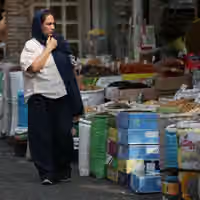

Nearly one-third of registered adoptions in Iran over the past decade were illegal, according to state welfare data, exposing a hidden child-transfer market that advocates say can leave babies vulnerable to sale, abandonment, domestic servitude and other forms of abuse.
Parisa Valentina Pouyan, director of the Pouya Helpers of Child Workers Institute, told Iran’s labor-focused ILNA news agency that baby-selling is a hidden and complex phenomenon driven not only by poverty but also by addiction, cultural pressures, weak oversight, lack of parenting education and failures in state protection systems.
“Buying and selling children is one of the most horrifying forms of social harm and one of the most damaging acts committed against children,” Pouyan said.
Her remarks followed renewed attention in Iranian media to the case of a mother accused of selling several of her newborns over different years for small sums, reviving concerns about underground markets for infants and the future awaiting children transferred outside legal adoption channels.
A recent analytical report by Iran’s State Welfare Organization, known as Behzisti, found that illegal adoption remains a serious challenge for the country’s child-protection and judicial systems.
According to the report, 18,240 adoption cases were registered from 2013 to 2024, of which 13,020, or 71 percent, were legal, while 5,224, or 29 percent, were recorded as illegal.
Behzisti is the main state body responsible for welfare and child-protection cases in Iran, including formal adoption procedures. Illegal adoptions take place outside that system, often through private arrangements, brokers or concealed transfers of newborns.
Pouyan said official and precise statistics on baby-selling do not exist because the practice is hidden. But she said poverty creates fertile ground for such cases, especially during wider social and economic crises.
Still, she warned against reducing the issue to poverty alone.
“Would every poor family sell its child?” she said. “If parents have sold a child once and their living conditions improve a little, does that mean they will never do it again?”
Pouyan said global experience shows baby-selling has become a lucrative trade in some places, and that poverty is only one driver. She cited addiction, sex work, cultural pressures and the possibility that a mother herself may have been a victim of child-selling as factors that can feed the trade.
She said the hidden nature of illegal transfers means the child’s future is often irrelevant to the transaction.
“In this kind of trade, parents who sell their baby or child do not care whether the buyers have the conditions and qualifications needed to become parents,” she said, adding that in illegal transfers “money comes first.”
Pouyan said she had personally been approached several years ago by someone seeking a child for a couple living abroad, both doctors, who wanted to adopt by finding a parent willing to sell a child. She said she rejected the request and warned she would report any such case.
According to Pouyan, the darker danger is that not all buyers are seeking parenthood.
In some cases, she said, children are bought or taken through illegal adoption channels for domestic labor or other forms of exploitation.
“I have seen a case in which a child was illegally adopted and, a few years later, became the family’s servant,” she said.
Pouyan said Iran’s response to baby-selling and illegal adoption is weakened by poor oversight, ineffective intervention by responsible agencies and possible misconduct inside institutions meant to protect children.
Iran is prepared for either a continuation of war or its end, Interior Ministry spokesperson Ali Zeinivand said on Saturday.
If war continued, Iran would inflict another "historic defeat" on its enemy, Zeinivand told a news conference.
He said Iran was also ready to attract investment and speed development if conditions allowed, adding that the country had found ways to move forward despite sanctions.
The agreement between Tehran and Washington holds out the prospect of sanctions relief and potentially unprecedented foreign investment, but many of its economic promises remain uncertain and some may prove difficult to deliver even if negotiations succeed.
The relative strengthening of the Iranian rial suggests the agreement has already had a positive psychological impact.
The US dollar, which traded above 1.8 million rials during the recent conflict, has fallen to around 1.57 million. Even so, it remains roughly 18 percent higher than six months ago.
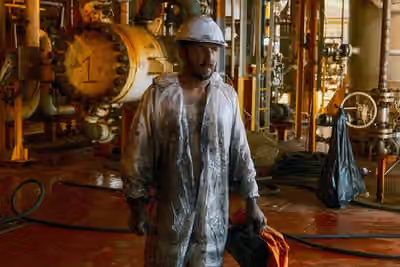
According to estimates by Kpler, Iran was exporting about 1.5 million barrels per day of crude oil and condensates before the recent conflict. Without sanctions, exports could eventually return to around 2.5 million barrels per day.
Iran would also no longer be forced to sell much of its crude to Chinese buyers at steep discounts.
Revenue boost
According to OPEC estimates, Iran earned $46.7 billion from exports of crude oil and petroleum products last year. If sanctions are lifted and oil prices remain relatively elevated, that figure could rise substantially.
A rapid recovery, however, should not be expected.
Iran's petrochemical and steel industries, which together generate roughly $17 billion in annual export revenue, have suffered extensive damage during the conflict.
As a result, Iran could temporarily become a net importer of some products it has traditionally exported.
Persian Gulf Holding, which accounts for 38 percent of Iran's petrochemical production, recently reported that output at six heavily damaged complexes fell to just 13 percent of levels recorded during the same period last year. Overall production across the holding's petrochemical subsidiaries declined by 75 percent.
According to Iran's Central Bank, oil, gas, steel and petrochemicals account for 73 percent of the country's total exports, underscoring the importance of rebuilding damaged industrial capacity.
Release of frozen assets
Iran is estimated to hold approximately $24 billion in frozen assets abroad, about half of which could be released within two months.
The Wall Street Journal reported on June 19 that, contingent upon what it described as appropriate Iranian behavior and the transfer of enriched uranium, Tehran could gain access to $6 billion in frozen funds currently held in Qatari banks for the purchase of humanitarian and agricultural goods from the United States.
The arrangement could benefit both countries. Iran imports approximately $17 billion worth of grain annually, while the United States remains the world's largest grain exporter.
Trade between the two countries has collapsed since the 1979 revolution. According to official US statistics, bilateral trade totaled $6.6 billion in 1978 but amounted to only $60 million last year, almost entirely consisting of US exports to Iran.
The reconstruction fund
One of the most ambitious — and least defined — elements of the agreement is a proposed $300 billion reconstruction fund involving foreign companies, including firms from Arab states, to support Iran's reconstruction.
Unlike historical reconstruction programs financed by governments, the proposed fund is expected to rely largely on private investment. That raises significant questions about how such a large sum could be mobilized and whether foreign companies would be willing to commit substantial capital to Iran after years of sanctions, regional tensions and political uncertainty.
Beyond political considerations, investors would also have to weigh sanctions risks, regulatory uncertainty and the long-term stability of the investment environment before committing significant capital.
Given Tehran's strained relations with many Arab states in recent years, enthusiasm among regional investors may remain limited, although countries such as Qatar and Oman could encourage some level of participation.
For now, the creation of a fund on the scale envisioned by the agreement appears unlikely in the medium term. More modest investment flows may be possible if Tehran complies with future commitments and continues improving ties with its neighbors.
The need for investment is undeniable. Iran's oil and gas sector alone is estimated to require at least $300 billion in capital to modernize infrastructure and expand production after decades of underinvestment.
Ultimately, the economic benefits outlined in the agreement depend not only on sanctions relief but also on Tehran's ability to reassure investors, rebuild damaged industries and maintain stable relations with regional and international partners.
For now, the agreement has boosted expectations. Whether it can deliver a lasting economic recovery remains an open question.
A member of Iran’s parliament’s presiding board described the memorandum with Washington as a US defeat and said Tehran’s hand remains “on the trigger” even in peacetime.
Farshad Ebrahimpour told the semi-official ISNA news agency on Saturday that Iran had “never tied its security to political agreements.”
He said the memorandum between Tehran and Washington showed what he called the failure of the United States.
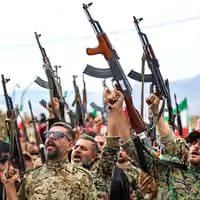
Ebrahimpour’s remarks add to a growing line of warnings from Iranian officials and hardline voices who have framed the memorandum not as a step away from confrontation, but as a pause.
The US-Iran memorandum could restore a major source of revenue for Tehran by allowing it to resume oil and fuel sales, the Wall Street Journal reported.
The report said Iran could earn more than $60 billion a year from oil sales based on its prewar production levels and current prices.
Several oil-laden Iranian tankers have already left port and crossed the US naval blockade line this week, the report said, describing the movement as an early sign of anticipated exports.


