Iranians say US deal leaves people out of the equation
As Tehran and Washington move toward a memorandum to end the war and reopen the Strait of Hormuz, messages from inside Iran show anger that the deal speaks of uranium, Lebanon and money, while ordinary Iranians remain absent from the text.
The messages, sent to Iran International on Thursday, reflect grief, suspicion and political anger after details emerged of the memorandum between Tehran and Washington.
The agreement outlines a halt to the war, a 60-day negotiation period, steps toward reopening the Strait of Hormuz, possible oil waivers and discussions over frozen assets and sanctions relief.
As Tehran and Washington move toward a memorandum to end the war and reopen the Strait of Hormuz, messages from inside Iran show anger that the deal speaks of uranium, Lebanon and money, while ordinary Iranians remain absent from the text.
The messages, sent to Iran International on Thursday, reflect grief, suspicion and political anger after details emerged of the memorandum between Tehran and Washington.
The agreement outlines a halt to the war, a 60-day negotiation period, steps toward reopening the Strait of Hormuz, possible oil waivers and discussions over frozen assets and sanctions relief.
But for many Iranians who responded, the central question was not what the Islamic Republic might receive, or whether Washington would enforce the terms. It was why ordinary Iranians appeared absent from the agreement.
“We gave our fallen, we endured more hunger and poverty, there was war, we moved further away from our dreams, we were hurt, we were killed unjustly, but uranium was the main issue,” one message said. “In these several clauses of the agreement, there was no word about the people of Iran.”
Another message described the memorandum as an agreement signed “over the bodies of Iran’s children,” referring to what the sender said were 42,000 lives lost.
The message reflected a broader anger among several respondents who saw the deal as a bargain made after months of bloodshed and repression.
Some directed their anger at US President Donald Trump, saying they had hoped Washington would side more clearly with the Iranian people. “Trump is a businessman who first sees his own profit and his country’s interests, and it does not matter to him what has happened or what will happen,” one message said.
Another sender wrote: “Tell Trump that your betrayal has remained so deeply in our hearts and minds that if one day America and Europe need the help of the people of Iran, not a single person will come toward you.”
Others focused on Mohammad Bagher Ghalibaf, the lead Iranian negotiator expected to sign the memorandum in Switzerland on Friday. Ghalibaf has defended the document and urged officials to focus on improving the economy, but one message accused him of speaking more about Lebanon than about Iranians.
“Mr. Ghalibaf, in the same speech where you said we should fix people’s economy, you spoke several times more about Lebanon than about the people of Iran, and said the first clause of the agreement is also Lebanon,” the message said.
The 14-point memorandum includes a provision on ending military operations on all fronts, including Lebanon, and ensuring Lebanon’s sovereignty and territorial integrity. It also includes provisions on the Strait of Hormuz, oil exports, frozen assets, sanctions and Iran’s nuclear program.
US officials have since sought to limit expectations, saying the memorandum does not provide Tehran with automatic access to frozen assets, immediate sanctions relief or direct US funding.
They said any economic benefit would depend on Iranian compliance and progress toward a final deal, particularly on nuclear issues.
Inside Iran, however, the messages show that many are judging the agreement less by its financial mechanisms than by what it signals politically.
Some saw it as proof that the Islamic Republic’s long confrontation with the United States had ended in failure. “We are not fooled by the regime’s propaganda,” one message said. “The current memorandum between Iran and America was a definite defeat for the Islamic Republic’s 47-year policy.”
Another urged patience and unity, framing the deal as part of a longer process of weakening the system. “Be patient, regime change is happening, although at a gentle speed,” the message said. “Just stay united and give each other hope.”
But several messages were more despairing than hopeful. One sender compared the moment to a scene in a war film where a soldier, after fighting through chaos, suddenly stands still in shock and cries.
“That is how we, the people of Iran, feel with the news of the negotiations,” the message said.
Another asked why no country had insisted that Iranians themselves had rights that should be part of any settlement. “Why was there no one anywhere in the world to say that we, the people of Iran, had the right to live?” the message said. “Why should the human rights of all people in the world be respected except those of Iranians?”
Several Iranian bank card services were disrupted on Saturday, with customers reporting failed payments, blocked transfers and POS errors in messages sent to Iran International.
Iranian media reported disruptions affecting cards issued by Bank Melli, Tejarat, Sepah and Saderat. Messages from users also cited problems with Mellat cards and said both online transfers and ATM or card payments were failing.
One shopkeeper said nearly 90% of bank cards had been down for about four hours, leaving customers unable to make purchases.
Another message from Mashhad said banks had been facing disruptions since the morning.
A customer said cards from Bank Melli, Mellat and Tejarat were not working at a shop, while another message said POS devices were showing an “issuer error.”
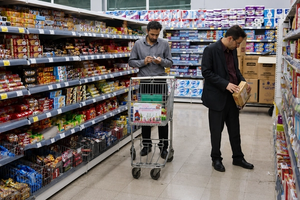
File photo of shoppers browse grocery shelves at a supermarket in Iran as households face rising living costs and inflation. The photo quality was enhanced using AI.
Citizens across Iran say soaring food prices have reduced household diets to the bare minimum needed to stave off hunger, with nutrition and variety increasingly out of reach.
Messages sent to Iran International from cities across the country paint a picture of households slipping steadily down the hierarchy of human needs.
Many say their tables have been reduced to the level of survival, where staying full matters more than quality, variety or nutritional value.
If many families had already removed red meat, fish and even chicken from their diets in recent years, messages received by Iran International suggest that fruit, eggs and dairy products have now also become luxuries for a large share of households.
Instead, they say they rely on filling foods such as pasta, potatoes, onions, bread and plain rice.
One citizen summed up the sense of despair bluntly: "If the Islamic Republic remains, we will be buried in the graveyard of our dreams."
Another said that most days their family eats little beyond potatoes, onions and lentil soup.
The accounts reflect a shift toward the most basic physiological needs required for survival, with little room for long-term health, development or security.
One citizen said that after months of buying food from weekly street vendors because shops had become too expensive, even those purchases are now out of reach.
"I only buy the absolute necessities now, things like potatoes, tomatoes and onions, and even then I buy the lowest-quality produce available," the person said.
File photo of a a woman shopping at a bakery in Tehran, Iran, amid rising food prices and persistent inflation.
A resident of Isfahan said the family's meals now consist largely of potatoes, pasta, or bread and cheese.
Official figures show some food categories rising well into triple digits over the past year while wages have failed to keep pace.
According to Central Bank data for the past month, year-on-year inflation reached 161 percent for milk, cheese and eggs, 267 percent for oils and fats, and 176 percent for meat products.
Citizens reported that lamb currently sells for around 22 million rials ($12.5) per kilogram, while beef costs roughly 15 million rials ($8.5) per kilogram.
Masoud Rasouli, secretary of the Meat Packaging and Protein Industry Association, said in early June that demand for red meat had fallen by about 50 percent compared with the previous year.
Many families told Iran International they had eliminated animal protein entirely from their diets despite warnings from health experts that prolonged protein deficiencies can lead to widespread malnutrition, particularly among children and adolescents.
Doctors have warned that shrinking household food baskets and a shift toward cheaper, lower-quality products could contribute to rising rates of anemia, weakened immune systems and other long-term health problems.
Several citizens said an ordinary package of breakfast cheese now costs around 2 million rials ($1.1).
"Many days our lunch and dinner consist only of bread and cheese," one person said. "But even if you live only on bread and cheese, you would still need about 150 million rials ($85) a month."
Iran's minimum monthly wage currently stands at around 160 million rials ($90).
Citizens reported prices of around 250,000 rials ($0.14) for a single egg, more than 10 million rials ($5.6) for a liter of cooking oil, and about 5 million rials ($2.8) for a 2.5-kilogram container of yogurt.
Many said that salaries which barely reach 200 million rials ($113) a month have left them struggling to secure even protein-free meals.
The messages also point to a more troubling development: the gradual replacement of food with whatever can fill an empty stomach.
A resident of Tabriz said they now buy meat stock instead of meat simply to create the flavor of meat in stews.
A mother from Dehloran in Ilam Province said her children have not eaten meat for months and that even chicken has become unaffordable.
Others described selling household belongings to cover food expenses.
"We have cut costs everywhere possible and there is almost nothing left on our table," one citizen said. "I have not eaten a proper meal in a week. We are reaching a point where we cannot afford three meals a day."
For a growing number of Iranians, the question is no longer how to maintain a standard of living, but how to secure enough food to get through another day.
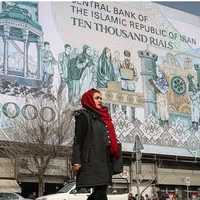
File photo of a billboard featuring Iran's 10,000-rial banknote is seen behind red traffic lights in Tehran, Iran.
Simple pleasures, personal goals and everyday purchases have become out of reach for many Iranian teenagers, who told Iran International that economic hardship is reshaping their lives and dimming their hopes for the future.
Messages sent by teenagers described a growing gap between what they need and what their families can afford, with some saying even routine activities and modest purchases now feel unattainable.
Iranian youth use their mobile phones as they walk at a park in Tehran
Simple pleasures, personal goals and everyday purchases have become out of reach for many Iranian teenagers, who told Iran International that economic hardship is reshaping their lives and dimming their hopes for the future.
Messages sent by teenagers described a growing gap between what they need and what their families can afford, with some saying even routine activities and modest purchases now feel unattainable.
One teenager said upgrading a computer has become unrealistic after the price of an 8GB DDR5 memory module rose to around 500 million rials (over $280).
Iran's minimum monthly wage is currently worth around $90-$110, depending on exchange-rate fluctuations, while estimates from labor experts put average monthly earnings for many workers at roughly $150.
"With these conditions, buying or upgrading a computer has become a dream," the teenager said.
Another wrote that a mobile phone purchased for 500 million rials (over $280) in February is now worth 930 million rials (over $520).
Others pointed to the disappearance of simple recreational activities from their lives. A 15-year-old said swimming pool fees have more than doubled since early April, while another said that a bicycle that once cost 300 million rials (around $170) now sells for 620 million rials (about $350).
"We Iranian teenagers and young people have reached a point where eating one good meal makes us happy, while our peers in other countries have many things to enjoy," one message said.
Embarrassed to ask
Several teenagers said financial pressure has not only reduced their expectations but also left them feeling ashamed to express their needs.
They described watching their parents struggle with rising living costs and choosing to remain silent about things they want or need.
An 11-year-old girl said her birthday falls in September but she is embarrassed to ask her father to organize a celebration.
She questioned why having a birthday party should be considered a wish rather than a normal part of childhood.
A group of teenagers sit on a bench with skateboards, looking at their phones and talking outside a building.
A 14-year-old wrote: "Whenever I ask my parents for something, they say they don't have the money. I feel ashamed when I sit at the dinner table."
Another 15-year-old said gym membership fees had tripled.
"I feel guilty asking for things I need because I know dealing with these prices is not easy for my parents," the teenager wrote.
Some others said they increasingly feel like a burden on their families. One wrote that their parents regularly give up their own wishes to provide for their children, while another said the feeling of being an extra weight on the family has become constant.
A 14-year-old girl said she feels guilty whenever her parents buy something for her and has become pessimistic about her future.
Adult worries replace childhood concerns
Some said their attention has shifted from hobbies, friendships and future plans to concerns about war, economic conditions and daily news.
"Whenever I think about war and ceasefires, I cry," one teenager wrote. "Why can't I enjoy life like other teenagers or go to school wearing what I want?"
A 12-year-old asked why children should be preoccupied with current events instead of enjoying their free time.
Several said the issues occupying their minds resemble adult concerns rather than those usually associated with adolescence.
"I should be thinking about having fun and playing, not working or worrying about politics and the price of gold and dollars," one teenager wrote.
Comparisons with teenagers abroad appeared frequently in the messages.
A 16-year-old girl said she works instead of pursuing leisure activities and is often too exhausted to remain on her feet.
A university entrance exam candidate wrote that seeing graduation celebrations in other countries leaves the strongest sense of longing.
Growing uncertainty about the future
Several teenagers said they struggle to imagine a future for themselves at a stage in life when they should be exploring talents, setting goals and pursuing ambitions.
An 18-year-old said the country's conditions have left little motivation even for ordinary daily life, let alone planning for the future.
Another wrote that, despite being only 18, they are already watching their hopes and ambitions fade.
A 15-year-old said economic pressure, exhaustion and disappointment have become part of everyday life and make long-held aspirations feel impossible to achieve.
Some said uncertainty is even shaping major life decisions.
A ninth-grade student wrote that although they would like to choose an academic path based on personal interests, the future feels so unpredictable that passion has become a luxury.
Instead of focusing on dreams, the student said thoughts are dominated by rising prices, war and the memory of those who have died, creating a sense of being trapped with no clear path forward.