Iran rearrests protester shot during January crackdown after medical release


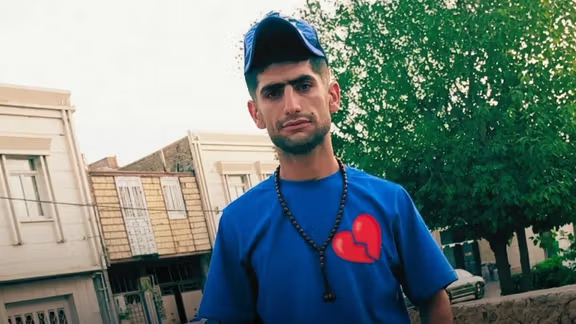
Iran's authorities have detained Ismail Khanbaba, a protester from the southwestern Iranian city of Dezful, after he was temporarily released from prison to receive medical treatment for injuries sustained when he was shot by security forces during the nationwide January protests, sources told Iran International.
His family had secured a heavy bail of 200 billion rials, about $127,000, for his temporary release so that treatment for his injuries could continue in hospital.
Despite this, security forces rearrested Khanbaba after his release from Dezful prison.
Authorities have not given any information about his whereabouts, place of detention or health.


Baluch women were beaten during protests over local mining projects in southeastern Iran, renewing attention on the Islamic Republic’s treatment of one of the country’s poorest and most heavily policed minorities.
The incidents were reported in Faryab county in Kerman province and in Taftan county in Sistan and Baluchestan, where residents had gathered to protest mining projects they say have damaged local livelihoods or excluded native communities from the benefits of natural resources.
The Baluch rights group Haalvsh said at least eight Baluch women were injured and six people, including three women, were arrested on Wednesday after forces attacked a protest over a chromite mine in Pashmoki, a village in Faryab county.
According to Haalvsh, residents were protesting what they described as the transfer of mining benefits to people with influence while local communities remain deprived of the economic gains. Videos published by the group show uniformed forces confronting women and other residents, with several women seen being pushed, struck or beaten.
Haalvsh said the detainees had been taken to an unknown location and their families had not received clear information about their condition or whereabouts.
The Pashmoki incident came less than 48 hours after Haalvsh reported another assault on Baluch women protesting activity linked to the Taftan gold mine in Sistan and Baluchestan province.
In that case, women in Sarsiah village said forces insulted, threatened and beat them after they objected to the mine’s impact on local water, farmland and daily life. Haalvsh said one woman was injured in the head after being struck with the butt of a weapon.
The immediate disputes are local, but the anger around them is rooted in a much wider sense of exclusion. Residents say mining projects are damaging water resources, disrupting villages and enriching others while Baluch communities remain poor.
Sistan and Baluchestan has long been one of Iran’s most deprived provinces. Its mostly Sunni Baluch population has faced discrimination, underdevelopment and heavy security pressure under the Islamic Republic. The region has repeatedly seen deadly crackdowns, including the 2022 “Bloody Friday” killings in Zahedan.
Human rights groups have also documented the disproportionate use of executions against Baluch prisoners, especially on drug-related charges. Amnesty International said Baluch people accounted for 29% of Iran’s drug-related executions in 2023 despite making up about 5% of the population. Iran Human Rights said Baluch prisoners represented 17% of drug-related executions in 2024, while forming an estimated 2% to 6% of Iran’s population.
Molavi Abdolhamid, the influential Sunni cleric in Zahedan, has repeatedly criticized the execution of Baluch prisoners. He said in 2023 that many people executed on drug-related charges had been accused of sales worth as little as $15 to $20, and that poverty, unemployment and lack of infrastructure had pushed some people in the region into smuggling fuel, goods or drugs as a lifeline.
That background is why the beatings at the mine protests have resonated beyond the two villages. The images show Baluch women, among the most marginalized voices in Iran, confronting security forces over the basic question of who benefits from the wealth beneath their land.
The Islamic Republic often frames unrest in Baluch areas through the language of security, smuggling or separatism. But the protests in Pashmoki and Sarsiah point to another reality: communities demanding water, livelihood, dignity and a say over local resources, and being met with batons, threats and arrests.
Iranian President Masoud Pezeshkian published the Persian-language text of the Iran-US memorandum of understanding on X, saying the document reflected the voice of a nation that did not trade its dignity and independence for threats or pressure.
The image published by Pezeshkian showed the memorandum had also been signed by US President Donald Trump and Pakistani Prime Minister Shehbaz Sharif.
“What was recorded today was the result of national steadfastness, political rationality and responsible diplomacy,” Pezeshkian wrote.
Israeli Prime Minister Benjamin Netanyahu is seeking to influence the final Iran deal by using right-wing media figures and friendly senators to pressure US President Donald Trump, CNN reported, citing an Israeli source.
CNN cited the source as saying Netanyahu has been skeptical of Iran’s intentions throughout the talks with the United States and believes Tehran was never willing to negotiate in good faith.
The source added that Netanyahu still assesses there will not be a final deal between the United States and Iran and that Tehran will not genuinely agree to restrictions on its nuclear program.
The US Justice Department is investigating how Iran’s Supreme Leader Mojtaba Khamenei built a global investment portfolio with exposure to Wall Street banks, Bloomberg reported, citing four officials with direct knowledge of the matter.
The probe is examining allegations of money laundering and corruption, including possible involvement by American financial institutions such as JPMorgan Chase and Citigroup in facilitating large money movements between firms overseen by Khamenei, according to the report.
Bloomberg said investigators are looking at the role of US correspondent banks and possible gaps in due-diligence procedures that may have allowed financial flows linked to Khamenei’s network. The existence of the probe does not mean charges will be filed, the report said.
Khamenei, who became supreme leader in March after his father was killed in a US-Israel airstrike at the start of the Iran war, has not been seen publicly since taking office.
Bloomberg previously reported that Khamenei had built a sprawling business empire involving Persian Gulf shipping, Swiss bank accounts and luxury properties in Britain, with funds routed through financial institutions in the UK, Switzerland, Liechtenstein and the UAE.
The report said the Justice Department’s investigation has become more diplomatically sensitive as Washington and Tehran move through an interim peace agreement that was signed Wednesday to end the war and open talks on wider issues, including Iran’s nuclear program.
Before becoming supreme leader, Khamenei relied heavily on financier Ali Ansari, whose banking, construction and trading interests served as a conduit for moving funds abroad, Bloomberg reported. Ansari has denied any relationship with Khamenei.
The report said the DOJ is also examining European and Middle Eastern lenders, as well as property-related payments by the network to global brands, including Hilton Worldwide.
Iranian Foreign Minister Abbas Araghchi said on Thursday that he spoke with Kuwaiti Foreign Minister Sheikh Jarrah Jaber Al-Ahmad Al-Sabah about Tehran’s memorandum of understanding with the US.
He said Iran remained committed to a policy of good-neighborly relations and hoped the agreement would help restore peace and stability in the region.
Araghchi also stressed the need for dialogue with Persian Gulf countries to improve engagement and clear up existing ambiguities, the ministry said.