G7 leaders for a family photo before a cultural performance and concert during the G7 summit, in Evian-les-Bains, France, June 16, 2026.
G7 leaders welcomed on Wednesday the announcement of a deal between the United States and Iran, saying it offered a major opening to prevent Tehran from acquiring a nuclear weapon and address regional and missile-related threats.
“We welcome the announcement of a deal between the United States and Iran, secured under the strong leadership of President Trump, with the support of mediating countries,” the leaders said in a statement on geopolitical issues.
They said the agreement provided “an historic opportunity to prevent Iran from acquiring any nuclear weapon and tackling the threats related to its regional and ballistic activities.”
“We support and are ready to contribute to its implementation,” the statement said.
The Group of Seven also backed further diplomacy after the US-Iran memorandum of understanding, saying any follow-on negotiation should address threats posed by Iran “in the region and beyond” and include relevant partners, including the International Atomic Energy Agency.
“We reaffirm that Iran will never obtain a nuclear weapon,” the leaders said.
On Lebanon, the G7 tied its support to an immediate ceasefire and the disarmament of Iran-backed Hezbollah.
“In Lebanon, we support, through an immediate robust ceasefire, the Lebanese leadership’s efforts to achieve the disarmament of Hezbollah and the monopoly of arms, and to protect Lebanon’s territorial integrity and sovereignty with the appropriate international security guarantees,” the statement said.
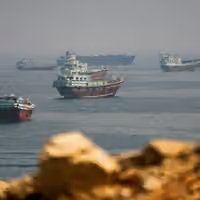
The leaders also backed the resumption of traffic through the Strait of Hormuz, saying “the right of transit passage without restrictions or tolls is the bedrock of international trade.”
They said a multinational defensive initiative led by France and the UK could help protect merchant vessels, reassure shipping operators and verify the removal of mines.
The G7 also pledged to reduce global vulnerability to the Strait of Hormuz by accelerating the diversification of energy supply routes and increasing energy stocks.