

Hezbollah commander Ali al-Hajj was killed in Israel’s airstrike on Dahieh in Beirut on Sunday, Al Arabiya reported.
Al Arabiya also reported that the Israeli military carried out three airstrikes on the town of Sajd in southern Lebanon.
The Israeli military earlier said it targeted a Hezbollah headquarters in Dahieh in Beirut in response to the Iran-backed group launching three drones toward northern Israel.
Iranian government spokesperson said on Sunday that those attacking the country’s negotiators were in effect attacking a national decision, not a person or political faction.
Fatemeh Mohajerani said diplomacy was not opposed to the battlefield but a continuation of it, adding that negotiating from a position of strength meant turning national power into tangible benefits for the public.
The spokesperson warned that any voice creating division would weaken Iran’s hand at the negotiating table and signal weakness to the other side.
The strikes in Beirut are creating issues with finalizing the Iran-US deal, Fox News correspondent Trey Yingst said on X, citing a diplomat involved in the talks.
“This is a clear attempt by Israel to sabotage the President’s deal and drag the United States back into war,” the diplomat told Fox News.
A senior Israeli official rejected the notion that Israel was to blame for the exchange of fire.
“Hezbollah attacks have targeted Israeli civilians the past three days,” the Israeli official told Fox News.
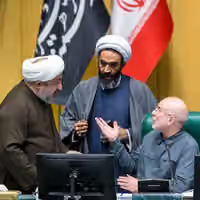
Iranian Parliament Speaker Mohammad Bagher Ghalibaf said Israel’s attack on Dahieh in Beirut showed Washington either lacked the will or the ability to carry out its commitments, warning that the path forward was impossible if the United States failed to do so.
“The Zionists’ aggression against Dahieh once again showed that the United States either has no will to implement its commitments or lacks the ability to do so. You cannot gain concessions by showing a green light to the regime. The bad cop-good cop game has become old,” Ghalibaf said in a post on X.
“If you do not have the will and ability to implement your commitments, it is not possible to speak of continuing the path,” he added.
Deepening poverty in Iran is driving a rise in child labor, exposing children to sexual exploitation, violence and malnutrition, the head of Iran's Association of Social Workers warned on Sunday.
Hassan Mousavi Chalak told Khabar Online that worsening economic conditions were forcing more families to rely on their children's income to meet basic needs.
"We must accept that poverty in Iran has deepened," Mousavi said. "The more difficult economic conditions become, the more the use of children's labor capacity to cover family expenses increases."