• العربية
  • فارسی
Brand
  • Iran Insight
  • Politics
  • Economy
  • Analysis
  • Special Report
  • Opinion
  • Podcast
  • Iran Insight
  • Politics
  • Economy
  • Analysis
  • Special Report
  • Opinion
  • Podcast
  • Theme
  • Language
    • العربية
    • فارسی
  • Iran Insight
  • Politics
  • Economy
  • Analysis
  • Special Report
  • Opinion
  • Podcast
All rights reserved for Volant Media UK Limited
volant media logo

US pressure failed to shift Iran's stance, Guards-linked media says

Jun 12, 2026, 11:25 GMT+1

Tasnim, a news agency affiliated with the Revolutionary Guards, cited informed sources as saying Washington told Tehran through Qatari mediators that it no longer required changes sought by the United States to a proposed text.

According to the report, efforts by US President Donald Trump to alter the Islamic Republic's position through military pressure, diplomatic threats and Qatari mediation failed, with Tehran rejecting the latest proposed changes.

Tasnim also quoted the sources as saying the 14-point text remains under review by relevant institutions in the Islamic Republic and that speculation over the outcome of the negotiations is not "credible" until that process is complete.

Most Viewed

US probes NIAC founder Trita Parsi for possible deportation - Free Press
1

US probes NIAC founder Trita Parsi for possible deportation - Free Press

2

How Nourabad Mamasani became an early flashpoint of Iran’s January bloodshed

3

Military escalation overshadows US-Iran peace efforts

4

War damage adds new strain to Iran’s blackout-prone power grid

5

Tit-for-tat under ceasefire: Experts warn of new normal in Mideast conflict

Banner
Banner

Spotlight

  • Iran officials threaten Hormuz escalation as Trump says deal is near

    Iran officials threaten Hormuz escalation as Trump says deal is near

  • How Nourabad Mamasani became an early flashpoint of Iran’s January bloodshed

    How Nourabad Mamasani became an early flashpoint of Iran’s January bloodshed

  • As prices soar, Iranian diets shrink to survival level
    VOICES FROM IRAN

    As prices soar, Iranian diets shrink to survival level

  • Iranian teens say rising costs turn simple wishes into distant dreams
    VOICES FROM IRAN

    Iranian teens say rising costs turn simple wishes into distant dreams

  • Faith in diplomacy further dented by Iran-Israel exchange
    INSIGHT

    Faith in diplomacy further dented by Iran-Israel exchange

  • 'Nothing is over':  Iran-Israel conflict enters a new phase
    ANALYSIS

    'Nothing is over': Iran-Israel conflict enters a new phase

•
•
•

More Stories

State media releases reported details of Iran-US draft deal

Jun 12, 2026, 09:06 GMT+1
State media releases reported details of Iran-US draft deal
100%

New details of a reported 14-point draft understanding between Iran and the United States have been published by Mehr News, which cited a source close to the Iranian negotiating team.

According to the report, the draft includes the following provisions:

1. A permanent and immediate halt to fighting on all fronts, including Lebanon.

2. A US commitment not to interfere in Iran's internal affairs and to respect the sovereignty of the Islamic Republic of Iran.

3. The full lifting of the naval blockade within 30 days.

4. A US commitment to withdraw its forces from areas surrounding Iran.

5. The reopening of the Strait of Hormuz within 30 days under arrangements set by Iran.

6. The suspension of sanctions on Iran's oil sales, petrochemical products and derivatives, along with full Iranian access to the resulting financial resources.

7. A requirement for the United States and its allies to present plans for Iran's reconstruction worth at least $300 billion.

8. A 60-day negotiating period aimed at reaching a final agreement covering nuclear issues and the complete removal of US primary and secondary sanctions, as well as United Nations Security Council and International Atomic Energy Agency Board of Governors resolutions.

9. A reiteration of Iran's commitment under the Nuclear Non-Proliferation Treaty not to produce nuclear weapons.

10. During the negotiation period, the United States would not deploy additional forces to the region or impose new sanctions.

11. The release of $24 billion in blocked Iranian funds during the 60-day negotiation period, with half of that amount to be made available to Iran before negotiations begin.

12. The establishment of a monitoring mechanism to implement the agreement.

13. Approval of the final agreement through a United Nations Security Council resolution.

14. Final negotiations would not begin before the release of half of Iran's blocked funds, the suspension of Iran's oil sanctions and the lifting of the naval blockade. The final agreement would focus exclusively on the fate of enriched material and enrichment activities, sanctions relief and plans to rebuild Iran's economy. Discussions regarding Iran's missile program and support for resistance groups would be definitively excluded from the agenda.

Foreign Ministry spokesman Esmail Baghaei has said the text still requires review and finalization by the relevant authorities in Iran.

Lawmaker says Tehran will not abandon regional allies

Jun 12, 2026, 09:00 GMT+1
Lawmaker says Tehran will not abandon regional allies
100%

Iran has shown it will not compromise on its core principles or allow the "Axis of Resistance" to be sacrificed, an Iranian lawmaker said, citing Tehran's military action against Israel in support of Lebanon.

"The Islamic Republic will not allow the 'Axis of Resistance' to be sacrificed, and by attacking Israel in support of Lebanon, it showed that it does not bargain over its values," Fathollah Tavassoli, a member of parliament, said on Friday.

Iran MP denies rift between battlefield and diplomacy

Jun 12, 2026, 07:09 GMT+1

A member of Iran’s parliament National Security and Foreign Policy Committee denied any split between the Islamic Republic’s military and diplomatic decision-makers, saying both sides take orders from Supreme Leader Mojtaba Khamenei.

Mansour Haghighatpour said Western countries were hoping to hear signs of division among Iranian officials, but argued that military and diplomatic actors operate under the same command.

“Both Majid the precision-striker (IRGC Aerospace Force commander Brigadier General Majid Mousavi) and Mohammad-Bagher the negotiator (Parliament Speaker Mohammad Bagher Ghalibaf) take orders from one commander named Mojtaba Khamenei,” Haghighatpour said. “So in response to the West’s wish to hear the sound of discord and division among the system’s officials and functionaries, one must say: dream on.”

Haghighatpour also described the Foreign Ministry’s support for the IRGC’s Sunday night military operation as evidence of coordination between the military and diplomatic arms of the Islamic Republic.

He said the battlefield and diplomacy are “two wings” of the system and operate under the command of the commander-in-chief.

Iran officials threaten Hormuz escalation as Trump says deal is near

Jun 12, 2026, 07:04 GMT+1
•
Maryam Sinaiee

Hours after threatening to hit Iran “very hard,” President Donald Trump said a deal with Tehran was close, leaving Iranian officials to balance threats of retaliation with signals that talks over Hormuz, sanctions relief and a fragile ceasefire are still alive.

The sudden shift followed a volatile day in which US forces were reportedly hours away from launching new strikes inside Iran before Trump called off the operation and said the two sides had reached what he described as a “great deal.”

Reports by Axios, Politico and other outlets said the emerging memorandum of understanding would immediately reopen the Strait of Hormuz without tolls, lift the US blockade, extend the ceasefire for 60 days, including in Lebanon, and leave detailed nuclear negotiations for a second stage.

The agreement has not been formally signed. Axios reported that it still needed final approval, while Iran’s Foreign Ministry said Tehran had not reached a final decision. Al Arabiya reported that Iran had conveyed approval of a draft through Qatari mediators.

The latest diplomatic push came after a sharp escalation in rhetoric. Trump had earlier threatened new strikes against Iran and suggested the United States could eventually take control of Kharg Island and other parts of Iran’s oil infrastructure.

For Tehran, the public response has mixed defiance with pressure tactics.

Ali Abdollahi, commander of Iran’s Khatam al-Anbiya Central Headquarters, warned that attacks on Iran’s energy infrastructure could threaten exports across the region.

“Either oil and gas exports will remain available for everyone, or they will be possible for no one,” he said, adding that Iran would respond more forcefully if US attacks continued and that “the fire of war could spread further.”

Continue reading...

Iran officials threaten Hormuz escalation as Trump says deal is near

Jun 12, 2026, 06:18 GMT+1
•
Maryam Sinaiee
Iran officials threaten Hormuz escalation as Trump says deal is near
100%
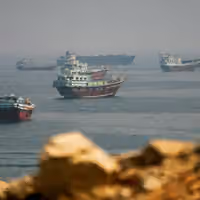
Vessels are anchored in the Strait of Hormuz, as seen from Musandam, Oman, June 11, 2026.

Hours after threatening to hit Iran “very hard,” President Donald Trump said a deal with Tehran was close, leaving Iranian officials to balance threats of retaliation with signals that talks over Hormuz, sanctions relief and a fragile ceasefire are still alive.

The sudden shift followed a volatile day in which US forces were reportedly hours away from launching new strikes inside Iran before Trump called off the operation and said the two sides had reached what he described as a “great deal.”

Reports by Axios, Politico and other outlets said the emerging memorandum of understanding would immediately reopen the Strait of Hormuz without tolls, lift the US blockade, extend the ceasefire for 60 days, including in Lebanon, and leave detailed nuclear negotiations for a second stage.

The agreement has not been formally signed. Axios reported that it still needed final approval, while Iran’s Foreign Ministry said Tehran had not reached a final decision. Al Arabiya reported that Iran had conveyed approval of a draft through Qatari mediators.

The latest diplomatic push came after a sharp escalation in rhetoric. Trump had earlier threatened new strikes against Iran and suggested the United States could eventually take control of Kharg Island and other parts of Iran’s oil infrastructure.

For Tehran, the public response has mixed defiance with pressure tactics.

Ali Abdollahi, commander of Iran’s Khatam al-Anbiya Central Headquarters, warned that attacks on Iran’s energy infrastructure could threaten exports across the region.

“Either oil and gas exports will remain available for everyone, or they will be possible for no one,” he said, adding that Iran would respond more forcefully if US attacks continued and that “the fire of war could spread further.”

Parliament Speaker Mohammad-Bagher Ghalibaf also warned that US actions could destabilize the region and energy markets.

“Wrong strategies and impulsive decisions will reset the entire board for the worse, explode energy infrastructure and markets, and create an endless quagmire that you will be stuck in for years,” he wrote on X. “You will see a different Iran.”

Mohsen Rezaei, a military adviser to Supreme Leader Mojtaba Khamenei, mocked Trump’s strategy and said military pressure would deepen Washington’s problems.

“The unhinged US president imagines that bombs can get him out of the quagmire he himself created,” Rezaei wrote. “But Iranian missiles will sink him even deeper into it.”

He added that Washington must choose between accepting Iran’s terms and losing what he called the last remains of its credibility.

Lawmaker Mojtaba Zarei said Iran had effectively moved beyond the ceasefire, saying Tehran was using its military power in three arenas: the Strait of Hormuz, the blockade front, and Lebanon and Bab al-Mandab. He said Iran would not relinquish control over Hormuz.

Iranian state media have also sought to portray the US strikes as ineffective and Trump’s threats as exaggerated. Outlets including Fars, IRNA and state broadcaster IRIB have described the attacks as aggression and a repeated violation of the ceasefire, while emphasizing reported damage to civilian infrastructure, including drinking-water reservoirs in southern Iran.

They have largely ridiculed Trump’s remarks about taking Kharg Island and Iranian oil infrastructure, describing them as delusion, adventurism or hollow threats.

Still, Iranian-linked actions and claims have continued around the edges of the ceasefire. Fox News reported that US forces shot down two Iranian one-way attack drones after an attempted strike on commercial ships transiting the Strait of Hormuz.

Iranian state media also reported that the IRGC Navy had confronted what it described as a “violating” vessel near Sirik and forced an oil tanker to comply with a traffic prohibition order.

The mixed signals have left analysts divided over whether the latest exchange marks a return to war or another stage of coercive bargaining.

Hassan Hanizadeh, a foreign policy analyst, told Fararu that the US strikes appeared aimed less at launching a full-scale campaign than at restoring Washington’s initiative.

“The United States is trying to shift the psychological balance in its favor through limited military actions,” he said.

Hanizadeh argued that the likelihood of a full-scale war in the short term remains low, and that Washington is instead pursuing a war of attrition combining military pressure with economic tools.

Others in Tehran have described the strikes as part of the negotiating process itself. Ebrahim Azizi, chairman of parliament’s National Security Committee, called the military operations “the military annex to the negotiating table.”

Political analyst Hossein Ghatib argued that Washington is trying to turn the Strait of Hormuz from a geopolitical asset for Iran into a source of military, economic and diplomatic vulnerability.

He said recent attacks on coastal radars, air-defense systems, naval command centers, drone bases and missile facilities appeared designed to weaken Iran’s ability to monitor and control the waterway.

But Shahin Shahid-Saless, an international affairs analyst, argued that military pressure is unlikely to soften Tehran’s position.

“Under military pressure, no matter how powerful, the Islamic Republic will not change its position,” he wrote on X. “I would even go further and say that heavy bombing will not soften its stance; it will make it harder and less reconcilable.”

That tension now defines the moment: Washington is using military threats and a blockade to push Tehran toward a preliminary deal, while Iranian officials are threatening Hormuz, US interests and regional energy flows to raise the cost of further pressure.

Whether the emerging agreement holds may depend less on Trump’s claim that the deal is nearly done than on whether Tehran treats the current pressure as a reason to sign – or as another reason to harden its terms.