• العربية
  • فارسی
Brand
  • Iran Insight
  • Politics
  • Economy
  • Analysis
  • Special Report
  • Opinion
  • Podcast
  • Iran Insight
  • Politics
  • Economy
  • Analysis
  • Special Report
  • Opinion
  • Podcast
  • Theme
  • Language
    • العربية
    • فارسی
  • Iran Insight
  • Politics
  • Economy
  • Analysis
  • Special Report
  • Opinion
  • Podcast
All rights reserved for Volant Media UK Limited
volant media logo

Iran's Arab neighbors turn to 'dark' transfers to keep oil moving

Jun 9, 2026, 03:29 GMT+1

Iran's Arab neighbors are increasingly using shipping methods long associated with Tehran's sanctions-evasion network to keep crude exports flowing amid disruption in the Persian Gulf, according to maritime intelligence firm TankerTrackers.
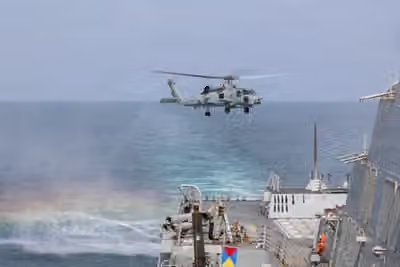

The firm said it observed a surge in "dark" ship-to-ship oil transfers across the Middle East over the weekend.

"This weekend saw a lot of dark ship-to-ship transfers of oil in the Middle East. It's not Iranian oil. Instead, this is oil coming from Iran's Arab neighbors," TankerTrackers said on X.

The company suggested the covert transfers were helping ease pressure on global oil markets despite continuing tensions in the region.

"Yet another reason why oil isn't $200/barrel right now," it added.

Dark ship-to-ship transfers and tankers operating with tracking systems switched off have long been associated with Iranian oil exports and sanctions evasion.

Shipping across the Persian Gulf has been heavily disrupted since early March, when Iran closed the Strait of Hormuz in retaliation for US-Israeli strikes on the country and subsequent attacks on its regional allies.

The disruption deepened after Washington launched a naval blockade of Iranian ports in mid-April, prompting traders and regional producers to seek alternative ways to move crude to global markets.

Most Viewed

Delayed burial, absent successor: Questions over post-Khamenei Iran
1

Delayed burial, absent successor: Questions over post-Khamenei Iran

2

Student protests over university entrance exam rules continue across Iran

3
INSIGHT

What Israel hit at Iran's Karoon Petrochemical and why it matters

4
INSIGHT

Iran turns to LA-based singer for state-backed religious event

5

Inside the Iranian missile base hit by Israel near Najafabad

Banner
Banner

Spotlight

  • Faith in diplomacy further dented by Iran-Israel exchange
    INSIGHT

    Faith in diplomacy further dented by Iran-Israel exchange

  • Tehran seeks to draw a line around Lebanon
    INSIGHT

    Tehran seeks to draw a line around Lebanon

  • 'Nothing is over':  Iran-Israel conflict enters a new phase
    ANALYSIS

    'Nothing is over': Iran-Israel conflict enters a new phase

  • Delayed burial, absent successor: Questions over post-Khamenei Iran

    Delayed burial, absent successor: Questions over post-Khamenei Iran

  • From banks to blockchains: US opens new front in Iran sanctions
    ANALYSIS

    From banks to blockchains: US opens new front in Iran sanctions

•
•
•

More Stories

Dollar holds high as Iran uncertainty boosts safe-haven demand

Jun 9, 2026, 02:55 GMT+1

The US dollar held near a two-month high on Tuesday as uncertainty over the Middle East conflict and growing expectations of a Federal Reserve rate hike boosted demand for safe-haven assets.

The greenback strengthened against most major currencies despite a pause in direct attacks between Iran and Israel after an appeal from President Donald Trump.

The euro traded at $1.1528 and sterling at $1.3335, both down around 0.05% in Asian trading after hitting two-month lows in the previous session.

Tehran seeks to draw a line around Lebanon

Jun 9, 2026, 02:19 GMT+1
Tehran seeks to draw a line around Lebanon
100%
An Israeli ultra-Orthodox Jewish man reacts near a part of a missile protruding from the ground, following strikes from Iran, in the central Israeli-occupied West Bank, June 8, 2026.

Iranian officials and media outlets say Tehran's missile strike on Israel in response to attacks on Beirut has established a new red line: future attacks on Hezbollah and Lebanon could trigger direct Iranian retaliation.

The debate emerged after Iran launched missiles at Israel following Israeli strikes in Beirut's southern suburbs, at a time when negotiations between Tehran and Washington were widely described as nearing an agreement.

Speaking to the Revolutionary Guards (IRGC)-linked Tasnim News Agency, an unnamed military source dismissed Washington's lack of public endorsement for Israeli attacks as a "purely propagandistic and deceptive act."

"If the Israelis and Americans believe they can, through 'controlled escalation,' make Iran and the Resistance Front predictable or limit the nature of Iran's response, they are making a foolish mistake," he said.

Read the full article here.

Israeli envoy rejects Iran bid to link Lebanon to US talks

Jun 9, 2026, 01:44 GMT+1

Israel's ambassador to the United States said Iran is wrongly attempting to tie developments in Lebanon to ongoing negotiations with Washington, insisting the two issues are unrelated.

"The main issue here is that Iran is trying to connect the negotiations with the United States with Lebanon, and they have nothing to do with Lebanon," Yechiel Leiter told Fox News.

"When we hit Hezbollah, that has nothing to do with Iran, and they have to stay out of it," he said.

Leiter argued that Lebanon's future depends on reducing Iranian influence, saying the country "will not have a future if it remains linked to Iran."

Stocks slip, oil pares gains as Iran and Israel halt attacks

Jun 9, 2026, 01:13 GMT+1

Global stocks edged lower on Monday while oil prices gave up part of their earlier gains after Iran and Israel said they had halted attacks on each other following an appeal from US President Donald Trump.

Markets remained cautious as uncertainty persisted over the durability of the ceasefire. Tehran warned it would resume strikes if Israel continued attacks on Iran-backed Hezbollah in Lebanon.

In energy markets, US crude settled up 0.84%, or 76 cents, at $91.30 a barrel after earlier trading above $95. Brent crude ended the session up 1.25%, or $1.16, at $94.25 a barrel after briefly rising above $98.

Tehran seeks to draw a line around Lebanon

Jun 9, 2026, 00:38 GMT+1
•
Maryam Sinaiee
Tehran seeks to draw a line around Lebanon
100%
An Israeli ultra-Orthodox Jewish man reacts near a part of a missile protruding from the ground, following strikes from Iran, in the central Israeli-occupied West Bank, June 8, 2026.

Iranian officials and media outlets say Tehran's missile strike on Israel in response to attacks on Beirut has established a new red line: future attacks on Hezbollah and Lebanon could trigger direct Iranian retaliation.

The debate emerged after Iran launched missiles at Israel following Israeli strikes in Beirut's southern suburbs, at a time when negotiations between Tehran and Washington were widely described as nearing an agreement.

Although Iran's Khatam al-Anbiya Central Headquarters announced on Monday that it was halting further strikes, it warned that attacks would resume if Israel targeted either Iran or Lebanon again.

US President Donald Trump called on both sides to halt retaliatory attacks, while Foreign Ministry spokesman Esmail Baghaei said Washington bore "direct responsibility" for any action taken by Israel against Iran.

Speaking to the Revolutionary Guards (IRGC)-linked Tasnim News Agency, an unnamed military source dismissed Washington's lack of public endorsement for Israeli attacks as a "purely propagandistic and deceptive act."

"If the Israelis and Americans believe they can, through 'controlled escalation,' make Iran and the Resistance Front predictable or limit the nature of Iran's response, they are making a foolish mistake," he said.

A new strategic doctrine?

Among the most notable reactions came from Sadegh Larijani, chairman of Iran's Expediency Council.

In a post on X, Larijani described the strike carried out in defense of Lebanon as "the official declaration of a strategic doctrine" and the opening of "a new chapter in defense policy," in which Iran would pursue its regional power through initiative and offensive capability.

Parliament Speaker Mohammad Bagher Ghalibaf, who also heads Iran's negotiating team in talks with Washington, argued that Iran had "overturned the equation of a ceasefire on paper and its repeated violation on the battlefield."

"As long as there is no genuine will for confidence-building, Iran's response will remain the same," he wrote on X.

President Masoud Pezeshkian struck a more measured tone, arguing that diplomacy and deterrence remained complementary rather than contradictory.

"We will firmly defend the rights of the nation and retreat before no threat," he wrote. "Diplomacy and defense are the two wings of national power; we have abandoned neither the battlefield nor the negotiating table."

Media echo the new strategy

Iranian media quickly expanded on that interpretation, arguing that the strike reflected a broader shift in Tehran's deterrence strategy.

Farda News, a website close to Ghalibaf, argued that attacks on Lebanon would no longer be cost-free and that Israeli actions on one front could trigger responses on another. The outlet also interpreted the reported targeting of the Haifa refinery—described by the IRGC as retaliation for attacks on Iran's petrochemical industry—as an example of "strategic symmetry."

"The era of cost-free attacks on the Resistance Front has ended," it wrote.

Other conservative outlets advanced similar arguments. Tabnak, which is considered close to Mohsen Rezaei, an adviser to Iran's supreme leader, argued that Tehran had for the first time retaliated militarily for an Israeli attack on a country other than Iran itself.

Khabar Online described the strike as a redefinition of deterrence equations in the Middle East, while Rouydad24 argued that Tehran was signalling a willingness to expand both the geography and scope of future confrontations.

Several commentators framed the issue not simply as support for Hezbollah but as a test of Iran's credibility with its regional allies. Allowing Hezbollah to be weakened or destroyed without a response, they argued, would undermine decades of Iranian regional strategy and raise questions about the reliability of Tehran's support for its partners.

Mixed reactions online

Public reactions on social media were more divided.

Some users criticized Iran's involvement on behalf of Hezbollah. One commenter wrote that Iran had effectively become "the proxy force of a foreign group called Hezbollah," arguing that resources intended to strengthen Iran's own security were instead being spent defending an ally.

Others focused on the domestic costs of escalation.

"If they hit our water, electricity, refineries and power plants tomorrow, remember that your Revolutionary Guard brothers dragged Iran into war because of Lebanon," one user wrote.

Several users expressed concern that prolonged conflict could make Iran resemble Lebanon, a country long marked by instability and recurring wars.

"I fear the Beirutization of Tehran," one commenter wrote. "I am terrified of the Beirutization of Iran."

Together, the reactions highlighted a widening debate over the costs and benefits of Tehran's regional strategy. While officials and conservative media presented the strike as the emergence of a new deterrence doctrine, many ordinary Iranians appeared more concerned about the risks that such a doctrine could bring at home.