Tehran hardliners demand escalation as Trump says talks are progressing

Iranian officials and hardline media are signaling a tougher stance toward Washington after the most serious US-Iran military exchange in weeks, even as President Donald Trump says negotiations are progressing and an Iran deal may still be within reach.
The latest escalation began early Wednesday, when the United States struck an Iranian telecommunications tower on Qeshm Island. Iran responded by announcing attacks on US military facilities in Kuwait and Bahrain.
Kuwaiti authorities said an Iranian drone struck Kuwait International Airport, killing one person and injuring dozens of others. The IRGC, however, denied targeting the airport.
The confrontation has put new pressure on the 56-day ceasefire between Washington and Tehran, with President Trump seeking to preserve the truce while Iranian hardliners argue that recent military action has strengthened Tehran’s position.
Read the full article here.
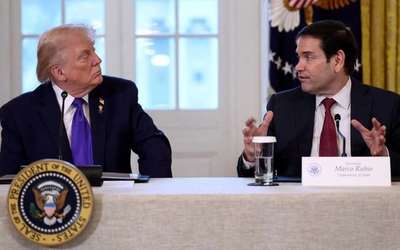




Iranian officials and hardline media are signaling a tougher stance toward Washington after the most serious US-Iran military exchange in weeks, even as President Donald Trump says negotiations are progressing and an Iran deal may still be within reach.
The latest escalation began early Wednesday, when the United States struck an Iranian telecommunications tower on Qeshm Island. Iran responded by announcing attacks on US military facilities in Kuwait and Bahrain.
Kuwaiti authorities said an Iranian drone struck Kuwait International Airport, killing one person and injuring dozens of others. The IRGC, however, denied targeting the airport.
The confrontation has put new pressure on the 56-day ceasefire between Washington and Tehran, with President Trump seeking to preserve the truce while Iranian hardliners argue that recent military action has strengthened Tehran’s position.
Trump keeps talks alive
Despite the latest confrontation, Trump has publicly remained optimistic about diplomacy, saying talks are progressing well and suggesting that an agreement could be reached by the end of the week.
He has described the latest American strike as severe but framed Iran’s response as retaliatory, a distinction that appears intended to leave space for diplomacy.
According to the Wall Street Journal, Trump privately told advisers that he wants to preserve the current ceasefire and would only consider resuming large-scale military operations if American service members are killed.
The message has left Washington in a delicate position: seeking to deter further Iranian attacks while avoiding steps that could collapse the ceasefire and end the negotiations altogether.
Iran’s rhetoric hardens
In Tehran, however, the public messaging has moved in the opposite direction.
Iran’s English-language Press TV argued that the country’s period of restraint had ended and described recent military action as part of a doctrine of “qualitative asymmetry,” under which Iranian responses would not necessarily remain proportional to the original attack.
The article said any hostile action by the United States, regardless of scale, could trigger a significantly broader Iranian response.
Hardline political figures have echoed that argument.
Kamran Ghazanfari, a former hardline lawmaker, accused officials of limiting the armed forces because of what he described as fruitless negotiations. He said Iran should respond to attacks with significantly greater force rather than seek compromise.
“Under no circumstances should we back down before the enemy, and if they hit one of our ships, we must hit three or four of theirs,” he said.
Such statements reflect growing pressure from hardliners who believe recent military action has strengthened Tehran’s position and that negotiations should not be allowed to restrain Iran’s military options.
Araghchi warns regional states
Foreign Minister Abbas Araghchi also adopted a sharper tone Thursday, saying Iran had previously warned regional countries about allowing the United States to use military bases on their soil.
His comments followed Iranian attacks on US military facilities in Kuwait and Bahrain, which Tehran announced after the United States struck an Iranian telecommunications tower on Qeshm Island in the early hours of Wednesday.
The exchange marked the most serious confrontation between Washington and Tehran since the ceasefire came into effect and immediately raised questions about its durability.
Kuwaiti authorities said an Iranian drone struck Kuwait International Airport, killing one person and injuring dozens of others. The IRGC denied targeting the airport.
A spokesperson for the force claimed that damage to the passenger terminal was caused by a malfunction involving a US-supplied Patriot missile system, arguing that interceptor missiles had fallen on the facility after failing to stop incoming Iranian projectiles.
Washington denied that Iranian missiles successfully struck American military installations. Iranian media outlets, however, published satellite images they said showed damage to a shelter used for drones and aircraft at Kuwait’s Ali Al Salem Air Base.
Iranian state media and IRGC-affiliated outlets have also dismissed photographs that purportedly show damage to Kuwait Airport, describing them as fabricated images intended to support what they called a false narrative.
Regional alarm grows
The attacks have deepened concern among regional governments that the ceasefire could unravel.
Pakistan’s Foreign Ministry condemned the Iranian missile and drone attacks on Kuwait and Bahrain, warning that escalating hostilities could derail efforts to resolve the conflict through peaceful means.
Islamabad called on both sides to exercise maximum restraint and noted that formal negotiations between Tehran and Washington, which Iran suspended after recent US military actions, have not yet resumed.
The Pakistani statement underscored the widening regional stakes of the confrontation. While Trump has continued to emphasize the possibility of a deal, Iran’s suspension of direct message exchanges through mediators has left the diplomatic track vulnerable to further military escalation.
Lebanon adds pressure
Developments in Lebanon have added another layer of uncertainty.
Iran has linked continued negotiations with Washington to ceasefires across all regional fronts. But despite an earlier truce arrangement, Israel launched new attacks in southern Lebanon on Thursday.
Hezbollah Secretary-General Naim Qassem criticized agreements reached by the Lebanese government and said the group remains committed only to a complete cessation of Israeli attacks, a formal ceasefire and a full Israeli withdrawal from Lebanese territory.
The IRGC reinforced that position, saying a comprehensive ceasefire, including in Lebanon, remains a prerequisite for ending the broader regional conflict.
Some Iranian media outlets, including Iran View 24, have argued that Israeli military activity in Lebanon is intended not only to violate ceasefire arrangements but also to test Iran’s deterrence and the resilience of allied groups across the region.
Risk of unraveling
The longer talks remain unresolved, the greater the risk that military incidents and hardline pressure could overtake diplomacy.
Canada-based analyst Shahir Shahid Saless argued in a post on X that as negotiations drag on and Iranian leaders gain confidence from recent attacks on US positions in Kuwait and Bahrain, Trump may eventually reconsider his commitment to the ceasefire.
His assessment points to the central danger facing both sides: Trump is still signaling that he wants a deal, but Tehran’s public posture is becoming less conciliatory, and the ceasefire now depends not only on the US-Iran track but also on events in Kuwait, Bahrain and Lebanon.
For now, both governments continue to leave room for diplomacy. But the latest exchange has narrowed that room, giving hardliners in Tehran more space to argue that military pressure, not negotiation, is what has shifted the balance.
Lebanon has emerged as a key obstacle to negotiations between Tehran and Washington, as Israel says it will continue striking Hezbollah and Iran insists that any ceasefire must apply across the region.
The dispute intensified after Tehran suspended talks with Washington on Monday, arguing that Israeli military operations in Lebanon violated the broader ceasefire framework established after the recent US-Iran conflict.
While US President Donald Trump described the interruption as a temporary “little glitch,” Iranian officials have since made clear that a halt to Israeli military operations in Lebanon remains a prerequisite for renewed diplomatic engagement.
On Tuesday, Fars News Agency, which is affiliated with the Revolutionary Guards (IRGC), cited an informed source as rejecting Trump's claims about ongoing, high-speed negotiations.
According to the source, exchanges of messages between Tehran and Washington had stopped “at least for a few days,” while Iran's latest communication to the United States was described as “a clear warning regarding Lebanon.”
Mohammad Bagher Ghalibaf, speaker of parliament and head of Iran's negotiating team, accused the United States of failing to uphold ceasefire commitments, saying on X that enforcement of a naval blockade and Israel's attacks on Lebanon were “clear evidence of US non-commitment to the ceasefire.”
“Every choice has a price, and the bill comes due,” he added.
Ghalibaf later said he had informed Lebanese Parliament Speaker Nabih Berri that Iran would not only suspend negotiations but would also be “in direct confrontation with the enemy” if Israeli attacks on Lebanon continued.
Foreign Minister Abbas Araghchi echoed that position, writing on X that a “ceasefire between Iran and the US is unequivocally a ceasefire on all fronts, including in Lebanon.” He added that any violation on one front “shall be considered a violation across all fronts.”
Tehran sees leverage in talks
With Tehran linking progress in negotiations to developments in Lebanon, the fate of any future agreement increasingly appears tied to the trajectory of the Israel-Hezbollah confrontation.
Some Iranian lawmakers believe Washington will ultimately seek to restrain Israel to prevent a broader crisis.
Ahmad Bakhshayesh, a member of parliament's National Security and Foreign Policy Committee, told Tabnak that the United States would likely increase pressure on Netanyahu's government to avoid further escalation.
Tabnak itself argued that Tehran could use the negotiations as leverage.
“Given that Hezbollah—Iran's most powerful regional ally—entered the conflict immediately following the attacks on Iran, Tehran could leverage the threat of walking away from ongoing negotiations to pressure the United States into restraining Israel,” the outlet wrote.
Growing doubts about a deal
Despite such expectations, several analysts expressed pessimism about the prospects for a final agreement between Tehran and Washington.
Hassan Hanizadeh, a senior analyst on Middle Eastern affairs, told Fararu that Israel's intensified military campaign in Lebanon was “directly designed to pressure Iran and can pose a major risk to the formation of any understanding between Tehran and Washington.”
He argued that Tehran views the attacks as part of broader Western pressure tactics and added: “Evidence shows that Trump has no desire for a comprehensive agreement in the current atmosphere.”
Amir-Ali Abolfath, an expert on US affairs, also questioned the likelihood of a breakthrough.
Speaking to Fararu, he said Israel's confrontation with both Iran and Hezbollah had made negotiations significantly more complicated than in previous rounds.
“The Americans are negotiating to not reach an agreement,” he said. “America proposes conditions that make it seem as though they are shouting: ‘We do not want to reach an agreement with the Islamic Republic,’ because their conditions are unfeasible.”
Other commentators voiced similar doubts. Reza Ghobeishawi, writing in Asr-e Iran, argued that Trump has concluded a deal with Tehran is unattainable and is instead using discussions over reopening the Strait of Hormuz to buy time.
As Tehran reviews US proposals and influential figures increasingly speak openly in favor of negotiations, developments on the ground are pulling Iran and the United States in the opposite direction.
The contrast was on display this week as senior Shiite cleric Ayatollah Jafar Sobhani publicly endorsed negotiations with Washington while fresh military exchanges across the Gulf highlighted the risk of renewed escalation.
Quoted by several Iranian outlets on Tuesday, Sobhani said “we should back negotiations and follow a good outcome from them, and a good negotiation must be based on the collective and national interests of the country.”
The remarks were among the clearest signs yet that influential clerical circles are prepared to publicly back diplomacy.
Several newspapers also published composite images showing chief negotiator and parliament speaker Mohammad Bagher Ghalibaf alongside IRGC commander Ahmad Vahidi, appearing to emphasize unity among senior officials as Tehran reviews US proposals.
Ghalibaf has also been quoted as saying Iran is examining Washington’s suggestions, while US Secretary of State Marco Rubio said this week that negotiations over the language of a possible agreement could be be concluded within days if progress continues.
Yet the diplomatic signals have coincided with renewed escalation on the ground. Iranian attacks on Kuwait and Bahrain, and US strikes on Iranian targets in the early hours of Wednesday, underscored how fragile any diplomatic opening remains.
At the same time, hardline rhetoric has continued inside Iran. A group of lawmakers on Tuesday called for expanding the range of Iran’s missiles until they could reach Washington.
The competing narratives were also laid bare in an interview with veteran diplomat and US expert Abbas Maleki in Sharq newspaper, and another with conservative analyst Hassan Hanizadeh published by Fararu.
Hanizadeh outlined ongoing indirect contacts between Tehran and Washington while warning that President Donald Trump’s approach could amount to a delaying tactic aimed at securing broader strategic advantages.
Yet unlike many conservative commentators, he did not reject negotiations outright. Instead, he acknowledged that Iran had already conveyed a five-point proposal to Washington through Pakistani intermediaries and argued that talks could be acceptable if they safeguarded national interests and delivered sanctions relief.
Maleki placed greater emphasis on diplomacy itself, describing it as a pillar of national power and pushing back against factions that rely primarily on military force.
He characterized the current phase of Iran-US relations as one of “suspension,” requiring diplomatic engagement to manage the aftermath of the conflict and protect Iran’s interests.
Despite their differences, both men portrayed negotiations as a necessary component of statecraft rather than a concession.
The limits of establishment support for diplomacy were also underscored by the conservative daily Farhikhtegan, which revisited the experience of the 2015 nuclear deal and described it as a “strategic error.”
The paper argued that any future agreement must satisfy two conditions: reversibility and multilateral guarantees.
Iran, it said, should retain the ability to immediately reverse any commitments if Washington defaults, while financial and political mechanisms should involve other international actors to raise the cost of a future US withdrawal.
While influential clerics, politicians and commentators increasingly portray negotiations as necessary, military confrontation continues to shape the political environment.
The result is a moment in which preparations for a deal and preparations for further conflict appear to be unfolding simultaneously.
Israel's new Mossad chief Roman Gofman took office Tuesday with a clear message: the campaign against Tehran is far from over, as Israel's outgoing spy chief and prime minister openly framed regime change in Iran as an achievable goal.
Gofman assumed leadership of Israel's intelligence agency with a vow to continue Mossad's covert campaign against Iran and its allies.
Israel's actions against Iran and its regional network had altered the balance of power in the Middle East, Gofman said at a welcoming ceremony.
"But the task is not yet complete. The heart of the Mossad lies in covert operations against its targets. We will safeguard that mission at all costs."
Standing beside him, Prime Minister Benjamin Netanyahu made the intent clearer, declaring that Iran's ruling system was destined to disappear.
"This regime of terror, whose fate is to pass from the world — and we will help it reach that destination — will not again threaten us with nuclear bombs and thousands of deadly ballistic missiles," he said.
The message echoed the farewell address of outgoing Mossad chief David Barnea, who publicly framed regime change in Tehran as a possible objective.
"Regime change in Iran is a possible and achievable goal," Barnea said. "This is a possible mission, and it is clear that this will require determination, patience, and adherence to the goal."
That is the agency Gofman now inherits: one openly encouraged by Israel's leadership to keep Iran at the center of its covert war, and possibly to think beyond containment.
A soldier takes the reins
Unlike several previous Mossad directors, Gofman is not a career intelligence officer. Born in Belarus in 1976, when it was part of the Soviet Union, he immigrated to Israel with his family in 1990 and built his career in the military before serving as Netanyahu's military secretary.
His appointment has generated debate in Israel because he comes from outside the traditional Mossad establishment. Supporters see him as a battle-tested commander with firsthand experience confronting Iran and its allies, while critics question whether a close Netanyahu confidant without a traditional intelligence background should lead the country's premier spy agency.
Gofman also arrives with a reputation for personal bravery.
"He is a very brave man," Alex Winston, a news editor at The Jerusalem Post, told Iran International.
Winston pointed to Gofman's actions on October 7, when he rushed to join the fighting after learning of the Hamas attacks.
Security camera footage later released online showed him fighting Hamas at a junction in southern Israel before being wounded and evacuated for treatment.
"He literally got in his car, went downstairs to fight Hamas terrorists," Winston said.
Despite the questions surrounding his appointment, Winston believes Gofman's years of service and battlefield experience have prepared him for the role.
"The fate of Israelis around the world and the Jewish people around the world is now in his hands," he said.
What it means for Iran
For Israeli analysts who closely follow Iran, Gofman's appointment signals continuity, and perhaps escalation.
"Roman is a very hard guy against Iran," Beni Sabti, an Iran researcher at the Institute for National Security Studies (INSS), told Iran International.
Sabti believes Gofman's upbringing in the Soviet Union shaped his views toward authoritarian regimes.
"We have to remember that he comes from Russia and his culture and childhood is full of experience from Soviet Union that seems so similar like the Iran regime," he said.
According to Sabti, Gofman's years as military secretary gave him an unusually close view of Israel's strategy toward Tehran. "He knows maybe more than anyone about the operations, about how Iranians think, what should Israel do."
Sabti expects Gofman to focus not only on Iran's nuclear and missile programs but also on Tehran's network of regional proxies, particularly Hezbollah.
"He has a knife between his teeth," Sabti said, using a Hebrew expression for someone relentless and aggressive.
The researcher predicted Gofman would seek to expand covert operations, intelligence gathering and agent recruitment while increasing pressure on Iran's regional activities and financial networks. He also expects the new Mossad chief to place a strong emphasis on countering Hezbollah and disrupting Iran's proxy network across the region.
Winston said confronting Tehran and preventing it from rebuilding its regional influence will remain the agency's top priority.
"We definitely have to deal with this problem. This is the utmost priority," Winston said.
"That's going to be his goal. That's his priority."
For some Iranians, Mossad has become more than an intelligence agency.
Sogand Fakheri, an Israeli-Iranian actress from the TV show Tehran, which chronicles Mossad agents inside Iran, said she regularly hears from Iranians looking for ways to help efforts against the Islamic Republic.
"A lot of Iranians inside Iran sent me messages for so long that they want to help the Mossad and how can they do it," Fakheri, who is also an Iran analyst at the Jerusalem Center for Security and Foreign Affairs (JCFA) told Iran International.
"People want to join, people want to help the Mossad, people want to cooperate with anyone who would come to help them."
International internet access has largely returned to Iran, but users and experts say the network remains degraded, unstable and significantly worse than before the war.
Despite the easing of restrictions, many websites, apps and online services continue to experience disruptions, slow speeds and intermittent outages.
Experts say the current wave of disruptions appears highly systematic, targeting core internet protocols that underpin everything from VPNs and video calls to websites and cloud services.
While restrictions on international internet traffic have reportedly been lifted significantly, internet quality still varies widely by province, provider and mobile operator.
Users across Iran report that connectivity remains noticeably worse than it was in the month before the war, when access had largely been restored following a 10-day shutdown triggered by nationwide unrest in January.
Many cite extremely slow connection speeds, repeated cycles of disconnection and reconnection, and severe difficulties accessing foreign websites and online services that were previously available.
Broken network environment
Rather than a return to normal internet access, many users describe what they call a “faulty” or “half-broken” network environment that imposes a more complex form of restriction and traffic manipulation.
At the same time, users and technology observers say a substantial share of DNS-based restrictions introduced during the shutdown remain active. The unresolved filters continue to disrupt email delivery, notifications, cloud services and other internet-dependent applications.
Public frustration is evident on social media and in comments posted on online news platforms.
“We have never experienced a normal, stable, and real internet at any period of time,” one user wrote in a comment on the Khabar Online news website.
Another user wrote on X that the situation had pushed many people to buy Starlink terminals or Iraqi SIM cards, while others were considering emigration. “They cut it in one go and restore it drop by drop. One can’t even be sure that this level of access will continue.”
An online poll conducted by Gadget News, while not necessarily representative of the broader population, illustrates the extent of dissatisfaction. According to the survey, 48.4% of respondents said they could access the internet but experienced low speeds and malfunctioning filtering systems. Another 26% reported effectively having access only to Iran’s national intranet.
VPN access still disrupted
Many Iranian internet users rely on Apple’s App Store and Google Play to download VPN applications that provide access to thousands of restricted websites and platforms.
Although authorities have technically removed filters blocking the app stores, users report a frustrating catch-22: network conditions often prevent VPN applications from downloading updates or functioning properly.
One user on X summed up the mood succinctly: “They want to make people get fed up and give up using the international internet.”
Core internet protocols targeted
Internet expert Vahid Farid told Gadget News that User Datagram Protocol (UDP) traffic—which underpins latency-sensitive services such as voice and video calls, online gaming and live streaming—has been almost completely disrupted.
As a result, many VPN protocols have either stopped working altogether or become highly unstable.
According to Farid, Transmission Control Protocol (TCP) traffic, which powers most websites and online services, is also experiencing persistent interference. The result is a cycle of VPN disconnections, stalled downloads and unreliable access to web services.
Farid said the apparent targeting of these protocols is effectively disabling widely available VPN tools and pushing users toward more complex and expensive alternatives, making access to the international internet both financially and technically burdensome.
Digital businesses struggle to recover
According to a report by Donya-ye Eghtesad newspaper, many digital businesses have been unable to return to normal operations because of the continuing disruptions.
Companies that depend on both domestic and foreign internet infrastructure report persistent difficulties maintaining critical services and data flows.
The restrictions have also affected search engine visibility, reducing traffic for e-commerce platforms, digital media outlets and startups that rely heavily on Google referrals.
Compounding the problem, network disruptions have interfered with the automated renewal of SSL security certificates. As a result, users are increasingly confronted with “Your connection is not private” warnings.
Industry observers say the alerts erode customer trust and further damage online businesses. Together with the broader disruptions, they reinforce a growing perception among users that while the shutdown may be over, many Iranians are still navigating a damaged version of the internet.