US War Secretary Pete Hegseth said the naval blockade on Iran remains in place and warned Tehran that Washington is ready to use military force again if diplomacy fails to produce a deal preventing Iran from obtaining a nuclear weapon.
“The blockade is very much still in place,” Hegseth said in Singapore, adding that the Strait of Hormuz had come up repeatedly in talks with US partners.
He said any eventual outcome, whether through agreement or continued pressure, must leave the Strait of Hormuz open and free of tolls.
“Once a deal is had or not, depending on the choice they make, it will be an open strait, a toll-free strait that the entire world can use, which is the way that it should be,” Hegseth said.
Hegseth said Iran claims to control the waterway, but argued that US military pressure had shaped the negotiating dynamics.
“They want to say that they control the Strait, but we do,” he said. “Everything behind the scenes shows that we are in control when it comes to that, including how the dynamics of the negotiation are coming together.”
On the nuclear talks, Hegseth said President Donald Trump’s position had not changed and that any deal must ensure Iran never obtains a nuclear weapon.
“The goalposts haven’t shifted at all,” he said, adding that Iran knew “very, very clearly” what Washington expected from the negotiations.
“We think we’re in a good place to make that deal,” Hegseth said. “Or they can deal with the War Department. And we are prepared. We’re postured even stronger today than we were on day one to address it that way if we have to.”
Hegseth also said the United States remained focused on strengthening its defense industrial base, including production of air defense missiles, Tomahawks and other munitions, while investing in drone capabilities.
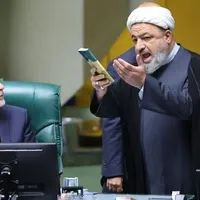
An Iranian lawmaker said parliament will soon approve a bill to formalize what he described as the Islamic Republic’s management and sovereignty over the Strait of Hormuz.
Alireza Salimi, a member of parliament’s presiding board, told ISNA that the bill on “exercising the Islamic Republic’s management and sovereignty over the Strait of Hormuz” would soon be passed and become law.
He said the entire Strait of Hormuz lies within the territorial waters of Iran and Oman, and that only those two countries should decide how it is managed.
The Joint Maritime Information Center said the US blockade of Iranian ports remains in effect and warned ships operating near the Strait of Hormuz and surrounding waters to comply with directions from blockading forces.
In an advisory dated May 29, JMIC said the maritime security threat level in the Strait of Hormuz remains “critical” because of blockade operations.
The advisory said a restricted area is in place due to military blockade operations in the Persian Gulf, the Gulf of Oman, the North Arabian Sea and the Strait of Hormuz.
It said the blockade restricts all traffic entering or leaving Iranian ports, and that ships helping vessels violate the blockade through ship-to-ship transfers are also considered in breach of the blockade.
JMIC warned that enforcement could include “disabling and destructive fires” against vessels that do not immediately comply with blockading forces.
The advisory urged ships to monitor VHF Channel 16, keep AIS transmissions in line with company policy, clearly show their transit intentions and report unusual activity to recognized reporting centers.
It said the warning zone was not intended to block neutral or merchant shipping, but warned that the US Navy could not guarantee the safety of vessels in areas where military operations are underway.
Ships and aircraft crossing the area were advised to avoid the zone if possible, maintain a 30-nautical-mile distance from US units and be ready to respond to US military hails or queries.
IRGC-affiliated Tasnim News Agency said US military warnings to vessels were continuing despite President Donald Trump’s remarks that the naval blockade affecting ships in the Strait of Hormuz “will now be lifted.”
Tasnim wrote that mariners had said CENTCOM warnings related to stopping Iranian ships were still continuing, even after Trump said vessels caught in the strait because of the US blockade could begin the process of “heading home.”
In a post on Truth Social, Trump said Iran must agree never to obtain a nuclear weapon, the Strait of Hormuz must be opened immediately without tolls and with unrestricted shipping in both directions, and remaining mines must be removed or destroyed.
Trump also said Iran’s enriched nuclear material would be recovered by the United States, in coordination with the Islamic Republic and the International Atomic Energy Agency, and destroyed.
He made the remarks before heading to the Situation Room to make a final determination on the possible agreement but left the meeting without any decision.
Mohsen Rezaei, an adviser to Iran’s Supreme Leader Mojtaba Khamenei, accused President Donald Trump of “betraying diplomacy” by continuing the US naval blockade and making what he called excessive demands in negotiations.
“The US president is betraying diplomacy for the third time,” Rezaei wrote on X.
He said Trump’s continuation of the naval blockade and his demands at the negotiating table showed he was not serious about diplomacy and was pursuing other objectives.