Iranian rapper Toomaj condemns death sentences in Ekbatan case


Iranian rapper Toomaj Salehi, who has himself faced imprisonment and a death sentence, condemned the death penalties issued against four defendants in the Ekbatan case, calling the rulings “anti-human.”
“Our conscience and honor demand that we stand against this injustice,” Salehi wrote on X after months of silence on social media.
Iran’s judiciary said on Sunday that several defendants in the high-profile Ekbatan case have been sentenced to death over charges linked to the killing of a Basij member during the country’s 2022 protests, despite courts acknowledging they could not determine who caused the fatal injury.
Salehi said that the movement, widely known by its central slogan Woman Life Freedom, had fought “for justice, freedom and human dignity.”
He also said freedom of expression and media freedom had been suppressed “under the pretext of war,” while poverty continued to worsen across the country.
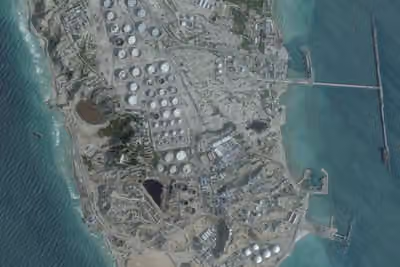

Oil prices edged higher Tuesday while stock markets were mixed as investor optimism over a possible US-Iran agreement was tempered by fresh US military strikes in the Middle East.
Nasdaq futures pared earlier gains to trade about 0.9% higher, while S&P 500 futures rose 0.68%.
Markets have swung sharply in recent weeks as traders try to gauge whether diplomacy between Tehran and Washington can prevent a deeper regional conflict and a prolonged disruption to shipping through the Strait of Hormuz.
Internet access in Iran appeared headed for restoration Monday as President Masoud Pezeshkian ordered a rollback of months-long restrictions and an IRGC-affiliated outlet appeared to fall in line behind the decision after initially questioning its legality.
Earlier in the day, Pezeshkian ordered the Ministry of Communications to restore international internet access to its pre-January status, according to his spokesman.
ICT Minister Sattar Hashemi later told Shargh daily that the process of restoring the country’s internet access had begun.
The semi-official ISNA news agency reported that the order is expected to be implemented on Tuesday.
Read the full story here.
An Iranian trade union official says soaring food prices have pushed many workers beyond the brink, with staples such as chicken, eggs and legumes increasingly out of reach.
Majid Rahmati, a board member of Tehran’s Coordination Council of Islamic Labor Councils, said chicken prices had risen to around 470,000 tomans per kilogram, adding that even basic alternatives like beans and lentils had become unaffordable.
“Now that chicken has disappeared from workers’ tables, should we replace it with legumes?” he said. “The problem is that legumes have also become extremely expensive.”
Rahmati said a minimum household living basket previously estimated at 45 million tomans had now climbed to around 70 million, while married workers receive wages of roughly 24 million tomans a month.
“With egg trays now costing 500,000 tomans, workers today are fighting simply to survive and stay alive,” he said.
More than six weeks after Iran disrupted shipping through the Strait of Hormuz and the United States moved to enforce a naval blockade, the confrontation increasingly appears to be entering a new phase: negotiations driven by exhaustion.
What began as a military and geopolitical standoff has evolved into a contest over economic endurance, one that neither Iran nor the global economy appears capable of sustaining indefinitely.
After weeks of escalation, diplomacy has regained momentum. Talks involving Tehran, Washington and regional mediators have intensified, while US President Donald Trump has repeatedly suggested a deal may be close.
At the center of the latest negotiations lies the issue of frozen Iranian assets.
Iranian officials are demanding guaranteed access to billions of dollars held abroad before accepting any preliminary understanding, while reports from Tehran suggest Qatar may be exploring financial mechanisms that would allow limited transfers without direct US payments to Iran.
The diplomacy reflects mounting pressure on both sides.
The head of the International Energy Agency warned in May that unless progress is made toward ending the crisis with Iran, the global oil market could enter a “red zone” by summer.
Beginning in mid-March — roughly two weeks after Iran moved to disrupt shipping through the Strait of Hormuz — IEA member states began gradually releasing strategic petroleum reserves to offset sharp declines in Gulf energy exports.
Hundreds of millions of barrels have already been released from emergency stockpiles, according to market estimates, as governments attempt to stabilize prices and prevent a broader supply shock.
But strategic reserves are not unlimited.
Even when commercial inventories are included, only part of global oil storage can realistically be released to the market. Much of the world’s inventories are tied to operational infrastructure, while many governments face legal and political constraints on how deeply emergency reserves can be depleted outside wartime conditions.
The strain is increasingly visible across the global economy.
High energy prices have weakened demand growth and raised recession fears in major economies, while shipping disruptions in the Persian Gulf continue to inject volatility into global markets.
Iran, meanwhile, faces mounting economic pressure of its own.
Exports of crude oil and petroleum products, which account for a large share of the country’s export revenues, have sharply declined under blockade conditions. Iranian steel and petrochemical facilities have also faced repeated disruptions and attacks during the conflict.
According to estimates by Kpler, Iran’s floating oil storage near East Asian waters has fallen sharply in recent weeks as Tehran struggles to maintain exports to China despite mounting logistical constraints.
The United States and its allies retain significant escalation options economically and militarily, while Iran’s ability to sustain prolonged confrontation increasingly appears tied to its capacity to continue threatening shipping routes and regional stability.
But Washington also faces limits. A prolonged energy crisis, rising oil prices and fears of a wider regional war are creating growing pressure on the United States and Gulf allies to secure at least a temporary understanding with Tehran.
That pressure helps explain the renewed urgency surrounding the Doha talks.
What now seems increasingly clear is that neither Iran’s economy nor the global economy can sustain the current trajectory for much longer.
The question is no longer whether economic pressure is being felt. It is whether the pressure forces compromise before miscalculation produces another round of escalation.
Qatar has denied reports suggesting it offered Iran $12 billion to help secure a deal with the United States, calling the claims an attempt to sabotage ongoing diplomacy.
“The reports suggesting Qatar ‘offered’ $12 billion to Iran to secure a deal are simply not true,” Foreign Ministry spokesman Majed Al Ansari wrote on X.
He said the claims were being circulated by parties seeking to undermine “ongoing diplomatic efforts toward regional de-escalation and stability.”
Ansari added that Qatar’s mediation role alongside regional partners was “well established and publicly documented,” dismissing the reports as attempts to damage Doha’s reputation as a “trusted international peace facilitator.”