Iran has not agreed to hand over enriched uranium - Reuters
Iran has not agreed to hand over its highly enriched uranium stockpile and the nuclear issue is not part of a preliminary agreement under discussion, Reuters reported on Sunday, citing a senior Iranian source.
The source said Tehran’s nuclear file would be addressed separately from the initial framework being discussed to ease the wider conflict.
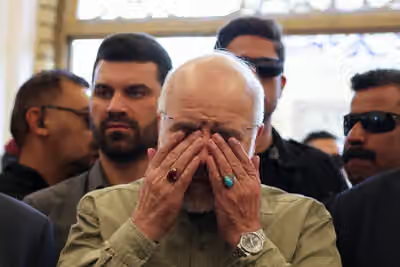
Iranian President Masoud Pezeshkian said no major decision would be taken outside the framework of the Supreme National Security Council or without the approval of Supreme Leader Mojtaba Khamenei, according to remarks published on Sunday.
Speaking at a meeting with managers from Iran’s state broadcaster, Pezeshkian said all branches of government and public platforms should support decisions made in the field of diplomacy.
“When a decision is made in the field of diplomacy, all institutions, platforms and political currents must support it,” Pezeshkian said.
“I have always tried not to say anything contrary to the leader’s position or take a stance that fuels division among the pillars of the system and allows the enemy to exploit it,” he said.
US Secretary of State Marco Rubio said on Sunday that progress had been made over the past 48 hours on an outline that could resolve the Strait of Hormuz crisis.
“We think we've made some progress on the outline of something that, if it works, could give us that outcome. Obviously, that will require full Iranian acceptance and then compliance, and it will require some future work on negotiating the details,” he said alongside his Indian counterpart in New Delhi.
He added that there was a possibility of “good news” within hours on the Strait of Hormuz.
“Perhaps there is the possibility that over the next few hours, the world will get some good news, at least with regards to the strait and with regards to a process that can ultimately leave us where the President wants us to be. And that is a world that no longer has to be in fear or worry about an Iranian nuclear weapon,” Rubio said.
He also said attacks on commercial vessels were totally illegal.
Iran’s digital hardware market has yet to recover from wartime disruption, with shortages, volatile prices and rising import costs pushing laptops, mobile phones and computer parts further beyond the reach of many consumers, an economic website reported on Saturday.
Traders and consumers say prices for phones, laptops and computer components now shift daily as importers grapple with currency pressures, supply uncertainty and disruptions to long-established trade routes through the United Arab Emirates, according to Eghtesad News.
“Today’s price is only valid for today,” has become a common refrain among sellers in Iran’s technology markets, reflecting uncertainty over replacement costs and future supplies, the report added.
The disruption has hit not only premium electronics but also basic hardware including SSD drives, graphics cards, motherboards, monitors and repair parts, according to market participants and customs data cited in the report.
UAE route emerges as key vulnerability
Iran’s technology market has long depended heavily on Dubai as a regional import and logistics hub for electronics. Customs figures cited in Iranian trade reports show roughly 600,000 laptops worth around $260 million entered Iran in 2023, with the overwhelming majority routed through the UAE.
File photo of shoppers visiting a computer and electronics market in Iran, where stores sell laptops, gaming equipment and digital devices.
Broader trade data also point to the scale of dependence. Iranian customs statistics showed exports from the UAE to Iran reached around $19.1 billion between March 2024 and January 2025.
Importers say alternative routes through China, Turkey, Oman and Qatar remain slower, more expensive or less flexible than the Dubai-based networks that previously dominated the market.
Mobile phones and laptops move out of reach
Iran’s mobile phone imports dropped sharply in 2025, according to customs figures cited in the report. Commercial imports fell to about 8.4 million devices worth roughly $1.6 billion, down from 11.4 million phones valued at nearly $2.5 billion a year earlier.
The loss of the national currency’s value against the dollar, along with rising import costs, has also fed directly into retail prices. Some high-end Apple models now sell for several billion rials, with certain iPhone 16 Pro Max listings approaching 5 billion rials ($2800) in some stores.
Laptop prices have also surged. Entry-level student laptops now commonly exceed 400 million rials ($225), while mid-range work models often sell for between 800 million and one billion rials ($450-550).
For many households and small businesses, the shift has changed buying behavior. Consumers increasingly delay purchases, turn to second-hand devices or opt to repair aging hardware instead of replacing it, added the report.
The pressure extends beyond consumers. Software firms, engineering offices, freelancers and online businesses now face sharply higher costs for maintaining basic digital infrastructure, adding strain to sectors already coping with weak purchasing power and economic uncertainty.
IRGC-linked Tasnim News reported on Sunday that Iran has insisted any initial memorandum of understanding with the United States should include the release of at least part of its frozen assets in the first step.
The report said Tehran had stressed that the released funds must be accessible to Iran.
It added that Washington had sought in recent weeks to link the release of the assets to a possible final nuclear agreement.
Iran wants part of the funds released at the start of any MOU and a mechanism set for releasing the rest during negotiations, according to the report.
The report said the possible memorandum of understanding would allow the number of vessels transiting the Strait of Hormuz to return to pre-war levels within 30 days.
It said that the US naval blockade must be fully lifted within 30 days under the draft, adding that no change in Hormuz traffic would take place if the blockade remained in place.
Iran has not accepted any action on the nuclear issue at this stage of talks with the United States, IRGC-linked Tasnim News reported on Sunday.
The report said a possible initial memorandum of understanding could include a US commitment to waive Iran oil sanctions during the negotiation period, allowing Tehran to sell oil without sanctions-related limits.
The possible MOU would also emphasize an end to the war on all fronts, including Lebanon, it added.
The draft would set a 30-day period for steps related to the Strait of Hormuz, alongside a 60-day period for nuclear talks, according to the report.