Iran seeks sanctions relief, asset release for US talks, lawmaker says
A senior Iranian lawmaker said on Sunday that negotiations with the United States would be futile unless sanctions were lifted and Iran’s blocked assets were released.
“They must accept that Iran’s blocked assets be released,” Alaeddin Boroujerdi said. “Sanctions must also be lifted.”
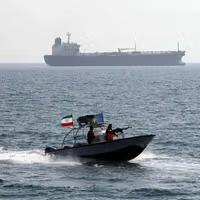
The deputy head of parliament’s national security committee also said Washington should also accept responsibility for the war and pay reparations, adding that United States should recognize Iran’s authority over the Strait of Hormuz.
File photo of drug addicts detained during a police crackdown in Iran.
Severe shortages of opium syrup are disrupting addiction treatment across Iran, Shargh daily reported on Sunday, raising fears that thousands of recovering drug users could return to narcotics use as clinics struggle to secure supplies of a key maintenance medication.
The shortages follow repeated disruptions in the production and distribution chain of opium syrup, a drug widely used in Iran’s maintenance treatment programs for patients who cannot easily switch to alternatives such as methadone because of physical dependence or medical complications.
Experts and addiction treatment activists warned the shortages are no longer only a clinical problem but a broader social crisis with potential consequences for public health, crime and family stability.
“These medications are essential for patients and stopping access does not mean they stop using drugs,” addiction expert Habib Bahrami told Shargh. “In many cases they return directly to narcotics use, bringing social, economic and family consequences.”
Some clinics, according to the report, have seen supplies fall so sharply that only one out of every 100 eligible patients can obtain opium syrup.
Patients pushed back toward illicit drugs
Bahrami said shortages had already emerged before the recent regional conflicts and economic pressures intensified.
“Before the war we were already seeing reduced supplies,” he said. “In some medical universities, opium syrup distribution was nearly halted before the Persian New Year (late March) without explanation.”
Patients unable to obtain the medication, he said, often return to street narcotics markets to avoid severe withdrawal symptoms, undermining years of treatment and increasing pressure on healthcare.
Methadone syrup continues to be distributed more consistently, Bahrami said, but many patients cannot easily transition to substitute medications.
Supply chain problems deepen shortages
Activists and treatment providers offered differing explanations for the shortages, with some blaming administrative restrictions and others pointing to shortages of raw materials used in production.
File photo of patients at an addiction treatment center in Iran.
Abbas Deilamizadeh, head of the addiction recovery NGO Tavallod-e Dobareh (Rebirth Society), said insufficient access to raw opium materials has sharply reduced production and fueled the emergence of a black market.
“The shortage of raw materials has caused shortages in the market and created serious problems for patients,” Deilamizadeh told Shargh.
He argued that tighter state oversight of legal cultivation could provide a long-term solution.
“The only solution, in my view, is government-supervised poppy cultivation to supply the raw materials needed for this treatment method,” he said.
Addiction centers face mounting pressure
Treatment providers also warned that financial pressures and recent regional conflict have weakened addiction recovery services more broadly.
Deilamizadeh said many residential treatment centers are struggling with unrealistic state tariffs that fail to cover operational costs amid high inflation.
“For a 30-day stay, less than 100 million rials ($55) is allocated per patient,” he said. “That amount does not realistically cover accommodation, utilities, staff and treatment standards.”
He also said voluntary admissions to treatment centers have dropped sharply in recent months because of insecurity and public anxiety linked to regional military escalation.
“Based on our experience, voluntary admissions have fallen by around 40 percent,” he said.
Bahrami said some centers discharged patients during periods of heightened military tension and avoided taking new admissions because of security concerns.
“When society is overwhelmed by war-related fears, vulnerable groups are pushed further to the margins,” he said.
An Iranian lawmaker warned Bahrain on Sunday against pursuing what he called “an anti-Iran move” at the United Nations, claiming that Manama was acting on behalf of Washington.
Manouchehr Mottaki, a former foreign minister, said some permanent members of the UN Security Council had warned the United States and Bahrain not to seek a new resolution.
He said Bahrain would face outcomes similar to previous failed efforts if it ignored the warning.
Iranian Parliament Speaker Mohammad Bagher Ghalibaf was appointed as the Islamic Republic’s special envoy for China affairs, Iran’s state media reported.
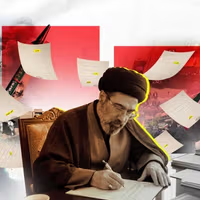
The appointment was made at the proposal of Iranian President Masoud Pezeshkian and with approval from Iran's Supreme Leader Mojtaba Khamenei, according to the reports.
The role had previously been held by Ali Larijani, Iran's slain top security official, and Abdolreza Rahmani Fazli, a former interior minister.
Iran’s internet blackout continued into its 79th day and 12th week on Sunday, internet monitor NetBlocks said.
“The mass-censorship measure has reshaped the nature of civic participation with information controls being used to relegate the general public to mere observers in their own country,” it added in a post on X.
US Senator Rick Scott said Iran still seeks to kill Americans and destroy Israel despite recent conflict involving Tehran, Washington and Tel Aviv.
“Iran wants to rebuild its weapons, they still hate this country, they still want to kill us, they still want to destroy Israel,” Scott said in an interview with Fox News on Saturday.
Scott also said Tehran of continuing to support Hamas, Hezbollah and the Houthis, while praising US President Donald Trump’s approach toward Iran in the Strait of Hormuz.