Shared housing spreads in Iran’s deepening rent crisis
Pressure on Iran’s housing market is pushing a rise in shared living arrangements in small urban apartments, with landlords and tenants increasingly dividing limited space to cope with rising rents and mortgage costs, according to local media.
A report by Peyam-e Ma documents a growing trend in which 40–60 square meter apartments are being split between unrelated occupants as rent levels outpace incomes and turn standard tenancy into negotiated cohabitation.
Israel began preparing a covert site in Iraq more than a year before using it in operations against Iran, The New York Times reported on Sunday, citing regional officials.
The report said the site, hidden in Iraq’s western desert, was used during the 12-day war against Iran in June 2025.
The New York Times also cited two Iraqi security officials as saying that in both the 12-day war and the current one, Washington compelled Iraq to shut down its radars to protect US aircraft.
The Wall Street Journal had previously reported the presence of an Israeli outpost in Iraq. Iraq’s security forces spokesman Lt. Gen. Saad Maan told The New York Times that Baghdad had “no information regarding the locations of any Israeli military bases.”
Israeli Prime Minister Benjamin Netanyahu said on Sunday he was scheduled to speak with US President Donald Trump later in the day, adding that he expected the conversation to include Iran.
Netanyahu said he wanted to hear about Trump’s recent trip to China, including his meeting with Chinese President Xi Jinping.
He said he believed the two leaders would also discuss “Iran, where, as I said several days ago, there are many possibilities and we are prepared for every scenario.”
Brazilian President Luiz Inacio Lula da Silva said he opposed US President Donald Trump on issues including the Iran war, but that their disagreements should not prevent constructive ties.
“Trump knows I oppose war with Iran, disagree with his intervention in Venezuela and condemn the genocide that is happening in Palestine,” Lula told the Washington Post.
He added that he had handed Trump a copy of a 2010 nuclear agreement that Brazil and Turkey negotiated with Iran and that Trump said he would read it.
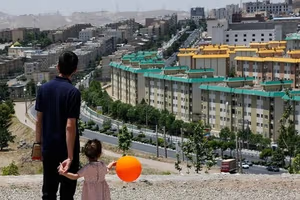
Two men overlook Tehran in this undated file photo illustrating Iran’s housing and rent crisis.
Pressure on Iran’s housing market is pushing a rise in shared living arrangements in small urban apartments, with landlords and tenants increasingly dividing limited space to cope with rising rents and mortgage costs, according to local media.
A report by Peyam-e Ma documents a growing trend in which 40–60 square meter apartments are being split between unrelated occupants as rent levels outpace incomes and turn standard tenancy into negotiated cohabitation.
Conditions reshape tenancy norms
In one case cited by the report, a landlord in a central district of Tehran asked for a deposit of 1,000,000,000 rials (about $550) and monthly rent of 50,000,000 rials ($28) for a shared arrangement, alongside strict conditions including limited visitors, full-time employment, and no pets.
The minimum wage in Iran is currently around $90 per month.
Another listing involved a 50-square-meter apartment where the owner offered reduced rent in exchange for domestic work. The monthly payment was set at 70,000,000 rials ($39), down from 120,000,000 rials ($67) if cooking duties were included.
A separate case involved a duplex property being partially rented out for a deposit of 3,000,000,000 rials ($1,667) and monthly rent of 150,000,000 rials ($83), with cohabitation offered to another couple.
From coping mechanism to structural pressure
A deputy head of Iran’s real estate brokers’ association told Peyam-e Ma that shared housing can be understood as a lifestyle choice seen in other countries, noting its historical presence in Iran as well.
But the report highlights a widening gap between that framing and current conditions, with landlords increasingly using cohabitation models to cover mortgage payments and living costs, while tenants accept reduced privacy in exchange for affordability.
File photo of Tehran amid rising housing and property prices in Iran.
Exit from Tehran’s rental market
Brokers interviewed for the report say some tenants are leaving the capital altogether or returning to smaller cities as rents rise beyond sustainable thresholds. Others, particularly single occupants, are moving back into parental homes.
One housing expert quoted in the report warns that continued displacement from urban centres could accelerate informal settlement growth around major cities, describing it as an emerging phase of housing exclusion rather than a temporary adjustment.
Another analyst argues that prolonged multigenerational living has masked underlying demand for independent housing, particularly among younger Iranians delaying marriage or household formation due to cost barriers.
This suppressed demand, he said, is becoming more visible as household structures shift and single-person living increases, exposing shortages in affordable rental stock.
Rising pressure on tenants
Data referenced in the report from Iran’s statistics authority indicates that roughly 51 percent of Tehran residents are renters, underscoring the city’s dependence on the private rental sector.
With average monthly rents for standard apartments ranging between 180,000,000 and 270,000,000 rials ($100–$150), costs now far exceed minimum wages reported at around 166,000,000 rials ($92).
Inflation in rent prices is recorded at 31.1 percent year-on-year, but market participants in the report say this figure reflects affordability limits rather than easing pressure, as tenants are unable to absorb further increases.
Poverty exposure among renters
Refering to a parliamentary research, the report says that around 27 percent of renting households fall below the poverty line under conventional measures, rising to roughly 40 percent when housing costs are included.
It also adds that the majority of low-income renters are concentrated in the bottom income deciles, with Tehran accounting for the largest share.
The spread of shared housing is therefore presented not as an isolated social shift, but as part of a broader tightening of access to independent accommodation in Iran’s largest urban centre.
The United States had set five conditions in response to Iran’s proposals, including no payment of damages and the transfer of 400 kilograms of uranium, the IRGC-affiliated Fars News reported on Sunday.
Washington also demanded limits on Iran’s nuclear facilities, refused to release Tehran’s blocked assets and made any halt to the war conditional on negotiations, it said, citing sources.
Iran, in turn, had made negotiations conditional on an end to the wars in Lebanon and Iran, sanctions relief, the release of blocked assets, compensation for war damages and US acceptance of the Islamic Republic’s authority over the Strait of Hormuz, the report added.