Xi may help Trump on Iran, but at a price
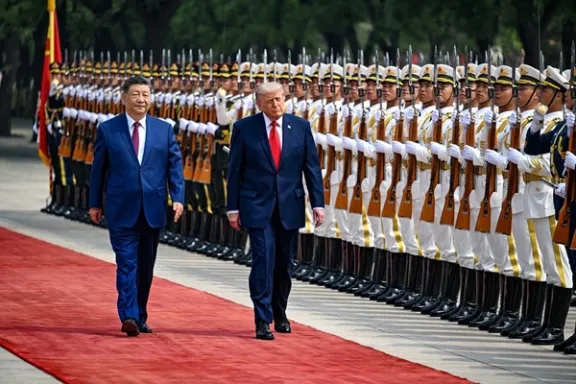
President Trump’s visit to Beijing appears to have confirmed two things about China’s approach to the Iran crisis: it is willing to help prevent further escalation, but not at Tehran’s expense.
Reports during and after the summit, including comments highlighted by Fox News, suggested China had signaled readiness to play a more active role in stabilizing the situation around Iran and the Strait of Hormuz.
But any Chinese cooperation is likely to remain limited, transactional and tied to Beijing’s broader strategic priorities.
Read the full article here.






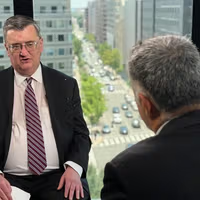
President Trump’s visit to Beijing appears to have confirmed two things about China’s approach to the Iran crisis: it is willing to help prevent further escalation, but not at Tehran’s expense.
Reports during and after the summit, including comments highlighted by Fox News, suggested China had signaled readiness to play a more active role in stabilizing the situation around Iran and the Strait of Hormuz. But any Chinese cooperation is likely to remain limited, transactional and tied to Beijing’s broader strategic priorities.
Before Trump’s departure from Washington, Treasury Secretary Scott Bessent accused China of “funding the largest state sponsor of terrorism,” while Trump himself said he was going to have “a long talk” with Xi. Earlier, the Treasury Department sanctioned five of the so-called “teapot” refineries that process Iranian oil in China.
These moves were not surprising. The war involving the United States, Israel and Iran has shaken the Middle East, threatened global energy flows and become increasingly unpopular among American voters and consumers. Iran has become a priority issue for the White House.
China has reasons to listen. Beijing has already shown some willingness to restrain Tehran, including by nudging Iran toward the Islamabad talks. It does not want the fragile ceasefire to collapse. It does not want the Strait of Hormuz closed. Nor does it want a global downturn that would damage Chinese exports.
China’s investments in electrification and renewable energy have increased its resilience, but they have not made it immune to a major shock in the Middle East. Yet Xi’s help, if it comes, will not be free.
In his recent conversation with Secretary of State Marco Rubio, Foreign Minister Wang Yi made clear that Taiwan remains the core issue for China and the greatest risk in US-China relations. Chinese readouts of the Trump-Xi meeting also placed Taiwan at the center of discussions, with the “situation in the Middle East” appearing much lower on the agenda.
The implication is difficult to miss: if Washington wants Chinese cooperation, Beijing will expect a more accommodating US position on Taiwan. Several current and former American officials have expressed concern that Trump, who said he intended to have “that discussion” with Xi, could delay or reduce the $14 billion weapons package for Taiwan approved by Congress in January.
In other words, China has strong reasons to support de-escalation over Iran, but Beijing also appears to view the crisis through the lens of a much larger strategic bargain with Washington.
Xi’s help is also likely to remain limited. Beijing and Tehran still share a fundamental objective. Both want the Iranian regime to survive. Both want Iran to avoid emerging from the conflict as a defeated and humiliated loser. Both oppose a regional order shaped by the United States and Israel.
For Tehran, defeat would be a regime-threatening disaster. For Beijing, it would be another demonstration that American coercive power can still break an anti-US partner.
China may therefore encourage Tehran to negotiate, support language about regional stability or help Trump claim diplomatic progress. It may even make quiet tactical adjustments to its economic dealings with Iran. But any such move will be carefully calibrated to serve China’s own interests.
China may help stabilize the situation; it will not help Washington defeat Tehran.
The fact that the Chinese embassy in Washington has not denied reports that Wang Yi and Rubio agreed in April that the Strait of Hormuz must remain toll-free is a good example of this dynamic. So too is the American readout stating that China opposes Iran developing nuclear weapons. Both signal goodwill, but neither represents a meaningful shift in Beijing’s position or a compromise of its interests.
This means Trump may have secured Chinese support for de-escalation. He may even have persuaded Xi that a prolonged conflict is too costly for China and that Beijing has an interest in pushing Tehran toward compromise. But he cannot force China to choose Washington over Tehran. Pressure alone is unlikely to work, especially if it requires Xi to appear publicly subordinate to American demands.
There is another problem: it remains unclear what Washington actually wants. It is not enough to accuse China of enabling Iran. The United States still lacks a clearly defined objective. Does it want a ceasefire, renewed nuclear talks, limits on Iranian regional activity, security guarantees for regional partners or some combination of these?
Without a coherent strategy, China will continue using the crisis to extract concessions elsewhere while offering only limited help.
The summit may not have determined the future of the Middle East. But it did reveal something important about the emerging great-power rivalry. The United States remains militarily dominant but strategically erratic. China is economically central but cautious as a security actor.
Trump arrived in Beijing seeking Chinese help on Iran. Xi may offer some. But the price will be high, and the help will not come at Tehran’s expense.
The relationship between the Taliban and Iran, once marked by military confrontation and nearly pushed to war, is now defined by caution and quiet engagement.
The Taliban, who present themselves as representatives of a hardline Sunni Islamist movement, and the Iranian system, one of the main centers of Shiite political power, now maintain relations in which practical politics and mutual necessity have largely replaced deep-rooted sectarian hostility.
In the past two decades, the regional landscape has changed, enemies have shifted and one principle has again proven true: in the Middle East and across Central and South Asia, religion is often expressed rhetorically while decisions are driven by political interests.
Read full article here.
The relationship between the Taliban and Iran, once marked by military confrontation and nearly pushed to war, is now defined by caution and quiet engagement.
The Taliban, who present themselves as representatives of a hardline Sunni Islamist movement, and the Iranian system, one of the main centers of Shiite political power, now maintain relations in which practical politics and mutual necessity have largely replaced deep-rooted sectarian hostility.
At first glance, the relationship appears contradictory. The 1998 Mazar-e-Sharif incident, when Iranian diplomats were killed and both sides nearly went to war, remains firmly embedded in the memory of both regimes.
Yet more than two decades later, the regional landscape has changed, enemies have shifted and one principle has again proven true: in the Middle East and across Central and South Asia, religion is often expressed rhetorically while decisions are driven by political interests.
From opposition to engagement
When the Taliban returned to power in 2021, Iran was among the few countries that did not completely shut its doors. Tehran neither formally recognized the Taliban administration nor severed ties with it.
Iran understood that an Afghanistan facing economic collapse, international isolation and political uncertainty contained both risks and opportunities—and chose engagement over exclusion.
The Taliban, constrained by sanctions, frozen assets and diplomatic isolation, were in turn forced to rely on neighboring countries. Iran—with its long shared border, fuel, electricity, transit routes and regional influence—became a practical partner.
After the death of Mullah Omar, the Taliban’s second leader, Mullah Akhtar Mohammad Mansour, emerged as a central bridge to Iran. His close associates, including Ibrahim Sadr, Mullah Shirin and Mullah Talib, established Sunni religious schools in Iran’s Sistan-Baluchistan region.
Over the past two decades, Iran pursued what Afghan officials describe as a “multi-track policy,” maintaining ties with Afghanistan’s republican government while simultaneously expanding covert and overt contacts with the Taliban to preserve influence under any future political arrangement.
Former senior Afghan presidential adviser Mohammad Iqbal Azizi says Iran significantly deepened ties with the Taliban after 2004, largely because of shared opposition to the US military presence.
“That’s why Mullah Mansour, Ibrahim Sadr and others went to Iran and received support from there,” he said.
Former head of Afghanistan’s Presidential Administrative Office Fazl Mahmood Fazli told Afghanistan International that some tribes maintain longstanding links with Iran.
“In recent years, Ishaqzai, Noorzai and Alizai Taliban commanders even cooperated with the IRGC in smuggling operations, and these relations have become so strong that they have now taken on a new form of partnership,” he said.
Former Pakistani senator Afrasiab Khattak said Iran has long maintained relations across Afghanistan’s political spectrum.
“Afghanistan is important for Iran, and its relations with Afghan governments are based on pragmatic politics,” he said. “Iran simply cannot operate on a purely religious basis.”
Khattak added that Iran invested heavily in ties with the Taliban during the war years and that its influence over some Taliban figures remains visible.
A key factor driving closer ties has been the Taliban’s deteriorating relationship with Pakistan. Relations with Iran help the Taliban avoid isolation, while Tehran understands the leverage this dependency creates.
Shared threats, shared interests
A central factor in improving Taliban-Iran relations has been the logic of shared threats.
The US military presence in Afghanistan represented a mutual challenge for both sides and laid the groundwork for gradual rapprochement. Iran sought to limit US influence while the Taliban fought directly against it.
Iran also faced broader security concerns linked to Afghanistan: border stability, ISIS-Khorasan, Baloch militancy, drug trafficking and refugee flows. From Tehran’s perspective, many of these issues could only be managed through engagement with the Taliban.
Economic factors also play a major role. Sanctions and isolation have pushed the Taliban toward regional economic networks, with Iran becoming an important supplier of fuel, electricity and goods. Tehran meanwhile seeks access to Afghanistan’s market, transit routes and water resources.
Relations between Kabul and Tehran appear to have grown closer following recent US and Israeli strikes on Iran. Facing pressure from Washington, Israel and parts of the Arab world, Tehran appears increasingly unwilling to lose Taliban cooperation.
A founding member of the Taliban movement, speaking anonymously to Afghanistan International-Pashto, said Mullah Akhtar Mansour opposed basing ties with Iran on sectarian identity.
“I remember in 2000 when Mullah Akhtar Mansour came to Pakistan and we met in Quetta,” he recalled. “Mansour carried a message from Mullah Mohammad Omar saying relations with Iran should be built on interests—not religious differences.”
He added that Iran supported Taliban forces in Helmand, Herat, Kandahar, Zabul, Ghazni, Maidan Wardak and Farah during the insurgency.
Former Afghan acting defense minister Shah Mahmood Miakhel said shared fears over ISIS-Khorasan have also created room for cooperation.
“The Taliban have learned from their first rule that conflict with Iran costs them dearly,” he said. “And Iran now feels more reassured because of the Taliban’s deteriorating relations with Pakistan.”
Iran and Afghanistan share nearly 900 kilometers of border, while refugee flows, narcotics trafficking, smuggling and water disputes remain impossible to manage without sustained engagement.
Abdul Ghafoor Liwal, the last ambassador of Afghanistan’s former republican government to Iran, said Tehran openly acknowledged its pragmatic reasoning.
“Iran officially told me that the Taliban are enemies of the United States, and so are we,” he said. “And because Iran shares a long border with Afghanistan, it is compelled to maintain relations with the Taliban.”
A Taliban Foreign Ministry official, also speaking anonymously, said the relationship is driven heavily by economics.
“Afghanistan is a good market for Iran, and Iran is a good source of goods for us,” he said.
Pragmatism without trust
Despite growing cooperation, the relationship remains constrained by deep ideological and geopolitical divides.
Iran’s Shiite Islamic Republic derives legitimacy from the doctrine of Velayat-e Faqih, while the Taliban adhere to a hardline Sunni Deobandi interpretation of Islam. The two sides do not view each other as natural allies so much as necessary and manageable rivals.
Regional rivalries further complicate the picture. Just as India-Pakistan competition shapes Afghanistan, so too does the rivalry between Iran and Arab states.
Although the Taliban have avoided directly condemning Iranian attacks on Arab countries, they have at times described regional escalation as destabilizing. Taliban officials also seek stronger relations with Saudi Arabia, Qatar and the UAE, making outright alignment with Tehran difficult.
The Taliban continue seeking better relations with the United States and Europe, particularly in hopes of easing diplomatic isolation and refugee pressures.
Domestically and bilaterally, disputes over Afghan refugees and Helmand River water rights remain persistent sources of tension.
The Taliban also hope Iran will eventually recognize their government formally. Tehran, however, appears determined to keep recognition as leverage.
For now, necessity binds Tehran and the Taliban more tightly than ideology divides them. But the relationship rests less on trust than on a volatile region in which both sides fear isolation more than each other.
As tensions escalate in the Middle East, critics say Canada’s “values-based realism” has left Ottawa a passive observer rather than an influential middle power confronting Iran’s threats and regional crises.
Prime Minister Mark Carney has emphasized diplomacy, multilateral cooperation and commitment to a rules-based international order. But critics, including parts of Canada’s Iranian diaspora and opposition politicians, describe Ottawa’s current approach as “beautiful words without operational backing."
Just one month before the start of Operation Epic Fury, Carney told the World Economic Forum in Davos that Canada would pursue a “values-based realism” approach, which he presented as a return to the country’s historical diplomatic role on the world stage.
Seventy years ago, during the Suez Crisis, Canada helped chart a path between war and paralysis through the initiative of Lester B. Pearson in establishing the first United Nations Emergency Force.
That episode became central to Canada’s diplomatic self-image as a middle power able to defuse conflicts through coalition-building and multilateral institutions.
It is this legacy that has raised expectations for Ottawa to play a meaningful role in today’s Middle East crises, from Iran’s nuclear program to security in the Strait of Hormuz.
Critics say the reality on the ground tells a different story.
Carney’s initial response to the latest tensions combined support, concern and caution. He stressed the need to prevent the Islamic Republic from obtaining nuclear weapons, while also insisting that all parties, including the United States and Israel, must adhere to international law.
On the Strait of Hormuz, Ottawa has emphasized international cooperation, legal frameworks for maritime security and efforts to restore safe shipping lanes. Critics argue the approach amounts to crisis management without addressing the root causes.
Leo Housakos, leader of Canada’s Conservatives in the Senate, delivered a sharper critique in an exclusive interview with Iran International. He said Canada had shown leniency toward the Islamic Republic and argued that the government’s moral statements, without concrete action, had weakened Ottawa’s international credibility.
Housakos said Canadian foreign policy had become overly reactive to the actions of others and that the country no longer creates diplomatic opportunities as it once did. According to him, Ottawa often arrives late to negotiations and settles for participating in decisions already shaped by larger powers.
These criticisms also resonate among many Iranian Canadians. For them, diplomacy only has meaning if the available tools are properly used — from stricter enforcement of sanctions and immigration laws to confronting the Islamic Republic’s financial and influence networks inside Canada.
The case of Mehdi Taj, head of Iran’s football federation and a former commander in the Islamic Revolutionary Guard Corps, became a prominent example of that debate.
Iran International reported that Taj had been granted a Temporary Resident Permit, a document that can allow entry for someone otherwise deemed inadmissible under normal circumstances.
After the report was published and political pressure mounted in Ottawa, Taj and his companions left Canada shortly after arriving. The incident renewed questions about how seriously Canada enforces its designation of the IRGC as a terrorist organization.
Housakos said Canada cannot simultaneously claim to stand with the Iranian people while showing leniency toward the Islamic Republic in practice. He argued that phrases such as human rights, women’s rights and freedom of expression should not remain rhetorical flourishes in speeches but should be reflected in government policy decisions.
According to critics, the current crisis is a test of Canada’s diplomatic capital. They say Ottawa still has the capacity, as a middle power, to help build new coalitions, defend freedom of navigation, contain nuclear threats and support Iranian civil society.
But they argue that role can only be revived if Canada moves beyond the broad language of diplomacy and demonstrates political will in practice — the very gap critics say now defines the distance between Canada’s diplomatic rhetoric and the realities of its foreign policy.
Iran’s water crisis is not only about scarcity or drought. It is also about where the Islamic Republic chooses to spend the country’s money, and what it leaves unfunded at home.
In a system where political and ideological objectives consistently outweigh environmental sustainability and public welfare, even severe and widely recognized crises fail to trigger meaningful correction.
In this sense, Iran’s water crisis is not a failure of resources, it is a consequence of deliberate choices. The impact of decades of misguided water engineering and policy decisions is already visible across Iran’s water systems.
Major lakes and wetlands such as Urmia Lake have shrunk. Groundwater has been depleted across more than half of the country’s plains, land subsidence is accelerating, and per capita water availability has fallen to near or below 1,000 cubic meters.
At the same time, access to reliable drinking water has become increasingly uncertain. Water quality is declining because of inadequate wastewater treatment and aging infrastructure, while policy still emphasizes large-scale agricultural self-sufficiency despite mounting environmental constraints.
It would be easy to assume that these failures could stem partially from financial limitations. But this is not a story of absolute constraint. Even under sanctions, Iran has continued to generate substantial revenues, particularly from oil exports, over the past decade.
The water crisis is not necessarily due to a lack of resources, but how those resources are allocated. Based on Iran’s FY1404 (2025-2026) public budget, significant funding is still directed toward religious and ideological institutions, amounting to roughly $750 to $860 million annually, depending on exchange rates.
At the same time, Iran’s regional activities, including support for groups such as Hezbollah, Hamas, Palestinian Islamic Jihad, the Houthis, and allied militias, are widely estimated, based on publicly reported figures, to cost an additional $1.1 to $1.5 billion each year.
These estimates reflect direct financial transfers and likely understate total support, which also includes substantial non-cash assistance such as weapons, equipment, and logistical backing.
In total, nearly $1.8 to $2.4 billion per year is allocated to priorities that do little to address Iran’s most urgent domestic challenges. Even redirecting a portion of these resources toward water management and infrastructure could support large-scale, practical solutions. Over a five-year period, such a shift would mobilize roughly $10 billion, enough to move beyond short-term fixes and begin addressing some of the structural drivers of Iran’s water crisis.
Based on order-of-magnitude cost benchmarks for standard water infrastructure projects, a reallocation of roughly $10 billion over five years could finance a coherent national water program. This would include a full-scale effort to reduce water losses in Tehran’s aging distribution network, where non-revenue water (NRW), water lost before it reaches consumers due to leaks, aging infrastructure, and inefficiencies is estimated at roughly 25 to 30 percent.
It could also support the deployment of potable reuse facilities across major urban centers such as Tehran, Mashhad, Isfahan, Shiraz, Yazd, and Ahvaz, helping relieve pressure on overstretched freshwater supplies.
In parallel, a targeted desalination and conveyance package could be implemented for Sistan and Baluchestan province, designed specifically to secure drinking water in a region facing chronic shortages, rather than to support inland agriculture.
Such an investment could also enable the construction of dozens of wastewater treatment plants nationwide, depending on facility size and treatment level, addressing both water quality degradation and reuse potential in regions struggling with untreated discharge.
Beyond urban infrastructure, even limited investments in agriculture could deliver measurable benefits. For example, modernizing irrigation in a single province such as Isfahan, where more efficient systems can reduce water use by roughly 30 to 60 percent, could significantly lower demand in one of Iran’s most water-stressed regions.
Even at the current economic development and growth, over a five-year period, roughly $10 billion directed toward ideological priorities could instead finance a nationwide water recovery program: upgrading Tehran’s water distribution system to reduce losses, building 10 potable reuse facilities for major cities, developing seven coastal desalination plants for southern Iran, and constructing a strategic water transfer system to Zahedan in Sistan and Baluchestan.
It could also fund eight large wastewater treatment plants, dozens of mid-size facilities across the country, and modernize irrigation in Isfahan. Instead, those resources are being directed elsewhere. Now imagine how the country’s water infrastructure can be overhauled if the regime is gone and Iran is back on the path to growth and prosperity, with access to the latest technologies the world has to offer, to tackle this issue.
These figures are illustrative, not precise. They highlight both Iran’s potential capacity to invest in water infrastructure and the scale of resources currently misallocated, without even accounting for additional spending on missile programs, and nuclear development, which further underscores the magnitude of available resources.
Ultimately, the constraint is neither technical nor financial: it is political. As long as the current regime remains in power, resources that could stabilize and modernize Iran’s water systems will continue to be diverted toward non-productive ideological ends.