• العربية
  • فارسی
Brand
  • Iran Insight
  • Politics
  • Economy
  • Analysis
  • Special Report
  • Opinion
  • Podcast
  • Iran Insight
  • Politics
  • Economy
  • Analysis
  • Special Report
  • Opinion
  • Podcast
  • Theme
  • Language
    • العربية
    • فارسی
  • Iran Insight
  • Politics
  • Economy
  • Analysis
  • Special Report
  • Opinion
  • Podcast
All rights reserved for Volant Media UK Limited
volant media logo
VOICES FROM IRAN

Tehran quake stirs dark humor, hopes for renewed strikes

May 13, 2026, 21:10 GMT+1
Smoke rises following an explosion, after Israel and the US launched strikes on Iran, in Tehran, Iran, March 3, 2026.

A series of tremors in and around Tehran late Tuesday stirred shock, dark humor and political despair among residents, with some initially mistaking them for renewed US-Israeli strikes.

On Tuesday night, Iran’s Seismological Center said a 4.6-magnitude quake struck near Pardis, east of Tehran, at a depth of 10 kilometers, with no immediate reports of casualties or major damage. A series of nine smaller earthquakes also struck the area overnight.

“This is what life is like for us inside Iran: an earthquake happens and my mother says, ‘I wish it were bombing instead.’ The result of 47 years of Islamic rule,” one message sent to Iran International said.

The reactions came against the backdrop of a fragile ceasefire after more than two months of war that began on February 28 with a US-Israeli bombing campaign on Iran.

Donald Trump said Monday that the ceasefire with Iran was “on life support” after rejecting Tehran’s response to a US proposal aimed at ending the war.

The ceasefire has been in place since April 7, but Trump has repeatedly threatened to end it if Iran failed to reach an agreement with Washington.

One message captured the bitter humor with which some residents viewed the quake amid fears of renewed conflict, suggesting divine intervention had stepped in where Trump had not.

“Trump dragged this out so much that God stepped in,” the message said.

Several residents said they initially mistook the shaking for renewed strikes.

“The earthquake at 11:40 p.m. on Tuesday in Tehran was really terrifying. For a few seconds, we thought the attacks had started again,” one Tehran resident said.

Another resident in eastern Tehran’s Tehranpars district said the tremor felt like a nearby missile strike.

“We are in eastern Tehran, in Tehranpars. Tuesday night’s earthquake shook and rattled our house so badly that we thought a missile had hit next to our home,” the resident said.

Several messages described the tremors as reviving memories of the recent war, when residents had become used to distinguishing between air defense fire, missiles, drones and explosions.

“Around 9 p.m. on Tuesday, an earthquake was felt in Tehran, but the one that came at 11:45 p.m. was felt very strongly. The whole house shook and the chandeliers rattled. It felt like the experience we had during those 40 days of war,” one message said.

Another resident said the earthquake and the sound of a storm afterward produced conflicting emotions.

“When the earthquake happened and then the sound of the storm afterward, we thought we were under attack again. We felt fear and relief at the same time,” the resident said.

In Pardis, east of Tehran, residents reported repeated tremors through the night.

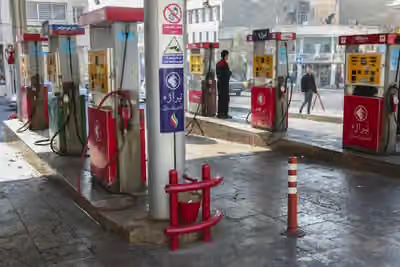
“In Pardis, from 8 p.m. until 1 a.m., there were three relatively strong earthquakes. People rushed into the streets in fear and gas stations became crowded,” one message said.

One resident said a sudden dust storm added to the confusion.

“We were sitting at home, the weather was nice, and suddenly the air became extremely dusty and the sky filled with dirt and dust. Even though the war experience has taught us to distinguish between air defense fire, missiles and drones — or judge from the sound and shaking how close an explosion is — when the earthquake happened, for a few seconds we could not tell whether it was an attack or something else,” the resident said.

Other messages reflected mistrust and speculation about whether the tremors were linked to underground missile activity or even a possible nuclear test near Parchin.

“Could the earthquake have been caused by the criminals’ underground missile activities? Especially considering Tehran naturally sits on a fault line and their underground activities were exposed during the war,” one person said.

Another message said there was speculation online that the quake’s epicenter near Parchin meant Iran may have carried out a nuclear test rather than experienced a natural earthquake.

One message accused state television of failing to quickly cover the earthquake because authorities feared people would pour into the streets.

“State TV was not covering the earthquake because they were afraid people would pour into the streets. Human lives are so worthless to them as long as they can stay in power a little longer,” the message said.

Most Viewed

Tehran rejects US terms as hardliners push escalation
1
INSIGHT

Tehran rejects US terms as hardliners push escalation

2

Iran's carpet exports collapse from $2.5 billion to near zero, official says

3

Iran has failed to export crude oil by sea for 28 days - TankerTrackers

4

Australia sanctions Iranian officials, entities over crackdown and destabilizing activity

5

Man charged after allegedly driving into Iran protest crowd in Canada

Banner
Banner

Spotlight

  • Tehran and Beijing close ranks as Trump heads to China
    INSIGHT

    Tehran and Beijing close ranks as Trump heads to China

  • Cambridge probes Iran scholar over alleged fabricated interviews

    Cambridge probes Iran scholar over alleged fabricated interviews

  • Iran looks to China for guarantees in future US deal
    INSIGHT

    Iran looks to China for guarantees in future US deal

  • How one Tehran hospital became a window into Iran’s January massacre
    SPECIAL REPORT

    How one Tehran hospital became a window into Iran’s January massacre

  • Iranians told to post pro-government content to regain internet access
    VOICES FROM IRAN

    Iranians told to post pro-government content to regain internet access

  • Fog of war meets fog of law in the Strait of Hormuz
    OPINION

    Fog of war meets fog of law in the Strait of Hormuz

•
•
•

More Stories

Cambridge probes Iran scholar over alleged fabricated interviews

May 13, 2026, 14:54 GMT+1
•
Benjamin Weinthal

A University of Arkansas Iranian-American professor fired from her tenured position in late March is now facing investigations in Britain over allegations of academic misconduct tied to her research on Iran.

Cambridge University Press, which published a book by University of Arkansas professor Shirin Saeidi based on her Cambridge PhD dissertation, is investigating claims that the work contains fabricated or unauthorized interviews with female victims of the Iranian government.

Iran International has also learned that Cambridge University is reviewing allegations related to Saeidi’s PhD dissertation itself.

University of Arkansas President Jay Silveria dismissed Saeidi over matters unrelated to the Cambridge investigations. She has appealed her termination, and the university’s Board of Trustees is set to review the case on May 21.

Saeidi’s book, Women and the Islamic Republic: How Gendered Citizenship Conditions the Iranian State, is now under scrutiny in Britain.

A spokesperson for Cambridge University Press told Iran International that the publisher “takes all complaints about our publications seriously” and is continuing to investigate the allegations “according to standard COPE guidelines.”

COPE, the Committee on Publication Ethics, is an organization that addresses ethical standards in scholarly publishing.

Iran International obtained a copy of a complaint submitted to Cambridge University Press by Maryam Nouri, author of the memoir In Search of Liberation, accusing Saeidi of fabricating interviews and using her work without permission.

Nouri, who was imprisoned by the Islamic Republic in 1985 while pregnant and later gave birth in prison, wrote that “I am writing to submit a formal complaint regarding the unethical and unauthorized use of my personal memoir and the fabrication of interview material by Dr. Shirin Saeidi.”

She added: “I never met with Ms. Shirin Saeidi, nor have I had any interview with her in the city of Cologne or in any other city in Germany.”

According to Nouri, Saeidi used material from her memoir “in both her doctoral dissertation and her published book without my written or verbal permission, for her own personal benefit, including advancing her academic credentials, university status, and professional position.”

“I consider this misuse a clear violation of my personal rights and dignity, and I strongly condemn it,” she wrote.

A Cambridge University spokesperson told Iran International that the university “takes allegations of academic misconduct seriously” and that concerns raised would be reviewed “in line with the relevant University policies and procedures.”

In a series of posts published on X in December, former Iranian political prisoner Nasrin Parvaz also denied ever being interviewed by Saeidi.

“I never knew Saeidi, and I never had an interview with her,” Parvaz wrote, adding that Saeidi had only used the Farsi version of her memoir published more than two decades earlier.

Numerous requests for comment sent by Iran International to Saeidi and her attorney, JJ Thompson, went unanswered.

Saeidi had already drawn controversy prior to her dismissal from the University of Arkansas. The university had previously disciplined her for allegedly using official university letterhead in an appeal seeking the release of Hamid Nouri, an Iranian official convicted in Sweden in 2022 over his role in the mass execution of political prisoners in 1988.

Saeidi has said she had permission to use the letterhead.

Lawdan Bazargan, director of the Alliance Against Islamic Regime of Iran Apologists (AAIRIA), who first publicized Saeidi’s support for Hamid Nouri, later began examining the sourcing in Saeidi’s academic work.

Bazargan told Iran International that several former political prisoners named in Saeidi’s dissertation and book had publicly denied being interviewed by her, raising broader questions about documentation, recordings, consent forms, and sourcing.

“The credibility of oral history research depends entirely on documentation, informed consent, and verifiable sourcing,” Bazargan said.

“If key testimonies cannot be substantiated, then the scholarly foundation of the book itself comes into question, because its central arguments rely heavily on those contested interviews.”

Bazargan also called for scrutiny of the supervisory process behind Saeidi’s Cambridge dissertation, including the role of her PhD supervisor, Professor Glen Rangwala. Iran International sent a request for comment to Rangwala.

Saeidi also drew criticism over social media posts praising former Supreme Leader Ali Khamenei and defending the Iranian establishment during the recent war. Her X account has since been suspended.

Suspected IRGC agent offered Briton money to target journalist - Jewish Chronicle

May 13, 2026, 09:18 GMT+1

A British-Iranian man said a suspected Iran-linked agent offered him £40,000 ($53,000) to kill a London-based journalist critical of Tehran, the Jewish Chronicle reported.

The man, identified by the pseudonym “Nima,” told the newspaper he reported the incident to British police after returning to the UK and warned the journalist, who works for a Persian-language broadcaster.

Nima, who has lived in Britain for about a decade and works as a bartender, said the encounter began during a holiday in southern Europe, where he visited an Iranian restaurant and met two men, including one he recognized from Iran.

The man initially discussed plans to open a bar in London and asked for Nima’s contact details, presenting the approach as a business proposal, according to the report.

Alleged murder proposal

Nima said a second meeting took a darker turn when the man arrived with two others and began referring to personal details about his life in Britain and relatives in Iran.

“He told me: ‘You are a decent man. You have family in Iran who need your support. I would like to offer you a job, with an initial payment of £40,000,’” Nima told the Jewish Chronicle.

According to the report, the man referred to an Iranian journalist in London with whom Nima had argued online and said he wanted to “punish” him, asking whether Nima could carry out the act or find someone else to do so.

Nima said he was offered 20,000 pounds in cash immediately and the remaining amount after identifying the journalist’s location. He said the men appeared to believe the journalist lived in a safe house.

The suspected operative did not directly identify himself as an IRGC member, Nima said, but an acquaintance suggested he held influence in Iran and referred to “Sepah” - the Persian name for the IRGC –while discussing possible help for Nima’s family.

  • Iranian assaulted in London amid concern over threats to regime critics

    Iranian assaulted in London amid concern over threats to regime critics

  • Three charged over attempted arson at Iran International office in London

    Three charged over attempted arson at Iran International office in London

  • Suspected Iran-linked group claims north London Jewish ambulance arson

    Suspected Iran-linked group claims north London Jewish ambulance arson

  • Two men charged with spying for Iran targeting London Jewish community

    Two men charged with spying for Iran targeting London Jewish community

Security concerns in Britain

The alleged approach comes amid heightened concern in Britain over Iranian-linked threats targeting dissidents, journalists and Jewish institutions.

Iran-aligned group Harakat Ashab al-Yamin al-Islamia has said it carried out attacks on Jewish sites in Britain and Europe, including incidents involving two north London synagogues last month.

MI5 Director General Ken McCallum has warned repeatedly that Iran, acting through the IRGC, poses what he described as a “potentially lethal” threat in Britain. British authorities have disrupted multiple alleged Iran-linked plots since 2022 targeting dissidents, journalists and Jewish or Israeli-linked individuals, according to British officials.

Iran executes man over accusations of spying for Israel

May 13, 2026, 06:12 GMT+1

Iran executed Ehsan Afrashteh on Wednesday on accusations of espionage and intelligence cooperation with Israel, the judiciary’s Mizan News reported.

Afrashteh, who was born in the central city of Isfahan in 1993 and held a master’s degree in civil engineering, was arrested in early 2024 after returning from Turkey and spent several months in solitary confinement under interrogation at a security facility, according to Iran Human Rights Monitor.

Mizan claimed Afrashteh had become fluent in English, French and Hebrew during what it described as his cooperation with Israel.

It accused him of selling sensitive information to Israel and claimed that he had been trained by Mossad in Nepal.

The judiciary-linked outlet also claimed that he initially carried out instructions while working as an online taxi driver.

Several human rights organizations had previously warned that he was at imminent risk of execution.

Iranian poet faces execution after review of death sentence denied

May 13, 2026, 05:26 GMT+1

Iranian poet Peyman Farahavar remains at risk of execution after the country’s Supreme Court rejected his request for judicial review, a rights group said on Tuesday.

The case against him stemmed from his poetry, political writings and protest activities, the Abdorrahman Boroumand Center said, citing sources close to his family, who also said he had not taken part in any armed activities.

The US-based group said former cellmates reported torture during interrogation, the destruction of some of his handwritten poems and denial of full medical care despite serious health problems.

Farahavar, a 37-year-old father from Iran’s northern province of Gilan, was sentenced to death on accusations of “armed rebellion against the state” (baghi) and “enmity against God” (moharebeh) by a Revolutionary Court in Rasht.

Farahavar was arrested in Rasht in September 2024 and later transferred to Lakan Prison after being held at an Intelligence Ministry detention center, the group said.

Iran has been carrying out near-daily executions, which has raised fears for detainees believed to be facing the death penalty over January’s anti-government protests, as well as prisoners accused of espionage during the war with the United States and Israel.

  • Iran executes another political prisoner on spying charges

    Iran executes another political prisoner on spying charges

Iranians told to post pro-government content to regain internet access

May 12, 2026, 12:54 GMT+1
•
Saba Heidarkhani

Some Iranians say security bodies blocked their internet or SIM cards over alleged online activity against the Islamic Republic, then demanded pro-government posts, written pledges and guarantors to restore access, according to messages sent to Iran International.

The unsigned notices asked recipients to provide personal details including home and work addresses, bank account information, images of bank cards and links to all their social media accounts.

They were also instructed to sign handwritten pledges not to publish content deemed harmful to the country’s “psychological, social or political security.”

The notices warned that users’ activities were being monitored through “smart surveillance and artificial intelligence systems” and said repeated violations could lead to judicial action and heavier punishment.

Some citizens were further instructed to publish at least 20 posts supporting the Islamic Republic on social media and send evidence that the posts had been uploaded.

  • Internet shutdown drives Iranians to leave country for access

    Internet shutdown drives Iranians to leave country for access

Pressure campaigns expand online

The demands mark the latest effort by Iranian authorities to tighten control over online activity following waves of dissent and criticism on social media over the past year.

Recipients were told not to publish all pro-government posts in a single day “to make the activity appear natural,” according to the messages.

Some were also ordered to attend nighttime government rallies that began after US and Israeli attacks earlier this year and continued after a ceasefire took hold. Participants were instructed to photograph themselves carrying Islamic Republic flags or images of Supreme Leader Ali Khamenei.

In several cases, authorities requested identification documents from a guarantor who would accept responsibility for any future “criminal activity” by the targeted individual.

  • Iranians describe toll of 70 days of internet restrictions

    Iranians describe toll of 70 days of internet restrictions

In August 2025, many Iranians wrote on social media that their SIM cards had been abruptly disconnected without warning or court orders after they published critical posts online, particularly in the aftermath of the 12-day war.

Some said security bodies contacted them through the domestic messaging platform Eitaa and told them to meet a series of demands or report to entities including the Prosecutor’s Office cyber division to regain access.

During those visits, citizens said they were ordered to submit copies of their national ID cards and sign written pledges promising to stop critical online activity.

Similar measures were reported in October 2024, when journalists and political activists said security bodies blocked their SIM cards, forced them to delete posts and ordered them to publish content that contradicted their views.