Iran lawmaker calls for annual fees on fiber-optic cables crossing Hormuz
Countries should pay Iran annual fees for fiber-optic cables that pass beneath the Strait of Hormuz, an Iranian lawmaker said, saying that hundreds of billions of dollars in financial transactions move through the lines each day.
“The Strait of Hormuz is a God-given treasure, like other mines and reserves placed at Iran’s disposal,” said Hossein Ali Hajideligani, a member of Iran parliament’s presiding board.
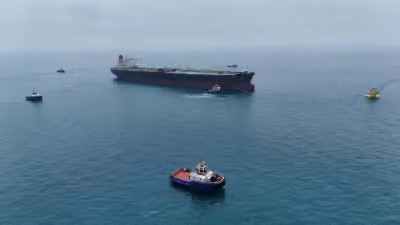
Countries should pay Iran annual fees for fiber-optic cables that pass beneath the Strait of Hormuz, an Iranian lawmaker said, saying that hundreds of billions of dollars in financial transactions move through the lines each day.
“The Strait of Hormuz is a God-given treasure, like other mines and reserves placed at Iran’s disposal,” said Hossein Ali Hajideligani, a member of Iran parliament’s presiding board.

The Strait of Hormuz is a critical route for the digital economy, with several undersea fiber-optic cables running across the seabed and linking India and Southeast Asia to Europe through the Persian Gulf states and Egypt.
Iran had previously warned that submarine cables in the Strait of Hormuz were a vulnerable point for the region’s digital economy, raising concerns about potential attacks on critical infrastructure.
Last week, IRGC-linked media called for Iran to generate revenue from undersea internet cables passing through the Strait of Hormuz, framing the waterway not only as an energy and shipping chokepoint but also as a digital pressure point.
Hajieligani said Iran should also impose fees on ships passing through the waterway, citing guidance he attributed to Supreme Leader Mojtaba Khamenei’s messages.
He also called for an end to negotiations with the United States, saying Washington had “miscalculated” and was using the process to buy time rather than accept what he called Iran’s “absolute right.”
He said the US was the one that sought a ceasefire and alleged that Washington was after buying time for domestic political purposes.
Parham Mehrabi, 18, was killed by direct fire from security forces in Mashhad on January 8, 2026, while standing alongside his father, sources familiar with the matter told Iran International.
His death occurred during the January Massacre, a nationwide crackdown on anti-establishment protests that resulted in the deaths of thousands of people across Iran.
Witnessing the shooting from just a few meters away, Parham's father immediately retrieved his son’s body.
Iran’s foreign minister accused the United Arab Emirates on Thursday of direct involvement in military operations against Iran, escalating Tehran’s criticism of regional states during a BRICS meeting in New Delhi.
Abbas Araghchi made the remarks in response to comments by the Emirati representative and added that he had avoided naming the UAE in his main speech “for the sake of unity.”
US Treasury Secretary Bessent said China was likely to work behind the scenes to influence Tehran over the Strait of Hormuz, saying the reopening of the key energy route would benefit Beijing.
“I think they will work behind the scenes to the extent anyone can sway Tehran,” Bessent told CNBC, adding that he believed China would “do what it can” on the strait.
Bessent also said Iran’s main loading facility had seen no loadings for the past three days and that Washington believed its storage was full.
“We believe we’re at the point where Iran is not paying soldiers or replenishing weapons stocks from abroad,” he said.
On oil, Bessent said he expected the curve to move lower in six months and believed prices would come down quickly.
Iran’s foreign minister accused the United Arab Emirates on Thursday of direct involvement in military operations against Iran, escalating Tehran’s criticism of regional states during a BRICS meeting in New Delhi.
Abbas Araghchi made the remarks in response to comments by the Emirati representative and added that he had avoided naming the UAE in his main speech “for the sake of unity.”
“But the truth is that the UAE was directly involved in the aggression against my country,” Araghchi said. “When the attacks started, they didn't even issue a condemnation.”
He accused Abu Dhabi of providing bases, airspace, territory, intelligence and other facilities to the United States and Israel during the attacks.
Araghchi said Iran had not attacked the UAE, but had targeted US military bases and facilities on Emirati soil.
He urged the UAE to reconsider its policy toward Iran, saying neither the US military presence nor ties with Israel had protected it.
His remarks came against the backdrop of the war involving Iran, the United States and Israel, during which Tehran said it targeted US military positions in response to attacks on Iran.
They also followed reports that Israeli Prime Minister Benjamin Netanyahu had visited Abu Dhabi during the war and that Israel had provided the UAE with military equipment. The UAE rejected reports of the visit.
Araghchi cited the reports in his remarks, saying the UAE had become “an active partner in this aggression.”
The office of Israeli Prime Minister Benjamin Netanyahu said Wednesday he had made a secret visit to the United Arab Emirates during the US-Israeli war with Iran earlier this year and met UAE President Sheikh Mohammed bin Zayed.