• العربية
  • فارسی
Brand
  • Iran Insight
  • Politics
  • Economy
  • Analysis
  • Special Report
  • Opinion
  • Podcast
  • Iran Insight
  • Politics
  • Economy
  • Analysis
  • Special Report
  • Opinion
  • Podcast
  • Theme
  • Language
    • العربية
    • فارسی
  • Iran Insight
  • Politics
  • Economy
  • Analysis
  • Special Report
  • Opinion
  • Podcast
All rights reserved for Volant Media UK Limited
volant media logo
INSIGHT

Iran analysts pessimistic on US talks despite China’s role

Behrouz Turani
Behrouz Turani

Iran International

May 14, 2026, 03:35 GMT+1
A graffiti of Iran's supreme leader Mojtaba Khamenei with an anti-US mural in the background, Tehran, May 8, 2026

Iranian former diplomats and political analysts struck a pessimistic tone in Wednesday’s media ahead of Donald Trump’s talks with Chinese President Xi Jinping, warning of renewed escalation and portraying China as central to any Iran-US settlement.

Most outlets framed negotiations as deadlocked. Reform-leaning Fararu warned of “the increasing possibility of yet another escalation.”

In an article titled “Negotiating About Negotiating” published by Sharq, former diplomat Kourosh Ahmadi examined the growing impasse after Trump reportedly rejected Iran’s latest 14-point proposal as “completely unacceptable.”

According to Tasnim and IRIB, Tehran’s proposal included demands for the withdrawal of US forces from Iran’s periphery, war reparations, full sanctions relief and a new legal framework for the Strait of Hormuz.

Ahmadi argued that the recent exchange of written messages marked a regression from even the already limited framework of indirect negotiations.

“This is no longer substantive diplomacy,” he wrote, describing the process instead as “negotiating about the method of negotiation.”

He argued that Trump remains focused on Iran’s 60 percent uranium enrichment while Tehran continues prioritizing sovereignty and economic compensation, leaving little common ground.

Rather than full-scale war, Ahmadi predicted prolonged “low-intensity military encounters,” tighter naval blockades and sustained economic pressure aimed at keeping Iran unstable.

In Etemad, foreign policy analyst Morteza Makki argued that after 40 days of military confrontation both Tehran and Washington are now effectively “forced” to seek some form of agreement.

Makki said the conflict had reshaped regional dynamics, arguing that despite heavy costs Iran had preserved key strategic objectives and demonstrated deterrence in the Persian Gulf, while Washington had failed to secure broader goals despite military escalation and operations such as Operation Freedom.

“The White House is now managing the costs of war rather than leading an offensive,” he said.

Makki pointed to domestic pressures in the United States, fears of rising energy prices and reluctance among Arab allies such as Saudi Arabia to enter a broader conflict.

He concluded that both the nuclear issue and the Strait of Hormuz remain negotiable if political will exists, but argued that China is now the only power capable of offering guarantees Tehran would trust.

“It seems China is the only country that can play an effective role in creating space for dialogue and guaranteeing a stable agreement between Iran and the U.S.,” he said.

Expanding on China’s role, Iran’s former ambassador to Beijing Hamid Aboutalebi argued in a Fararu commentary that the confrontation has evolved beyond a regional crisis into a test of China’s willingness to defend partners against US pressure.

He wrote that the conflict was no longer simply about sanctions or Iran’s nuclear program, but about whether Beijing is prepared to challenge a US-centered global order.

According to Aboutalebi, if China succeeds in building alternative financial and energy networks while defending partners such as Iran, Tehran could evolve from an isolated sanctioned state into a key player in an emerging multipolar order.

But if Beijing retreats under pressure, he warned, it would expose the limits of Chinese power despite its global ambitions.

He argued that tensions surrounding the Strait of Hormuz have elevated the conflict into a broader geopolitical contest, increasingly forcing China to balance its ambitions as a global power against its dependence on stability and open trade routes.

Most Viewed

Iran's carpet exports collapse from $2.5 billion to near zero, official says
1

Iran's carpet exports collapse from $2.5 billion to near zero, official says

2

Iran has failed to export crude oil by sea for 28 days - TankerTrackers

3

Iran executes man over accusations of spying for Israel

4
SPECIAL REPORT

How one Tehran hospital became a window into Iran’s January massacre

5
VOICES FROM IRAN

Iranians told to post pro-government content to regain internet access

Banner
Banner

Spotlight

  • Tehran and Beijing close ranks as Trump heads to China
    INSIGHT

    Tehran and Beijing close ranks as Trump heads to China

  • Cambridge probes Iran scholar over alleged fabricated interviews

    Cambridge probes Iran scholar over alleged fabricated interviews

  • Iran looks to China for guarantees in future US deal
    INSIGHT

    Iran looks to China for guarantees in future US deal

  • How one Tehran hospital became a window into Iran’s January massacre
    SPECIAL REPORT

    How one Tehran hospital became a window into Iran’s January massacre

  • Iranians told to post pro-government content to regain internet access
    VOICES FROM IRAN

    Iranians told to post pro-government content to regain internet access

  • Fog of war meets fog of law in the Strait of Hormuz
    OPINION

    Fog of war meets fog of law in the Strait of Hormuz

•
•
•

More Stories

Tehran and Beijing close ranks as Trump heads to China

May 13, 2026, 18:20 GMT+1
•
Maryam Sinaiee

Ahead of Donald Trump’s arrival in Beijing, Iranian officials rejected suggestions that US pressure could weaken Iran-China ties amid growing speculation over a possible Chinese mediation role in the Iran conflict.

Iranian ambassador to China Abdolreza Rahmani-Fazli wrote Monday on X that relations between Tehran and Beijing “are stronger than any US effort aimed at changing China’s position toward Iran through pressure.”

Chinese Foreign Ministry spokesman Guo Jiakun reinforced that message Monday, saying Beijing’s position remained “clear and consistent” and that the priority should be preventing renewed war and further escalation.

Crucially, Beijing also signaled opposition to any US-led blockade of the Strait of Hormuz, saying such actions were “not in the common interests of the international community.”

Observers viewed last week’s meeting in Beijing between Iranian Foreign Minister Abbas Araghchi and Chinese Foreign Minister Wang Yi as an effort to coordinate positions ahead of the expected Trump-Xi talks.

During the meeting, Wang said China was prepared to play a “greater role” in regional peace efforts and encouraged dialogue between Iran and Persian Gulf Arab states.

Trump pressure Xi over Iran

Western media reports indicate Trump plans to press Xi over China’s economic and strategic ties with Iran, particularly oil purchases and alleged military assistance.

While Trump acknowledged he would raise the issue, he also said before departing for Beijing that he did not believe Xi’s cooperation was strictly necessary to manage the crisis.

Tensions between Washington and Beijing over Iran have intensified in recent weeks following the seizure of a Tehran-linked cargo vessel near the Strait of Hormuz.

In a CNBC interview, Trump criticized what he described as China’s “unexpected support for Iran,” saying he had anticipated greater understanding from Beijing.

Former US ambassador Nikki Haley also alleged on X that the seized vessel was carrying chemicals intended for Iran’s missile program, presenting the case as evidence of growing Chinese support for Tehran.

China’s expanding regional role

At a May 8 press conference in Beijing, Rahmani-Fazli said Tehran and Beijing had agreed to advance Xi’s four-point regional security initiative.

The proposal emphasizes peaceful coexistence, respect for sovereignty and territorial integrity and adherence to international law as foundations for stability in the Persian Gulf and the broader Middle East.

Iranian outlet Khabar Online described the initiative as part of Beijing’s broader effort to position itself as a major diplomatic mediator in the region while distancing itself from what it called US unilateralism.

The outlet argued that the approach could strengthen Iran’s negotiating position and increase pressure on Washington to accept at least some Iranian demands.

Rahmani-Fazli said Monday that any future agreement with Washington “must inevitably include guarantees from major powers” and ultimately be raised at the UN Security Council.

Could China become a mediator?

So far, China has largely pursued a cautious approach to the confrontation between Iran and the United States, avoiding direct involvement while calling for de-escalation.

Still, some Iranian analysts believe Beijing may now be willing to take on a more active diplomatic role.

Former Iranian ambassador to China Mohammad Keshavarzzadeh told Shargh newspaper that Chinese officials appeared interested in facilitating negotiations and reducing tensions.

Iranian Foreign Ministry spokesman Esmail Baghaei also suggested Beijing could use Trump’s visit to warn against what Tehran describes as unlawful US pressure and its consequences for regional and global stability.

At the same time, some Iranian analysts believe China may be uneasy with Tehran’s threats to restrict access through the Strait of Hormuz.

Former Iranian diplomat Kourosh Ahmadi told Nour News that Beijing’s primary concern remains preserving open trade routes essential to its export-driven economy.

According to Ahmadi, this could push China to place greater emphasis on protecting the legal status of international waterways and opposing any disruption in Hormuz that might set precedents elsewhere.

Disputes over Chinese support for Iran

Last month, Trump called on Xi not to send weapons to Tehran and claimed China had offered assurances on the matter.

In recent days, the US State Department sanctioned three Chinese satellite companies accused of assisting Iranian military operations by providing imagery linked to Iranian military activity. Beijing rejected the allegations.

The US Treasury Department also sanctioned several companies in mainland China and Hong Kong accused of helping supply weapons-related materials to Iran.

Beijing does not recognize US sanctions on Iranian oil exports and has instructed domestic companies not to comply with American restrictions targeting so-called “teapot” refineries purchasing Iranian crude.

The moves underscore growing US efforts to pressure Beijing over its ties with Tehran ahead of the Trump-Xi meeting.

Iran looks to China for guarantees in future US deal

May 13, 2026, 16:46 GMT+1
•
Behrouz Turani

Iran is increasingly looking to China not just as an economic partner, but as the only major power capable of offering credible guarantees in both the Persian Gulf and any future agreement between Tehran and Washington.

On May 10, Iran’s ambassador to China, Abdolreza Rahmani Fazli, said Beijing could serve as the guarantor of a future deal between Iran and major world powers. He added that any agreement should ultimately be endorsed by the UN Security Council, echoing Tehran’s long-standing preference for multilateral guarantees over bilateral commitments.

A day later, Rahmani Fazli wrote on X that Iran was prepared to support President Xi Jinping’s four-point proposal for “sustainable security” in the Persian Gulf, adding that the position had already been affirmed during recent talks between the two countries’ foreign ministers.

China’s approach to emphasizes mutual guarantees among regional states, with Beijing presenting itself as a mediator and economic stabilizer rather than a military enforcer.

In mid-April, Xi introduced a four-point proposal aimed at moving the region away from the brink of wider war toward what Chinese officials described as a “comprehensive and sustainable security architecture.”

The proposal called for peaceful coexistence among regional powers, respect for sovereignty, adherence to international law and the UN Charter, and balancing security with economic development and reconstruction.

Chinese diplomacy surrounding the Iran crisis has increasingly been framed in Tehran as an alternative to Washington’s military-first approach.

Iranian media and officials have portrayed Beijing as a power capable of maintaining relations with all sides while avoiding direct military involvement.

Tehran and Beijing have both linked these initiatives to their expanding strategic partnership, which Iranian officials increasingly describe as a counterweight to US influence in the region.

Donald Trump’s upcoming visit to China has added new significance to that relationship as ceasefire tensions persist and negotiations remain stalled.

Hossein Mousavian, Iran’s former ambassador to Germany, recently reiterated that security guarantees remain one of Tehran’s central demands in any negotiations with Washington.

Iranian commentators argue that while Tehran does not trust the Trump administration to uphold a purely bilateral agreement, Chinese involvement could provide a framework both sides may find harder to abandon.

Still, major obstacles remain.

Trump has repeatedly rejected any agreement resembling the 2015 nuclear deal, arguing that it failed to protect US interests. Iran, meanwhile, continues to push for a broader truce framework without first resolving disputes over its nuclear program, a position unlikely to gain traction in Washington.

Tensions escalated further on May 12, when Parliament Speaker Mohammad Bagher Ghalibaf said Iran was prepared for war if Trump rejected Tehran’s terms. The same day, Trump said military options remained on the table.

Against that backdrop, Beijing has increasingly signaled that its immediate priority is preventing further disruption in the Persian Gulf and ensuring safe navigation through the Strait of Hormuz, a critical artery for global energy markets.

For Tehran, China’s growing diplomatic role offers more than mediation. It represents the possibility of a powerful external guarantor at a time when trust between Iran and the United States appears close to collapse.

Tehran rejects US terms as hardliners push escalation

May 12, 2026, 02:42 GMT+1

Iran’s defiant response to a US proposal on ending the conflict is fueling new fears that the fragile ceasefire could collapse and fighting resume within days.

Tehran handed its response to the latest US proposal to Pakistan on Sunday for delivery to Washington. On Monday, President Donald Trump said “the ceasefire is on life support.”

The exchange has fueled growing expectations in Iranian media and political circles that another military confrontation may be approaching.

Arash, a 45-year-old engineer in Tehran, said many people were once again preparing for the possibility of war.

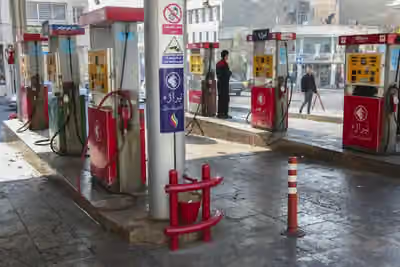
“Filling gasoline tanks and stocking up on food and water for emergencies has again become a priority,” he said.

Read the full article here.

Tehran rejects US terms as hardliners push escalation

May 12, 2026, 01:35 GMT+1
•
Maryam Sinaiee

Iran’s defiant response to a US proposal on ending the conflict is fueling new fears that the fragile ceasefire could collapse and fighting resume within days.

Tehran handed its response to the latest US proposal to Pakistan on Sunday for delivery to Washington. Hours later, President Donald Trump dismissed the Iranian reply as “totally unacceptable” and warned Monday that “the ceasefire is on life support.”

The exchange has fueled growing expectations in Iranian media and political circles that another military confrontation may be approaching, even as officials insist they remain open to diplomacy on their own terms.

Arash, a 45-year-old engineer in Tehran, said many people were once again preparing for the possibility of war.

“Filling gasoline tanks and stocking up on food and water for emergencies has again become a priority,” he said.

Tehran rejects key US conditions

Iranian state-linked media strongly denied Western reports suggesting Tehran’s response included compromises on nuclear issues.

Tasnim News Agency, affiliated with the Revolutionary Guards (IRGC), rejected claims that Iran’s proposal addressed the future of its nuclear materials or enrichment activities.

Iran's state broadcaster IRIB described the American proposal as “meaning Iran’s surrender to Trump’s excessive demands.”

According to IRIB, Iran’s counterproposal emphasized compensation for war damages, recognition of Iran’s sovereignty over the Strait of Hormuz, the lifting of sanctions and the release of frozen Iranian assets.

Former IRGC commander-in-chief Mohammad Ali Jafari said Monday that no further negotiations would take place unless Iran’s conditions were met.

Mixed signals

President Masoud Pezeshkian struck a more conciliatory tone during a meeting with senior police commanders on Sunday.

While acknowledging deep distrust toward Washington, Pezeshkian said Iran would remain committed to any agreement reached “while taking into account the concerns of the Supreme Leader and the interests of the Iranian nation.”

“The rational, logical and nationally beneficial preference is for the victory achieved by the armed forces on the battlefield to be completed in diplomacy as well,” he added.

Foreign Ministry spokesman Esmaeil Baghaei also said Monday that Tehran’s proposal was “reasonable and generous,” but accused Washington of continuing to insist on “unreasonable demands.”

Baghaei said Iran’s immediate priority was ending the war rather than negotiating details of the nuclear program, adding that decisions regarding “the nuclear issue, enriched materials and enrichment itself” would be announced later “at the appropriate time.”

Some hardline figures, however, are increasingly arguing that Iran should openly pursue nuclear weapons capability as a deterrent against future attacks.

Ebrahim Rezaei, spokesman for parliament’s National Security and Foreign Policy Committee, said lawmakers had questioned the value of remaining in the Nuclear Non-Proliferation Treaty and stressed the need to preserve Iran’s nuclear “achievements.”

Limited optimism

Despite the dominance of hardline rhetoric in official circles, online reactions suggested skepticism toward maximalist demands and calls for escalation.

Under a commentary published by Alef News listing Iran’s conditions, one reader wrote sarcastically: “Do not expect them to accept all these conditions unless you completely defeat them and even take prisoners.”

Another commented: “These are a list of wishes, and nobody is asking what they would receive in return.”

The skeptical comments drew significantly more support from readers than hardline calls for confrontation.

State television has repeatedly discussed the possibility of renewed fighting, often portraying another conflict as likely but manageable.

Reformist website Rouydad24 wrote that “the political atmosphere inside Iran is not favorable to a quick agreement,” arguing that hardline factions view any retreat as surrender while the government is trying to avoid appearing weak without securing sanctions relief.

“For now,” the outlet concluded, “the most likely scenario is not a comprehensive agreement but continued attritional negotiations combined with temporary ceasefires and crisis management—a situation that is neither full peace nor total war.”

As Iran’s economy sinks, hardliners turn to conspiracy

May 11, 2026, 22:10 GMT+1
•
Behrouz Turani

As prices continue to soar across Iran, hardline clerics and pro-government figures are increasingly attempting to shift blame away from the state even as economic pressure deepens for ordinary citizens.

In Mashhad, firebrand Friday prayer leader Ahmad Alamolhoda claimed that “US Army infantry is responsible for rising prices.” He later said the remark was metaphorical, arguing that the war had triggered hyperinflation and that “profiteers and the main culprits behind rising prices are the US army’s infantry.”

Earlier in the week, Hossein Shariatmadari, editor of the hardline daily Kayhan, wrote that “rising prices and hoarding are the products of the enemy’s infiltration in the government.”

While Iran’s armed forces were “working miracles,” he argued, the economy had been left undefended, allowing enemies to undermine battlefield gains.

Shariatmadari, who for decades attacked previous administrations over inflation and economic mismanagement, remained notably quiet during the ultraconservative governments of Mahmoud Ahmadinejad and Ebrahim Raisi.

In 2024, he claimed rising prices had “nothing to do with the performance of the government or parliament,” describing inflation as part of a foreign conspiracy.

Last week, he questioned why parliament had stopped monitoring the government’s performance. Days later, lawmakers held an online session with Agriculture Minister Gholamreza Nouri Ghezeljeh to discuss food prices, a move widely mocked in Iranian media as ineffective and detached from public hardship.

While Alamolhoda urged Iranians to embrace a vague “jihadist economy,” Shariatmadari called on officials to confront an unspecified “economic mafia.”

Moderate outlets, however, framed the crisis differently. The daily Arman Melli argued on Sunday that the latest surge in prices could not be explained solely by wartime conditions, pointing instead to years of structural economic problems, rising state expenditures and populist policymaking.

The paper also called for “effective use of diplomacy” to end the conflict while safeguarding national interests, arguing that renewed negotiations could help stabilize the economy.

The reformist website Rouydad24 described a society undergoing “economic and psychological erosion,” where inflation was no longer an abstract statistic but a daily reality.

Families were removing meat from their diets, patients cutting medication in half and tenants being pushed toward cheaper outskirts of major cities.

Economic newspapers described parliament’s online session as “a bitter confession” that authorities were losing control of the situation, reflected in shrinking household budgets, disappearing essentials and rising public anxiety.

Despite government claims of wage increases of up to 60 percent for workers, many public employees say they have not received the raises. Unemployment is rising, layoffs are spreading and businesses are shutting down, while temporary contracts leave many workers with little protection against dismissal.

Iranian media now report complaints about living costs even among government supporters attending nightly demonstrations. Families that once lived modest but stable lives increasingly struggle to afford housing, medical treatment, tuition and other basic necessities.

Many workers say they are still earning salaries set years ago in an economy where prices change almost daily, leaving much of Iran’s working and middle classes crushed by relentless inflation.