US says Vatican honor for Iran envoy was routine


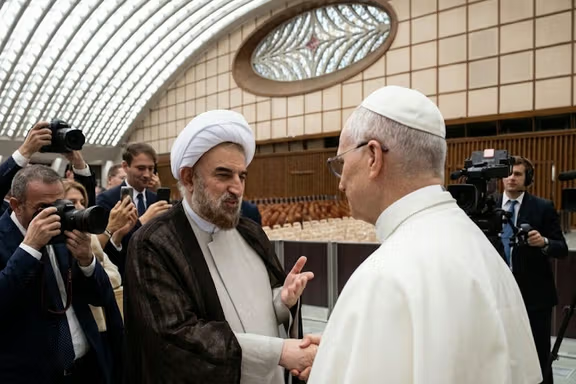
The US Embassy to the Holy See said Pope Leo XIV did not bestow an exclusive special honor on Iran’s ambassador to the Vatican, after reports said Mohammad Hossein Mokhtari had been named a Knight of the Grand Cross of the Pontifical Order of Pius IX.
“This decoration is given to all accredited ambassadors to the Holy See after 2+ years of service and has been standard practice for many years,” the embassy said.
The embassy said the recognition was personal and “does not imply support or opposition to any policy or country.”
Thirteen ambassadors recently received the same recognition, and the decoration was not given in person by the pope, it added.


Saudi fighter jets carried out airstrikes on Iran-linked Shi’ite militia targets inside Iraq during the Iran war, while retaliatory strikes were also launched from Kuwait into Iraqi territory, Reuters reported citing multiple sources familiar with the matter.
Sources cited by Reuters included three Iraqi military and security officials, a Western official and two people briefed on the matter, including one in the United States.
According to one Western official and another source familiar with the operations, Saudi air force fighter jets targeted Iran-backed militia positions near the kingdom’s northern border with Iraq.
The Western official said some of the Saudi strikes took place around the time of the April 7 US-Iran ceasefire, underscoring how military activity in the region continued even as diplomacy sought to halt the wider conflict.
Global equities rose modestly on Wednesday alongside the US dollar, while Treasury yields moved toward a third consecutive day of gains as investors assessed fresh signs of inflationary pressure linked to the Iran war.
MSCI’s global equities gauge advanced slightly as markets focused on hotter-than-expected US producer price data and awaited a summit between US President Donald Trump and Chinese President Xi Jinping.
The US Labor Department said producer prices rose more than expected in April, marking the sharpest increase since early 2022.
Iran is increasingly looking to China not just as an economic partner, but as the only major power capable of offering credible guarantees in both the Persian Gulf and any future agreement between Tehran and Washington.
On May 10, Iran’s ambassador to China, Abdolreza Rahmani Fazli, said Beijing could serve as the guarantor of a future deal between Iran and major world powers. He added that any agreement should ultimately be endorsed by the UN Security Council, echoing Tehran’s long-standing preference for multilateral guarantees over bilateral commitments.
A day later, Rahmani Fazli wrote on X that Iran was prepared to support President Xi Jinping’s four-point proposal for “sustainable security” in the Persian Gulf, adding that the position had already been affirmed during recent talks between the two countries’ foreign ministers.
China’s approach to emphasizes mutual guarantees among regional states, with Beijing presenting itself as a mediator and economic stabilizer rather than a military enforcer.
In mid-April, Xi introduced a four-point proposal aimed at moving the region away from the brink of wider war toward what Chinese officials described as a “comprehensive and sustainable security architecture.”
The proposal called for peaceful coexistence among regional powers, respect for sovereignty, adherence to international law and the UN Charter, and balancing security with economic development and reconstruction.
Chinese diplomacy surrounding the Iran crisis has increasingly been framed in Tehran as an alternative to Washington’s military-first approach.
Iranian media and officials have portrayed Beijing as a power capable of maintaining relations with all sides while avoiding direct military involvement.
Tehran and Beijing have both linked these initiatives to their expanding strategic partnership, which Iranian officials increasingly describe as a counterweight to US influence in the region.
Donald Trump’s upcoming visit to China has added new significance to that relationship as ceasefire tensions persist and negotiations remain stalled.
Hossein Mousavian, Iran’s former ambassador to Germany, recently reiterated that security guarantees remain one of Tehran’s central demands in any negotiations with Washington.
Iranian commentators argue that while Tehran does not trust the Trump administration to uphold a purely bilateral agreement, Chinese involvement could provide a framework both sides may find harder to abandon.
Still, major obstacles remain.
Trump has repeatedly rejected any agreement resembling the 2015 nuclear deal, arguing that it failed to protect US interests. Iran, meanwhile, continues to push for a broader truce framework without first resolving disputes over its nuclear program, a position unlikely to gain traction in Washington.
Tensions escalated further on May 12, when Parliament Speaker Mohammad Bagher Ghalibaf said Iran was prepared for war if Trump rejected Tehran’s terms. The same day, Trump said military options remained on the table.
Against that backdrop, Beijing has increasingly signaled that its immediate priority is preventing further disruption in the Persian Gulf and ensuring safe navigation through the Strait of Hormuz, a critical artery for global energy markets.
For Tehran, China’s growing diplomatic role offers more than mediation. It represents the possibility of a powerful external guarantor at a time when trust between Iran and the United States appears close to collapse.
US Central Command said Wednesday that American forces have redirected 67 commercial vessels since beginning enforcement of a blockade targeting ships entering and exiting Iranian ports four weeks ago.
In a statement posted on X, CENTCOM said 15 vessels carrying humanitarian aid had been allowed to pass, while four ships had been “disabled” to ensure compliance with the blockade.
“CENTCOM forces ensured that 2 commercial vessels turned around to comply with the blockade after communicating via radio and firing warning shots from small arms,” the statement added.
A senior aide to Iranian President Masoud Pezeshkian defended the country’s sweeping internet restrictions during wartime, arguing that security concerns outweigh public access to the global internet.
Mehdi Tabatabaei, deputy head of communications and information at the presidential office, said that if a referendum were held, people would prioritize security over unrestricted internet access.
“In wartime conditions, fully open international internet is fundamentally inconceivable,” Tabatabaei said.