Pezeshkian aide defends wartime internet restrictions
A senior aide to Iranian President Masoud Pezeshkian defended the country’s sweeping internet restrictions during wartime, arguing that security concerns outweigh public access to the global internet.
Mehdi Tabatabaei, deputy head of communications and information at the presidential office, said that if a referendum were held, people would prioritize security over unrestricted internet access.
“In wartime conditions, fully open international internet is fundamentally inconceivable,” Tabatabaei said.
US Ambassador to Israel Mike Huckabee urged countries astride the Persian Gulf to “pick a side” between Israel and Iran, saying the war had shown the benefits of normalizing ties with Israel.
“Pick a side. Which side are you going to pick?” Huckabee said on Wednesday at a conference in Tel Aviv.
“The lesson is that Israel is not your natural enemy. Israel is not out to destroy you. Israel is not trying to take over your land,” he said.
“It’s not sending missiles into your civilian territories. Who’s doing that? Iran is,” Huckabee added.
A bipartisan group of US lawmakers urged the UK to immediately designate Iran’s Revolutionary Guards as a terrorist organization in a letter released on Wednesday, citing hostile Iranian-backed activity in Europe and Britain.
The letter was led by Representatives Claudia Tenney, Brad Sherman and Mike Lawler and signed by lawmakers from both parties.
“The IRGC is one of the world’s most dangerous terrorist organizations and has the blood of innocent civilians, Americans, and dissidents on its hands,” Tenney said in the statement announcing the letter.
The lawmakers cited alleged links to antisemitic firebomb attacks, cyber operations, assassination plots and intimidation campaigns targeting dissidents and critics of Iran.
“Every day the British Parliament fails to vote on this legislation is another day that the IRGC evades the full impact of our nations’ combined sanctions,” Sherman said in the statement.
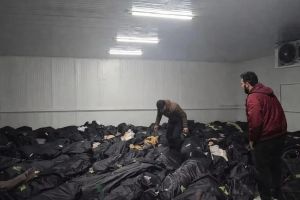
Alghadir hospital in east Tehran is one of the places where the January massacre could be seen in full: a five-body morgue overflowing, blood on the floors, and families searching through blankets and body covers for the people they loved.
As security forces opened fire around Haft Hoz and Tehranpars, two protest flashpoints in east Tehran, the wounded and the dead were carried to Alghadir hospital, where images and videos later captured one of the clearest records of the January massacre.
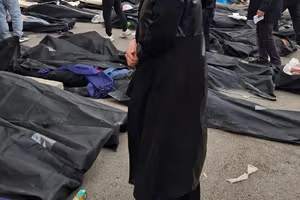
Some bodies were wrapped in blankets or plastic. Others were placed in garbage bags or left on top of one another.
After the images spread online, Hossein Kermanpour, the Health Ministry’s public relations chief, confirmed they were real. He said about 150 wounded people and 36 bodies were brought to Alghadir on January 8, while the morgue could hold only five bodies. The images, he said, were “accurate.”
The scenes formed one fragment of the wider January massacre, in which more than 40,000 people were killed in two days as the Islamic Republic moved to crush a nationwide uprising.
Iran International has identified and verified nine of the people whose bodies were taken to Alghadir or whose final hours passed through the hospital. Among them were a 17-year-old student, a 19-year-old woman, a father, a worker, a young man trying to build a future, and a protester shot while helping a wounded girl.
A witness said there were so many dead inside Alghadir that bodies were placed on top of each other. Security forces outside threatened to burn the hospital with everyone inside if the doors were not opened, while relatives of the wounded tried to block their entry.
A wounded protester said officers later entered, hit a nurse on the head with a baton and took several people away. Doctors hid some of the wounded in a storage room. “We kept hearing gunfire,” the protester said. “It sounded like coup de grace shots being fired at the wounded.”
Medical staff said body bags ran out, some of the dead were put in garbage bags, two vans came in the morning and took bodies away, and the corridors, elevators and courtyard were covered in blood as people carried the wounded in blankets toward surgery.
A nurse said January 9 was worse than the previous night. Security forces fired pellets and threatened those trying to help the wounded in the street, she said. One girl had been hit in the eye, one person had been shot in the heart and another had both legs torn apart. “I did not know who to help first,” she said.
Witnesses said security forces and Basij members set up checkpoints around Haft Hoz and near Sarallah Mosque, where the Zakereen Basij base is located. Armed forces were stationed on four sides of the square, they said, and shots were fired even inside the hospital grounds.
A source said many of the wounded had come from around Rashid police station in Tehranpars. Some who died after being taken to surgery were removed through the rear door of the operating room by IRGC and Basij forces, while relatives waited on the other side for news.
One hospital worker described a girl with long hair under a cloth, her head severed and her body missing. A staff member who saw the scene could not return to work for two days, the source said. Another witness said an elderly hospital guard suffered a fatal heart attack after seeing a headless body.
Several sources said security forces later reviewed Alghadir’s security cameras to control records of who had entered the hospital and how the wounded and dead had been moved.
But behind the scenes from Alghadir were individual lives that could still be traced. Families searched corridors, storage rooms, courtyards and morgues for those who had disappeared into the chaos of those two nights. Iran International has identified and verified nine of them.
Aida Aghili
Aida Aghili: The woman in the checkered blanket
Aida Aghili, born on June 23, 1991, joined the uprising in Haft Hoz on January 8. While chanting slogans, she was shot twice in the head at close range and killed.
Before leaving, she hugged her mother and told her what should be done with her belongings if she did not return.
Security bodies tried to bury her in the Behesht Zahra cemetery section used for executed prisoners, but her family resisted. She was buried beside her grandmother on January 11.
On her birthday, Aida had written on Instagram of stress “inside my bones,” “a war in my soul and my homeland,” and a freedom she still believed would come.
Hossein Heidari
Hossein Heidari: ‘Your place is on the street'
Hossein Heidari, 50, was killed in Haft Hoz on January 8, two days before his birthday. He was shot in the back of the head and the side.
Before joining the protests, he had written: “Your place is on the street; every night until freedom, we will not sit down for a moment.”
His family first searched for him at Ansari hospital, where they found no trace of him. They later found his body in Alghadir’s back courtyard, wrapped in a blue blanket.
Hossein loved Esteghlal, the Tehran football club known as the Blues.
His family identified him by his boots, a birthday gift from his daughter. Relatives described him as joyful and fond of laughter. He was buried on January 12 under security restrictions.
Gholamreza Mozhdehi
Gholamreza Mozhdehi: A man taken alive to hospital
Gholamreza Mozhdehi, 52, was wounded during night protests in Tehranpars on January 8 and taken to hospital while still showing signs of life, witnesses said.
Security agents prevented him from receiving medical help. Hours later, his body was found in Alghadir’s basement, in an area used for hospital waste, beside other bodies.
He had a live bullet wound to the neck, pellet injuries to the head, and wounds from knives or machetes. Married with two children, he had joined the protests in solidarity with others.
Mohsen Ghahremanpour
Mohsen Ghahremanpour: Shot at close range, buried in silence
Mohsen Ghahremanpour was 22 and from Malayer, Hamadan province. On January 8 in Tehranpars, security forces shot him in the head and eye from about one meter away.
People took him to Alghadir, where he died. His body was later found in the hospital’s back courtyard.
Relatives said the family faced threats and financial pressure, including a demand for 3.5 billion rials, about $1,945, to release his body.
Iran International has documented similar cases in which authorities demanded money from families or pressured them to sign papers identifying killed protesters as members of the Basij, the IRGC’s paramilitary force, turning the dead into evidence for the Islamic Republic’s own account of the crackdown.
Under that pressure, Mohsen was buried in silence as a Basij member.
He had worked as a laborer and had recently begun container construction.
Setareh Rafiei
Setareh Rafiei: The 19-year-old found in storage
Setareh Rafiei was killed in Tehranpars on January 8. She had been shot twice with live rounds, once in the heart and once in the head.
Her family later found her body in a storage area at Alghadir, among many others left there after the morgue filled.
Pouya Derakhshan
Pouya Derakhshan: A student lost among the dead
Pouya Derakhshan was 17 and a student. On January 8, he was near the Haft Hoz metro station with friends when security forces attacked protesters.
Sources said he was beaten on the head with batons, then shot in the heart. People called an ambulance and he was taken to Alghadir, where doctors found he had no pulse.
After his body was transferred to Kahrizak morgue, a wrong identification code left him missing among the dead.
Relatives had to open the covers of several bodies before identifying him at the washing facility in Behesht Zahra cemetery. He was buried on January 10 in section 326 under security measures.
Sahar Bayat
Sahar Bayat: A body held for days
Sahar Bayat was killed in the evening of January 8 while returning from protests with her husband and friends.
Sources said a live round hit her from behind and she died at the scene.
Her body was first taken to Alghadir, then transferred to Kahrizak. Her husband spent one night at Alghadir and three nights at Kahrizak waiting for her body to be released.
Sources said authorities refused to hand over the body until money was paid. Relatives were also forced to sign pledges that no slogans would be chanted at the funeral. Sahar was buried in Tuyserkan, Hamadan province.
Amir Hossein Emamjomeh
Amir Hossein Emamjomeh: A father shot beside his wife
Amir Hossein Emamjomeh was 29 and the father of a daughter. He was killed during the January 8 protests in Tehranpars after being shot with a live round.
Sources said he was in the crowd with his wife when he was targeted by a sniper, apparently because of the white hat he was wearing. The bullet struck near his nose.
People took him to Alghadir, but he died from his injuries.
Mohammad Radmannia
Mohammad Radmannia: Shot while helping a wounded girl
On January 9, he was on Tavousi Street in Nezamabad when he went to help a wounded girl. He was shot directly in the head and killed.
Sources said people took him to Alghadir, but security agents did not allow treatment. His body was not handed over to his family.
Mohammad had repeatedly helped wounded protesters, taking some into homes to bandage their wounds.
In his final moments, he was again moving toward someone who had been shot.
People who knew him described him as kind, athletic and fond of animals.
His fortieth-day memorial was held on what would have been his birthday.
The nine cases verified by Iran International are not a full list of those taken to Alghadir. They are names recovered from one hospital, in one part of Tehran, over two nights of the crackdown.
An image of Iranian scholar Shirin Saeidi that she posted on Instagram on May 13, 2026
A University of Arkansas Iranian-American professor fired from her tenured position in late March is now facing investigations in Britain over allegations of academic misconduct tied to her research on Iran.
Cambridge University Press, which published a book by University of Arkansas professor Shirin Saeidi based on her Cambridge PhD dissertation, is investigating claims that the work contains fabricated or unauthorized interviews with female victims of the Iranian government.
Iran International has also learned that Cambridge University is reviewing allegations related to Saeidi’s PhD dissertation itself.
University of Arkansas President Jay Silveria dismissed Saeidi over matters unrelated to the Cambridge investigations. She has appealed her termination, and the university’s Board of Trustees is set to review the case on May 21.
Saeidi’s book, Women and the Islamic Republic: How Gendered Citizenship Conditions the Iranian State, is now under scrutiny in Britain.
A spokesperson for Cambridge University Press told Iran International that the publisher “takes all complaints about our publications seriously” and is continuing to investigate the allegations “according to standard COPE guidelines.”
COPE, the Committee on Publication Ethics, is an organization that addresses ethical standards in scholarly publishing.
Iran International obtained a copy of a complaint submitted to Cambridge University Press by Maryam Nouri, author of the memoir In Search of Liberation, accusing Saeidi of fabricating interviews and using her work without permission.
Nouri, who was imprisoned by the Islamic Republic in 1985 while pregnant and later gave birth in prison, wrote that “I am writing to submit a formal complaint regarding the unethical and unauthorized use of my personal memoir and the fabrication of interview material by Dr. Shirin Saeidi.”
She added: “I never met with Ms. Shirin Saeidi, nor have I had any interview with her in the city of Cologne or in any other city in Germany.”
According to Nouri, Saeidi used material from her memoir “in both her doctoral dissertation and her published book without my written or verbal permission, for her own personal benefit, including advancing her academic credentials, university status, and professional position.”
“I consider this misuse a clear violation of my personal rights and dignity, and I strongly condemn it,” she wrote.
A Cambridge University spokesperson told Iran International that the university “takes allegations of academic misconduct seriously” and that concerns raised would be reviewed “in line with the relevant University policies and procedures.”
In a series of posts published on X in December, former Iranian political prisoner Nasrin Parvaz also denied ever being interviewed by Saeidi.
“I never knew Saeidi, and I never had an interview with her,” Parvaz wrote, adding that Saeidi had only used the Farsi version of her memoir published more than two decades earlier.
Numerous requests for comment sent by Iran International to Saeidi and her attorney, JJ Thompson, went unanswered.
Saeidi had already drawn controversy prior to her dismissal from the University of Arkansas. The university had previously disciplined her for allegedly using official university letterhead in an appeal seeking the release of Hamid Nouri, an Iranian official convicted in Sweden in 2022 over his role in the mass execution of political prisoners in 1988.
Saeidi has said she had permission to use the letterhead.
Lawdan Bazargan, director of the Alliance Against Islamic Regime of Iran Apologists (AAIRIA), who first publicized Saeidi’s support for Hamid Nouri, later began examining the sourcing in Saeidi’s academic work.
Bazargan told Iran International that several former political prisoners named in Saeidi’s dissertation and book had publicly denied being interviewed by her, raising broader questions about documentation, recordings, consent forms, and sourcing.
“The credibility of oral history research depends entirely on documentation, informed consent, and verifiable sourcing,” Bazargan said.
“If key testimonies cannot be substantiated, then the scholarly foundation of the book itself comes into question, because its central arguments rely heavily on those contested interviews.”
Bazargan also called for scrutiny of the supervisory process behind Saeidi’s Cambridge dissertation, including the role of her PhD supervisor, Professor Glen Rangwala. Iran International sent a request for comment to Rangwala.
Saeidi also drew criticism over social media posts praising former Supreme Leader Ali Khamenei and defending the Iranian establishment during the recent war. Her X account has since been suspended.