• العربية
  • فارسی
Brand
  • Iran Insight
  • Politics
  • Economy
  • Analysis
  • Special Report
  • Opinion
  • Podcast
  • Iran Insight
  • Politics
  • Economy
  • Analysis
  • Special Report
  • Opinion
  • Podcast
  • Theme
  • Language
    • العربية
    • فارسی
  • Iran Insight
  • Politics
  • Economy
  • Analysis
  • Special Report
  • Opinion
  • Podcast
All rights reserved for Volant Media UK Limited
volant media logo

TankerTrackers floats tongue-in-cheek Hormuz bypass through Oman

May 12, 2026, 01:44 GMT+1

Shipping monitor TankerTrackers has posted a lighthearted proposal suggesting Oman could theoretically create an alternative maritime passage bypassing the Strait of Hormuz.

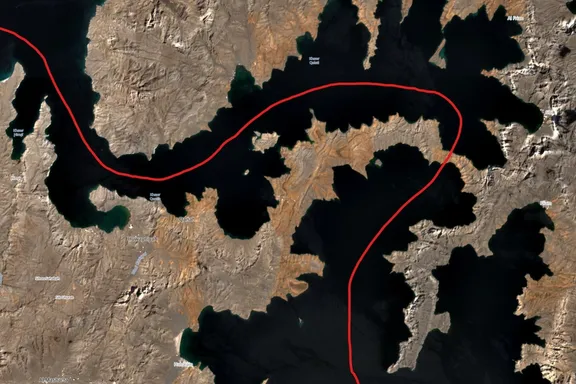
In a post on X, the account shared images and maps depicting a narrow section of Oman’s Musandam Peninsula, arguing that “in theory” a new channel deep enough for large vessels could be opened through the rocky land bridge at Maksa.

“Please don't take this seriously because Oman won't,” the account wrote, adding that the passage is only around 228 meters wide and could potentially allow vessels with drafts of up to 25 meters to pass.

The post compared the hypothetical project to the Suez Canal, noting that while the Suez stretches 193 kilometers, the proposed Musandam cut would involve only a tiny fraction of that distance.

Most Viewed

Netanyahu says Iran regime change ‘possible, not guaranteed’
1

Netanyahu says Iran regime change ‘possible, not guaranteed’

2
ANALYSIS

The strange stability between Tehran and the Taliban

3

Iran calls proposal to US ‘reasonable and generous’

4
INSIGHT

As Iran’s economy sinks, hardliners turn to conspiracy

5

Iran steps up crackdown on Baha’is with raids, arrests

Banner
Banner

Spotlight

  • Iranians told to post pro-government content to regain internet access
    VOICES FROM IRAN

    Iranians told to post pro-government content to regain internet access

  • Fog of war meets fog of law in the Strait of Hormuz
    OPINION

    Fog of war meets fog of law in the Strait of Hormuz

  • Tehran rejects US terms as hardliners push escalation
    INSIGHT

    Tehran rejects US terms as hardliners push escalation

  • As Iran’s economy sinks, hardliners turn to conspiracy
    INSIGHT

    As Iran’s economy sinks, hardliners turn to conspiracy

  • Iranians describe toll of 70 days of internet restrictions
    VOICES FROM IRAN

    Iranians describe toll of 70 days of internet restrictions

  • The strange stability between Tehran and the Taliban
    ANALYSIS

    The strange stability between Tehran and the Taliban

•
•
•

More Stories

Tehran rejects US terms as hardliners push escalation

May 12, 2026, 01:35 GMT+1
•
Maryam Sinaiee

Iran’s defiant response to a US proposal on ending the conflict is fueling new fears that the fragile ceasefire could collapse and fighting resume within days.

Tehran handed its response to the latest US proposal to Pakistan on Sunday for delivery to Washington. Hours later, President Donald Trump dismissed the Iranian reply as “totally unacceptable” and warned Monday that “the ceasefire is on life support.”

The exchange has fueled growing expectations in Iranian media and political circles that another military confrontation may be approaching, even as officials insist they remain open to diplomacy on their own terms.

Arash, a 45-year-old engineer in Tehran, said many people were once again preparing for the possibility of war.

“Filling gasoline tanks and stocking up on food and water for emergencies has again become a priority,” he said.

Tehran rejects key US conditions

Iranian state-linked media strongly denied Western reports suggesting Tehran’s response included compromises on nuclear issues.

Tasnim News Agency, affiliated with the Revolutionary Guards (IRGC), rejected claims that Iran’s proposal addressed the future of its nuclear materials or enrichment activities.

Iran's state broadcaster IRIB described the American proposal as “meaning Iran’s surrender to Trump’s excessive demands.”

According to IRIB, Iran’s counterproposal emphasized compensation for war damages, recognition of Iran’s sovereignty over the Strait of Hormuz, the lifting of sanctions and the release of frozen Iranian assets.

Former IRGC commander-in-chief Mohammad Ali Jafari said Monday that no further negotiations would take place unless Iran’s conditions were met.

Mixed signals

President Masoud Pezeshkian struck a more conciliatory tone during a meeting with senior police commanders on Sunday.

While acknowledging deep distrust toward Washington, Pezeshkian said Iran would remain committed to any agreement reached “while taking into account the concerns of the Supreme Leader and the interests of the Iranian nation.”

“The rational, logical and nationally beneficial preference is for the victory achieved by the armed forces on the battlefield to be completed in diplomacy as well,” he added.

Foreign Ministry spokesman Esmaeil Baghaei also said Monday that Tehran’s proposal was “reasonable and generous,” but accused Washington of continuing to insist on “unreasonable demands.”

Baghaei said Iran’s immediate priority was ending the war rather than negotiating details of the nuclear program, adding that decisions regarding “the nuclear issue, enriched materials and enrichment itself” would be announced later “at the appropriate time.”

Some hardline figures, however, are increasingly arguing that Iran should openly pursue nuclear weapons capability as a deterrent against future attacks.

Ebrahim Rezaei, spokesman for parliament’s National Security and Foreign Policy Committee, said lawmakers had questioned the value of remaining in the Nuclear Non-Proliferation Treaty and stressed the need to preserve Iran’s nuclear “achievements.”

Limited optimism

Despite the dominance of hardline rhetoric in official circles, online reactions suggested skepticism toward maximalist demands and calls for escalation.

Under a commentary published by Alef News listing Iran’s conditions, one reader wrote sarcastically: “Do not expect them to accept all these conditions unless you completely defeat them and even take prisoners.”

Another commented: “These are a list of wishes, and nobody is asking what they would receive in return.”

The skeptical comments drew significantly more support from readers than hardline calls for confrontation.

State television has repeatedly discussed the possibility of renewed fighting, often portraying another conflict as likely but manageable.

Reformist website Rouydad24 wrote that “the political atmosphere inside Iran is not favorable to a quick agreement,” arguing that hardline factions view any retreat as surrender while the government is trying to avoid appearing weak without securing sanctions relief.

“For now,” the outlet concluded, “the most likely scenario is not a comprehensive agreement but continued attritional negotiations combined with temporary ceasefires and crisis management—a situation that is neither full peace nor total war.”
Iran war helps narrow Australia’s budget deficit

May 12, 2026, 01:01 GMT+1

Australia is expected to post a smaller-than-anticipated budget deficit on Tuesday, with higher commodity prices linked to the Iran conflict boosting government revenues.

Rising prices for energy and raw materials have strengthened Australia’s export earnings and tax intake, providing a financial windfall for the government ahead of the budget release.

The government is also attempting to advance politically sensitive reforms while balancing concerns over cost-of-living pressures and the broader economic impact of prolonged instability in the Middle East.

Iran slams proposed UNSC move on Strait of Hormuz

May 12, 2026, 00:34 GMT+1

Iran’s deputy foreign minister Kazem Gharibabadi has accused the United States and its regional allies of attempting to shift attention away from what Tehran describes as unlawful military action and blockade measures against Iran by pushing for a new UN Security Council draft on the Strait of Hormuz.

“Freedom of navigation is a respected legal principle,” Gharibabadi wrote on X, “but it cannot be interpreted selectively, politically, and separately from the UN Charter.”

He warned that any Security Council text addressing the Strait of Hormuz without referring to “aggression, blockade, threat of force and Iran’s legitimate rights to defend its security and vital interests” would be “incomplete, biased, political and doomed to fail.”

Iraq denies reports of secret Israeli base in the country

May 12, 2026, 00:08 GMT+1

The Iraqi armed forces on Monday denied reports of unauthorized foreign military installations in the deserts of Karbala and Najaf, rejecting claims of a covert military presence linked to the Israel-Iran conflict.

In a statement posted on X, the military said rumors surrounding a secret base stemmed from a clash on March 5 involving Iraqi security forces and what it described as “unidentified, unlicensed detachments.”

The military said inspections carried out by Iraq’s Joint Operations Command since then had confirmed that “no unauthorised bases or forces have been present” in the area.

Baghdad also warned it would pursue legal action against individuals or outlets spreading what it called “misleading information” and “malicious rumors” that undermine Iraq’s sovereignty and damage the reputation of its security institutions.

The statement came days after the Wall Street Journal reported that Israel had established a secret military base in the Iraqi desert to support air strikes against Iran.

As Iran’s economy sinks, hardliners turn to conspiracy

May 11, 2026, 23:47 GMT+1

As prices continue to soar across Iran, hardline clerics and pro-government figures are increasingly attempting to shift blame away from the state even as economic pressure deepens for ordinary citizens.

In Mashhad, firebrand Friday prayer leader Ahmad Alamolhoda claimed that “US Army infantry is responsible for rising prices.” He later said the remark was metaphorical.

Earlier in the week, Hossein Shariatmadari, editor of the hardline daily Kayhan, wrote that “rising prices and hoarding are the products of the enemy’s infiltration in the government.”

While Iran’s armed forces were “working miracles,” he argued, the economy had been left undefended, allowing enemies to undermine battlefield gains.

Read the full article here.