• العربية
  • فارسی
Brand
  • Iran Insight
  • Politics
  • Economy
  • Analysis
  • Special Report
  • Opinion
  • Podcast
  • Iran Insight
  • Politics
  • Economy
  • Analysis
  • Special Report
  • Opinion
  • Podcast
  • Theme
  • Language
    • العربية
    • فارسی
  • Iran Insight
  • Politics
  • Economy
  • Analysis
  • Special Report
  • Opinion
  • Podcast
All rights reserved for Volant Media UK Limited
volant media logo

As Iran’s economy sinks, hardliners turn to conspiracy

May 11, 2026, 23:47 GMT+1

As prices continue to soar across Iran, hardline clerics and pro-government figures are increasingly attempting to shift blame away from the state even as economic pressure deepens for ordinary citizens.

In Mashhad, firebrand Friday prayer leader Ahmad Alamolhoda claimed that “US Army infantry is responsible for rising prices.” He later said the remark was metaphorical.

Earlier in the week, Hossein Shariatmadari, editor of the hardline daily Kayhan, wrote that “rising prices and hoarding are the products of the enemy’s infiltration in the government.”

While Iran’s armed forces were “working miracles,” he argued, the economy had been left undefended, allowing enemies to undermine battlefield gains.

Read the full article here.

Most Viewed

Netanyahu says Iran regime change ‘possible, not guaranteed’
1

Netanyahu says Iran regime change ‘possible, not guaranteed’

2
ANALYSIS

The strange stability between Tehran and the Taliban

3

Iran calls proposal to US ‘reasonable and generous’

4

Iran steps up crackdown on Baha’is with raids, arrests

5
INSIGHT

As Iran’s economy sinks, hardliners turn to conspiracy

Banner
Banner

Spotlight

  • Fog of war meets fog of law in the Strait of Hormuz
    OPINION

    Fog of war meets fog of law in the Strait of Hormuz

  • Tehran rejects US terms as hardliners push escalation
    INSIGHT

    Tehran rejects US terms as hardliners push escalation

  • As Iran’s economy sinks, hardliners turn to conspiracy
    INSIGHT

    As Iran’s economy sinks, hardliners turn to conspiracy

  • Iranians describe toll of 70 days of internet restrictions
    VOICES FROM IRAN

    Iranians describe toll of 70 days of internet restrictions

  • The strange stability between Tehran and the Taliban
    ANALYSIS

    The strange stability between Tehran and the Taliban

  •  Tehran’s youth emerge from war more cynical, not more hopeful
    TEHRAN INSIDER

    Tehran’s youth emerge from war more cynical, not more hopeful

•
•
•

More Stories

Man charged after allegedly driving into Iran protest crowd in Canada

May 11, 2026, 23:41 GMT+1

A man has been charged after allegedly driving dangerously near a demonstration related to the conflict in Iran in Richmond Hill, north of Toronto, according to York Regional Police.

Police said officers responded Sunday afternoon to reports of a dangerous driver near Major Mackenzie Drive West and Yonge Street, where a protest was taking place.

According to police, the suspect struck a food delivery driver who was not involved in the demonstration and hit another vehicle while fleeing the scene. He then stopped his car and yelled threats at demonstrators before being arrested.

The delivery driver was taken to hospital with minor injuries.

Police identified the suspect as 39-year-old Mehran Mohagheghi of Richmond Hill. He faces charges including assault with a weapon, dangerous operation, uttering threats and failure to stop after an accident.

Authorities said the investigation remains ongoing and appealed for witnesses and video footage to come forward.

The incident comes amid heightened tensions at Iranian diaspora demonstrations across North America and Europe since the January protests and crackdown inside Iran.

Rallies linked to the conflict have increasingly drawn sharp confrontations not only between supporters and opponents of the Islamic Republic, but also among rival opposition factions divided over strategy, leadership and foreign involvement.

Earlier this year, a vehicle drove into a crowd during a large anti-government rally in Los Angeles, injuring several protesters and prompting a police investigation.

Smaller scuffles and confrontations have also been reported at demonstrations in cities including London, Berlin and Paris in recent months.

US stocks hit record highs while oil rises on Iran ceasefire fears

May 11, 2026, 23:19 GMT+1

US equity indexes edged higher to fresh record closing highs on Monday as investors awaited a meeting between President Donald Trump and Chinese leader Xi Jinping, while oil prices climbed on renewed concerns over the Iran conflict.

Markets were rattled after Trump said the US-Iran ceasefire was “on life support” and dismissed Tehran’s response to a US peace proposal as “stupid,” fueling fears that the 10-week conflict could drag on and continue disrupting shipping through the Strait of Hormuz.

The S&P 500 rose 0.19% to close at 7,412.84, while the Nasdaq Composite gained 0.10% to 26,274.13, both record closing highs.

US sanctions firms over Iran oil exports to China ahead of Trump visit

May 11, 2026, 22:52 GMT+1

The United States on Monday imposed sanctions on three individuals and nine companies accused of helping Iran export oil to China, targeting networks based in Hong Kong, the United Arab Emirates and Oman.

The Treasury Department said the sanctions targeted individuals and entities involved in helping the Islamic Revolutionary Guard Corps sell and transport Iranian oil through a network of front companies.

Four of the sanctioned companies were based in Hong Kong, four in the UAE and one in Oman, according to the Treasury statement.

The move follows another round of sanctions announced Friday against individuals and firms accused of facilitating Iranian purchases of weapons and components used in drones and ballistic missiles.

The latest measures come days before President Donald Trump’s expected meeting with Chinese leader Xi Jinping, where Iran is expected to be a major topic of discussion alongside efforts to reopen the Strait of Hormuz and reduce tensions in the region.

Washington has repeatedly accused Beijing of enabling Iranian oil exports despite sanctions, while China has remained one of the main buyers of Iranian crude throughout the conflict and subsequent blockade crisis.

As Iran’s economy sinks, hardliners turn to conspiracy

May 11, 2026, 22:10 GMT+1
•
Behrouz Turani

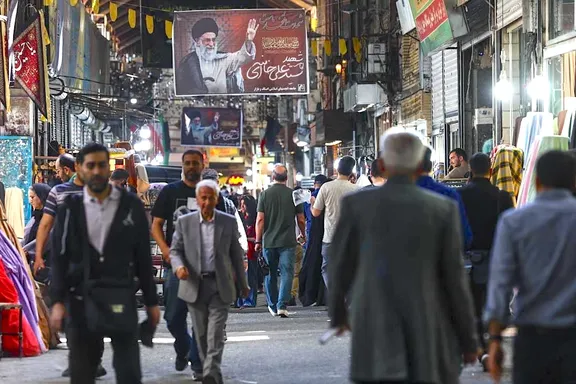
As prices continue to soar across Iran, hardline clerics and pro-government figures are increasingly attempting to shift blame away from the state even as economic pressure deepens for ordinary citizens.

In Mashhad, firebrand Friday prayer leader Ahmad Alamolhoda claimed that “US Army infantry is responsible for rising prices.” He later said the remark was metaphorical, arguing that the war had triggered hyperinflation and that “profiteers and the main culprits behind rising prices are the US army’s infantry.”

Earlier in the week, Hossein Shariatmadari, editor of the hardline daily Kayhan, wrote that “rising prices and hoarding are the products of the enemy’s infiltration in the government.”

While Iran’s armed forces were “working miracles,” he argued, the economy had been left undefended, allowing enemies to undermine battlefield gains.

Shariatmadari, who for decades attacked previous administrations over inflation and economic mismanagement, remained notably quiet during the ultraconservative governments of Mahmoud Ahmadinejad and Ebrahim Raisi.

In 2024, he claimed rising prices had “nothing to do with the performance of the government or parliament,” describing inflation as part of a foreign conspiracy.

Last week, he questioned why parliament had stopped monitoring the government’s performance. Days later, lawmakers held an online session with Agriculture Minister Gholamreza Nouri Ghezeljeh to discuss food prices, a move widely mocked in Iranian media as ineffective and detached from public hardship.

While Alamolhoda urged Iranians to embrace a vague “jihadist economy,” Shariatmadari called on officials to confront an unspecified “economic mafia.”

Moderate outlets, however, framed the crisis differently. The daily Arman Melli argued on Sunday that the latest surge in prices could not be explained solely by wartime conditions, pointing instead to years of structural economic problems, rising state expenditures and populist policymaking.

The paper also called for “effective use of diplomacy” to end the conflict while safeguarding national interests, arguing that renewed negotiations could help stabilize the economy.

The reformist website Rouydad24 described a society undergoing “economic and psychological erosion,” where inflation was no longer an abstract statistic but a daily reality.

Families were removing meat from their diets, patients cutting medication in half and tenants being pushed toward cheaper outskirts of major cities.

Economic newspapers described parliament’s online session as “a bitter confession” that authorities were losing control of the situation, reflected in shrinking household budgets, disappearing essentials and rising public anxiety.

Despite government claims of wage increases of up to 60 percent for workers, many public employees say they have not received the raises. Unemployment is rising, layoffs are spreading and businesses are shutting down, while temporary contracts leave many workers with little protection against dismissal.

Iranian media now report complaints about living costs even among government supporters attending nightly demonstrations. Families that once lived modest but stable lives increasingly struggle to afford housing, medical treatment, tuition and other basic necessities.

Many workers say they are still earning salaries set years ago in an economy where prices change almost daily, leaving much of Iran’s working and middle classes crushed by relentless inflation.
UAE struck Iranian refinery in April attack - WSJ

May 11, 2026, 21:44 GMT+1

The United Arab Emirates has carried out military strikes on Iran including an attack on a refinery on Iran’s Lavan Island in the Persian Gulf in early April, The Wall Street Journal reported citing people familiar with the matter.

The attack sparked a large fire and knocked much of its capacity off line for months, prompting Iran to launch a barrage of missile and drone strikes against the UAE and Kuwait in response, the report said.

The US quietly welcomed the participation of the UAE and any other Persian Gulf states that want to join in the fight, one source told the WSJ.