Trump says ‘treacherous’ reports Iran is doing well give Tehran false hope


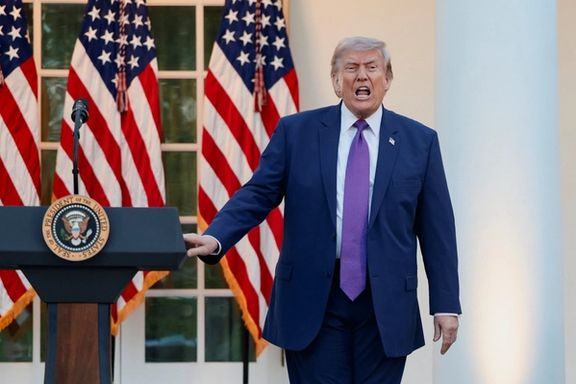
US President Donald Trump accused media outlets of “aiding and abetting” Iran by portraying Tehran as performing well militarily against the United States, saying such coverage gives Iran “false hope” when “none should exist.”
"When the Fake News says that the Iranian enemy is doing well, Militarily, against us, it’s virtual TREASON in that it is such a false, and even preposterous, statement. They are aiding and abetting the enemy! All it does is give Iran false hope when none should exist," Trump said in a post on Truth Social.
"These are American cowards that are rooting against our Country. Iran had 159 ships in their Navy — Every single ship is now resting at the bottom of the sea. They have no Navy, their Air Force is gone, all Technology is gone, their “leaders” are no longer with us, and the Country is an Economic Disaster. Only Losers, Ingrates, and Fools are able to make a case against America!"


The US military is considering renaming the war with Iran “Operation Sledgehammer” if the ceasefire collapses and President Donald Trump decides to restart major combat operations, NBC News reported, citing two US officials.
Any new military combat operations against Iran would be conducted under a new name and operation, the report said, citing a White House official familiar with the discussions.
From the administration’s point of view, the new operation name would effectively restart the 60-day clock requiring congressional authorization for war, the report added.
Operation Sledgehammer is not the only name under consideration, the report said citing unnamed US officials.
Iran has not successfully exported any crude oil by sea for 28 days amid the US naval blockade imposed in April, according to ship-tracking data from TankerTrackers, while loading activity at Kharg Island remains disrupted following a suspected oil spill near the terminal.
The tracker said on Tuesday crude shipments remain trapped inside the blockade zone despite some refined fuel cargoes escaping sanctions pressure.
“To our best knowledge, Iran hasn't successfully exported any crude oil by sea over the past 28 days,” the monitoring firm said on X, adding that its definition of an export is a tanker successfully crossing the US Navy blockade line without returning with the cargo.
The group said some refined petroleum products had still managed to leave Iran because the US Treasury’s Office of Foreign Assets Control (OFAC) had not sanctioned the tankers involved.
It also reported that multiple empty and loaded tankers remain clustered near the blockade perimeter and in waters not far from Pakistan.
The United States began enforcing a naval blockade on Iranian ports and oil exports on April 13 as part of its broader pressure campaign against Tehran during the ongoing conflict.
Washington has said the measures are aimed at restricting Iran’s oil revenues and limiting its ability to finance military operations and regional armed groups.
Kharg oil spill
Tanker Trackers said Kharg Island, the hub for 90% of Iran's oil exports, has not loaded any tankers since May 6 as a result of an oil leak which Tehran denied taking place.
Satellite images last week showed the suspected oil spill spreading across dozens of square kilometers of water near Kharg Island.
The likely spill, visible as a gray-and-white slick, appeared west of the five-mile-long island in images taken by Copernicus Sentinel satellites between May 6 and May 8 seen by Reuters.
Leon Moreland, a researcher at the Conflict and Environment Observatory, said the slick looked visually consistent with oil and estimated it covered about 45 square kilometers.
Louis Goddard, co-founder of climate and commodities consultancy Data Desk, also said the images appeared to show an oil slick, potentially the largest since the US-Israel war against Iran began in late February.
The cause and origin of the suspected spill remain unclear, Moreland said, adding that May 8 images showed no sign of further active spills.
Iran’s foreign ministry denied Kuwait’s allegation that four IRGC-linked detainees were planning “hostile acts,” saying they had entered Kuwaiti waters during a routine naval patrol due to a navigation system failure.
The ministry urged Kuwaiti authorities to “avoid hasty comments and baseless claims” and pursue the matter through official channels.
It also called for the release of the four detained personnel.
Senior US and Chinese officials agree that no country should be allowed to impose shipping tolls in the Strait of Hormuz, the State Department told Reuters on Tuesday.
In a statement to Reuters, the US State Department said Chinese Foreign Minister Wang Yi and US Secretary of State Marco Rubio discussed the issue during an April phone call.
“They agreed that no country or organization can be allowed to charge tolls to pass through international waterways like the Strait of Hormuz,” Reuters quoted State Department spokesman Tommy Pigott as saying.
Iraq and Pakistan cut separate deals with Iran to move oil and liquefied natural gas through the Strait of Hormuz, Reuters reported, citing five sources with knowledge of the matter.
Iraq secured safe passage for two very large crude carriers, each carrying about 2 million barrels of crude, that passed through the strait on Sunday, according to the report.
Iraq is seeking Iran’s approval for more transits to protect oil revenues that make up 95% of its budget, the report added, citing an Iraqi oil ministry official.
Two tankers loaded with Qatari LNG are also heading to Pakistan under a separate bilateral agreement between Islamabad and Tehran, the report said, citing two unnamed industry sources.
The sources said neither Iraq nor Pakistan made direct payments to Iran or Iran’s Revolutionary Guards over the transits, and Qatar was not directly involved in the bilateral deals.