• العربية
  • فارسی
Brand
  • Iran Insight
  • Politics
  • Economy
  • Analysis
  • Special Report
  • Opinion
  • Podcast
  • Iran Insight
  • Politics
  • Economy
  • Analysis
  • Special Report
  • Opinion
  • Podcast
  • Theme
  • Language
    • العربية
    • فارسی
  • Iran Insight
  • Politics
  • Economy
  • Analysis
  • Special Report
  • Opinion
  • Podcast
All rights reserved for Volant Media UK Limited
volant media logo

Bahrain says it arrested people linked to Iran’s IRGC

May 6, 2026, 18:11 GMT+1

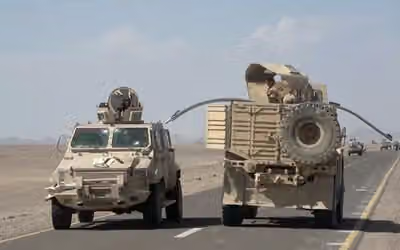
Bahrain’s Interior Ministry said an unspecified number of people with “close links” to Iran’s Islamic Revolutionary Guard Corps (IRGC) have recently been arrested in the kingdom, including some suspected in espionage-related cases.

The ministry did not provide details on the number of arrests or the specific allegations, but the announcement marks another escalation in tensions between Bahrain and Iran following weeks of regional conflict and security concerns.

The statement comes after Bahrain said in late April that it had stripped 69 people of their citizenship for allegedly supporting Iranian attacks on the country.
Most Viewed

Trump says Iranian people must have guns to fight
1

Trump says Iranian people must have guns to fight

2

Iran’s labor market cracking under layoffs and inflation

3

Pro-regime graffiti in Los Angeles sparks concern in Iranian-American hub

4

Iran labor outlet pushes back as officials downplay war-related job losses

5

US, Iran near one-page deal to end war - Axios

Banner
Banner

Spotlight

  • How to beat Iran’s internet kill switch
    OPINION

    How to beat Iran’s internet kill switch

  • Iran’s wartime unity push collides with hijab hardliners
    INSIGHT

    Iran’s wartime unity push collides with hijab hardliners

  • Pro-regime graffiti in Los Angeles sparks concern in Iranian-American hub

    Pro-regime graffiti in Los Angeles sparks concern in Iranian-American hub

  • Tehran media break silence on war’s toll on livelihoods
    INSIGHT

    Tehran media break silence on war’s toll on livelihoods

  • Iran secretly buries executed Swedish citizen at site linked to mass graves
    EXCLUSIVE

    Iran secretly buries executed Swedish citizen at site linked to mass graves

•
•
•

More Stories

Macron urges Iran to embrace Franco-British Hormuz mission

May 6, 2026, 18:01 GMT+1

French President Emmanuel Macron said he had invited Iran’s president to “take hold of the opportunity” presented by a proposed French- and British-backed multinational mission for the Strait of Hormuz.

Macron’s remarks come as France and Britain continue efforts to build a “strictly defensive” multinational initiative aimed at securing freedom of navigation through the strategically vital waterway while avoiding direct participation in the conflict.

Paris and London have been leading diplomatic and military planning discussions involving dozens of countries over possible post-conflict maritime security arrangements in Hormuz.

US, Iran move closer on one-page framework to restart talks - WSJ

May 6, 2026, 17:10 GMT+1

The United States and Iran are moving closer to an agreement aimed at restarting negotiations through a short interim framework proposal, The Wall Street Journal reported on Wednesday.

According to the report, mediators are working on a one-page memorandum intended to guide talks over the coming month while both sides continue negotiating major unresolved disputes.

The Journal said the proposed framework would serve as a temporary diplomatic mechanism to restart formal engagement.

Despite growing signs of momentum, the report noted that key disagreements remain unresolved and that negotiations are still fragile.

Ghalibaf says US misreading Iran’s resilience under economic pressure

May 6, 2026, 16:33 GMT+1

Iranian Parliament Speaker Mohammad Bagher Ghalibaf accused the United States of trying to create divisions inside Iran and force the country into “surrender” through economic and media pressure.

“The enemy is very hopeful about economic pressure, and it is clear that they have once again received false reports, and based on these reports, they have made wrong decisions,” Ghalibaf said in remarks carried by the IRGC-linked Fars news agency.

Ghalibaf also said that regardless of the scale of economic pressure, “the Iranian nation will endure … for the sake of independence.”

Trump says Iran conflict could end before China trip next week

May 6, 2026, 16:31 GMT+1

Donald Trump expressed optimism about reaching a deal with Iran, said it was possible an agreement could be reached before his trip to China next week and added that the war would have a “very good chance of ending,” PBS News reported citing an interview with the US president on Wednesday.

“Yeah, I think so, but I felt that way before with them, so we’ll see what happens,” Trump said when asked whether the United States was closing in on a deal with Iran.

“I think it’s got a very good chance of ending, and if it doesn’t end, we have to go back to bombing the hell out of them,” Trump added.

Trump also said Iran’s highly enriched uranium would be sent to the United States as part of a potential agreement.

Iran’s wartime unity push collides with hijab hardliners

May 6, 2026, 16:04 GMT+1
•
Maryam Sinaiee

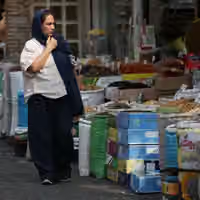
A hardline cleric’s attack on unveiled women, even as Iranian state media showcased them at pro-government rallies to signal broad wartime support, has exposed tensions within the establishment over hijab enforcement.

In the northern city of Rasht, Friday prayer leader Rasoul Fallahi delivered a fiery speech during one of the nightly pro-government gatherings held since the outbreak of the recent war.

Speaking to supporters, he accused unveiled women of standing against “the system and the Quran,” calling them “immoral and immodest.” He also attacked male relatives of such women, describing their fathers, husbands and brothers as “dishonorable.”

Addressing women seen without hijab at the events and elsewhere, Fallahi warned: “Do not think these people will put up with you.” He escalated his rhetoric further by saying that if the public decided to confront them, “they would do something that would make you no longer dare to leave your homes.”

The speech, broadcast live on provincial television, quickly spread across Iran’s domestic online space and reignited debate over hijab enforcement during wartime.

The conservative-leaning outlet Fararu addressed the issue in an article titled, Why Are Unveiled Women Being Attacked?

“From the parade of ‘Self-Sacrificing Volunteer Girls’ to nightly gatherings supporting fighters, camera lenses seek out women with such appearances to show that all segments of society are present among supporters of the homeland,” the editorial read.

The apparent contradiction—highlighting unveiled women in official imagery while condemning them from the pulpit—has not gone unnoticed.

Supporters of stricter dress codes, including clerics like Fallahi, argue that hijab compliance is mandated by Iranian law. They often cite remarks by Supreme Leader Ali Khamenei, who said several years ago that failing to observe hijab was both “religiously and politically forbidden.”

But Fallahi’s remarks have also drawn criticism from some clerics aligned with the government who argue that emphasizing such issues during wartime risks undermining national unity.

Abdolreza Pourzahabi, the Supreme Leader’s representative in Kurdistan province, cautioned against divisive rhetoric.

“We should not focus on points of division and disturb social calm, causing people already dealing with war to also have to answer for their hijab,” he said.

The debate has also fueled backlash online.

One user wrote: “So if there were no war, the law should be enforced and unveiled women would be beaten, arrested and imprisoned—but because the country is at war and needs people’s presence, it’s temporarily acceptable?”

The broader backdrop dates to September 2022, when the death of Mahsa Amini in custody triggered the nationwide “Woman, Life, Freedom” protests. Since then, authorities have largely avoided aggressive street enforcement of hijab laws for fear of reigniting unrest.

Restrictions nevertheless remain firmly in place in official settings. Women without hijab can still be denied entry to government offices, hospitals and courts, while mandatory hijab rules continue to apply in schools.

Enforcement also varies sharply across the country. In more religious cities such as Qom, stricter measures are still reported.

A user recently wrote on X that while shopping in Qom, an officer shouted at her to observe hijab. When she ignored him, she said he placed his hand on his weapon and threatened to impound her car if she could not find something to cover her head, photographing both her and her license plate.

The dispute reflects a deeper uncertainty within the Islamic Republic: whether the wartime softening around hijab is merely tactical, or a recognition that strict enforcement now carries political risks the state can no longer fully control.